

Educational Sensor Kits for Schools in the UAE: A 2026 Guide
The most useful sensor kit isn’t the one with the most modules. It’s the one that helps students answer a question with evidence. For schools comparing educational sensor kits for schools UAE, product listings can make feature counts look like educational value while leaving the key question unanswered: what can learners investigate, measure and explain in a lesson? Teachers need activities suited to students’ skills and available time, and school leaders need those activities to contribute to a coherent STEAM pathway.
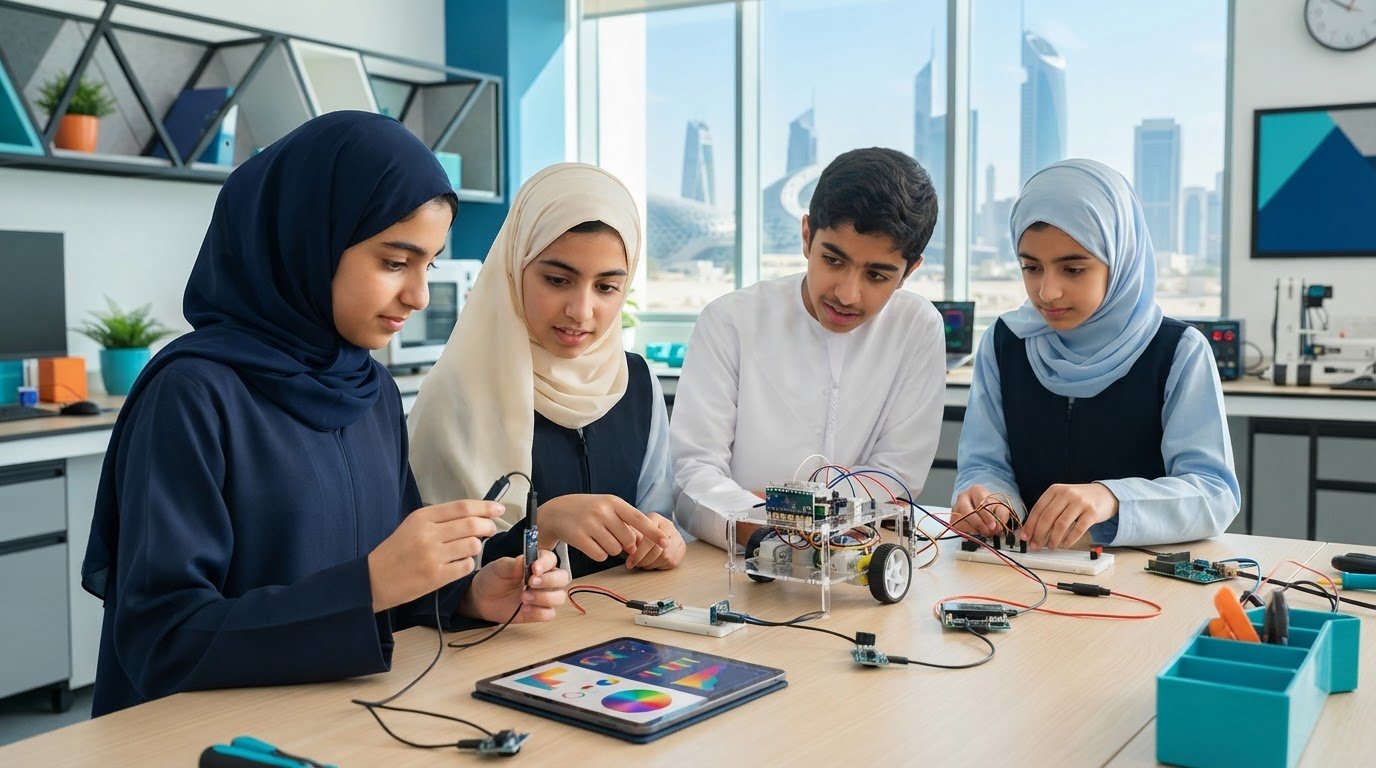
This guide explains how to choose sensor capabilities around clear learning objectives and plan investigations that move from observation to data and evidence-based conclusions. You’ll also see how sensor learning can connect with science, robotics, coding and wider STEAM experiences. Ednex’s Arduino Education programs and Future Science Lab setups can place sensor work within a broader learning environment, making it a bridge between curiosity, measurement and purposeful design. Start by choosing the investigation, then build the learning experience around it.
Key Takeaways
- Start with the question students will investigate, then identify the measurements that could help them answer it.
- Compare educational sensor kits for schools UAE by learning goals, student readiness, sensor types, data access and lesson fit, not module count alone.
- Structure lessons so learners collect and compare readings before interpreting what the evidence shows.
- Plan a clear sequence of objectives, investigation, measurement, analysis and reflection to make sensor activities practical for class time.
- Connect sensor investigations with Arduino Education, robotics, coding and wider STEAM learning to build a coherent experience.
What Educational Sensor Kits for Schools in the UAE Help Students Learn
A sensor kit earns its place in a school lab through the questions students can investigate, not simply the components it contains. A sensor detects a change in the physical world, such as a shift in light or temperature, and translates it into a reading that learners can record and interpret. Measuring that change gives students evidence to examine, compare and use when supporting an explanation.
An educational sensor kit combines sensors, a way to read their measurements, and a learning activity that helps students turn observations into evidence for inquiry. This definition keeps the educational purpose in focus. The sensor is a tool; the investigation is the learning experience.
What counts as an educational sensor kit?
The core elements are sensors, a method for reading data and a student activity. Depending on the setup, readings might appear on a connected device or be recorded by learners as they observe the sensor. Contents and capabilities vary, so there isn’t one standard configuration for every age group, subject or lesson.
Consider a class investigating how light changes across different parts of a room. Students can take readings at selected locations, note the conditions and compare results. The aim isn’t to assume one place will be brighter; it’s to gather observations that help answer the question. Sensors can measure different kinds of physical changes, as outlined in What is a Sensor? The relevant sensor depends on what students want to find out.
Which learning outcomes can sensor activities support?
Well-planned sensor activities build a sequence of scientific thinking. Students observe a situation, decide what to measure, record readings consistently and compare results. They may notice a pattern, identify an unexpected value or consider whether changing one condition affected the outcome. These steps develop measurement and data interpretation skills while giving students a reason to explain their thinking.
That inquiry distinguishes a learning activity from simply assembling or demonstrating a device. In a demonstration, learners may watch a sensor respond. In an investigation, they test a question, make choices about observations and use readings to form a conclusion. The distinction matters: a working device shows that components can function; evidence-based reasoning shows what students learned from using them.
Sensor investigations can bring several STEAM disciplines together:
- Science: Observe physical changes and test a question about them.
- Technology: Use a sensor and a reading method to collect information.
- Engineering: Consider how a measurement system or design could be improved.
- Mathematics: Organise readings, compare values and describe patterns.
For schools exploring educational sensor kits for schools UAE, this learning-first perspective is a practical starting point. Define what students should be able to investigate and explain, then choose a sensor activity that makes that learning visible.
How School Sensors Turn Classroom Questions into Useful Data
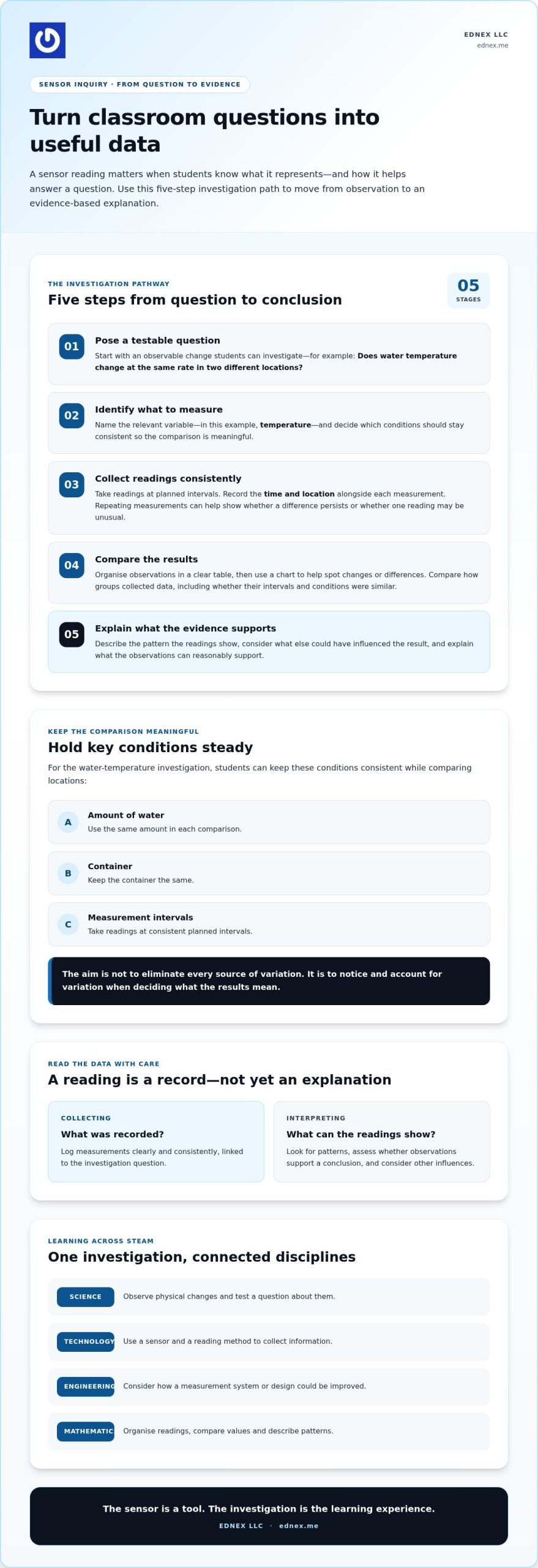
A sensor reading becomes useful when students know what it represents and how it relates to a question. A clear investigation connects five steps: pose a testable question, identify what to measure, collect readings consistently, compare the results and explain what the evidence supports. This sequence helps learners see data not as a screen full of numbers, but as a way to examine the world around them.
From a testable question to a sensor reading
Begin with a question that involves an observable change. For example: Does the temperature of water change at the same rate in two different locations? Students first identify temperature as the variable they’ll measure. They then decide what to keep consistent, such as the amount of water, the container and the intervals between readings. Controlling these conditions makes the comparison more meaningful because fewer factors change at once.
Next, students take readings at planned intervals and record the time and location alongside each one. Repeating measurements can help reveal whether an apparent difference persists or whether a single reading may be unusual. If groups collect data, they can compare their methods: were readings taken at similar intervals, and were the conditions similar enough to make the results useful? The aim isn’t to eliminate every source of variation, but to notice and account for it.
This inquiry-based structure is central to using sensors in classrooms. The university paper on Sensor Training Kits in STEM Education examines sensor training kits in STEM education, reinforcing the value of connecting tools with purposeful learning activities.
Helping students interpret measurements and patterns
Once measurements are collected, students need to organise them so comparisons are easy to see. A simple table can include the time, location and reading. A chart can then help students spot changes or differences across observations. The format matters less than keeping the record clear, consistent and connected to the question.
Collecting measurements tells students what was recorded; interpreting them means deciding what the readings can reasonably show. A class might notice that one set of readings changed more quickly, then discuss whether the observations support that conclusion and what else could have influenced the result.
Teachers can prompt evidence-based reasoning with questions such as:
- Which readings are you comparing, and what pattern do you notice?
- Does the pattern appear across repeated observations?
- What conditions were kept consistent, and what may have varied?
- What can you conclude from these measurements, and what remains uncertain?
These prompts move discussion beyond guesses. Students learn to distinguish an observed pattern from an explanation and to describe limitations rather than claim more than the evidence shows. For schools planning educational sensor kits for schools UAE, this is a useful design principle: choose activities that leave time for recording, comparison and reflection, not just taking a reading. It also aligns naturally with hands-on science lab learning, where experiments, data collection and analysis can work together.
How to Compare Educational Sensor Kits for UAE Schools
Begin with the learning objective, not the product list. A kit with a wide range of modules may look versatile, but unused options add little value to a lesson. Identify the science or STEAM concept students need to understand, then consider which measurements and activities can help them explore it. The strongest choice is the one that makes a purposeful investigation manageable for your learners and teaching context.
Match sensor capabilities to age group and learning goals
Start by defining what students should be able to do. Younger learners may benefit from observing and comparing readings, while more advanced students may be ready to explore how measurements are collected or introduce coding. In either case, allow time to set up, gather data and discuss results. Added complexity is useful only when it advances the learning objective.
Use this framework to compare options consistently:
| Decision criterion | What to consider | Essential or optional? |
|---|---|---|
| Learning goal | Which concept or question will the activity help students investigate? | Essential |
| Student level | Can learners manage the setup, instructions and interpretation? | Essential |
| Sensor type | Does it measure a change relevant to the planned investigation? | Essential |
| Data access | Can students view and record readings in a way they can discuss? | Essential |
| Lesson fit | Is there time for setup, measurement, comparison and reflection? | Essential |
| Extra capabilities | Would additional sensor variety or coding deepen the intended activity? | Optional, based on goals |
Assess classroom usability, data, and teacher readiness
A suitable activity must work in the classroom, not only in a demonstration. Consider how learners will access readings, how groups can take part and whether the activity fits the available lesson time. Think through storage and repeat use, too. Materials should be straightforward to organise between lessons, and the activity should remain practical when taught again.
Teacher preparation matters. Map the steps in advance: introduce the question, organise the investigation, support students as they record results and guide the discussion. A clear activity structure and manageable setup help teachers focus on student thinking rather than troubleshooting the process.
For schools evaluating educational sensor kits for schools UAE, separate what every planned lesson needs from what could extend learning later. A relevant measurement, accessible readings and time to interpret them form the core. A broader selection of capabilities can support future investigations, but module count alone is a weak measure of classroom value. Choose for the learning pathway you intend to build.
How to Plan Sensor-Kit Lessons That Work in UAE Schools
A sensor lesson is easier to deliver when its purpose and classroom routine are clear before equipment reaches the desks. Plan for the full learning cycle, from the question students explore to the evidence they discuss. The sequence below can be adapted for different year groups, subjects and lesson lengths.
- Set a focused learning objective. Identify the idea students should understand and express it as something they can demonstrate. For example, they might investigate how changing distance from a sound source affects a recorded measurement. Keep the objective narrow enough to explore within the available class time.
- Introduce the investigation. Present the question and invite students to predict what they may observe. Ask what evidence could support or challenge each prediction. This gives learners a reason to measure, rather than treating the activity as a set of assembly instructions.
- Model the classroom routine. Demonstrate how to take and record a reading using the selected setup. Explain handling expectations, where equipment should be placed and how groups should share it. A concise demonstration helps students begin with a common method and supports organised use.
- Assign roles and collect measurements. In each group, learners can take turns managing the setup, recording observations and checking that the agreed method is followed. Rotate roles in later activities so participation extends beyond the student most comfortable with equipment. Plan shared access so each group has a defined opportunity to gather data.
- Compare results and explain patterns. Reserve lesson time for students to organise their readings and compare them with their predictions. Ask what changed, what stayed consistent and whether results from different groups show a similar pattern. Guide learners to support explanations with observations rather than guesses.
- Reflect and assess understanding. Close with a short written or spoken conclusion: what does the evidence suggest, and what might limit that conclusion? Students can also propose a follow-up question. Their reasoning, not just a functioning setup, provides a useful indication of what they learned.
Adjust the level of guidance as learners progress. Younger or less experienced students may benefit from a prepared question, a recording template and clear measurement instructions. With greater familiarity, students can take more responsibility for deciding what to compare, planning the procedure and choosing how to present results. Keep the core routine consistent while increasing the independence of the investigation.
Shared equipment calls for practical planning: prepare materials before class, make group roles visible and allow time to return and organise equipment. The lesson should leave space for analysis and reflection, rather than using every minute for setup. This approach connects naturally with broader STEAM programs for schools, where inquiry can lead into design, coding and collaborative problem-solving.
For a coherent sensor-learning pathway, explore how Ednex’s STEAM and Arduino Education programs connect classroom investigations with wider hands-on learning.
How Ednex Connects Sensor Learning with Wider STEAM Education
Once schools have established what students should investigate and how lessons will work, the next step is connecting those activities to a broader learning pathway. Sensor investigations give learners a practical starting point: they ask a question, gather measurements and use their observations to inform what they might design, test or explore next. Within a wider STEAM environment, this process can link scientific thinking with technology, engineering and creative problem-solving.
Connect sensor activities to Arduino Education and STEAM
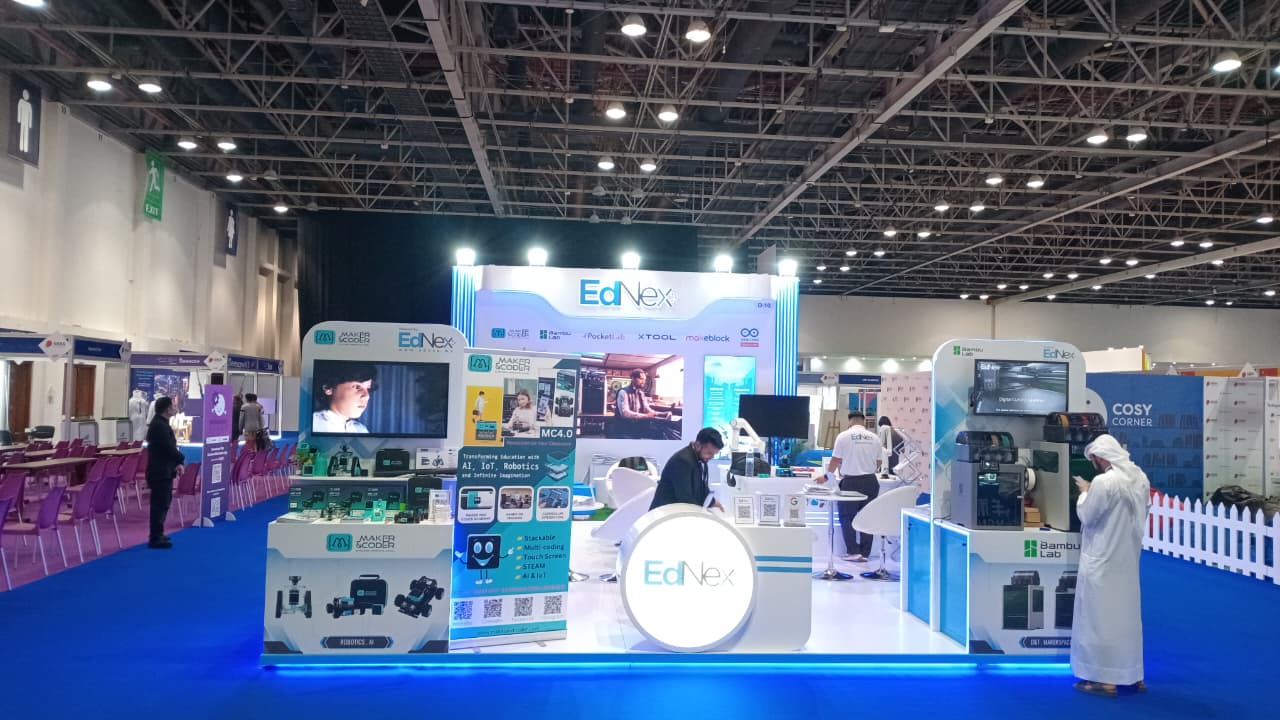
Ednex offers Arduino Education as part of a wider educational experience. Sensor-based learning can connect with the questions and concepts students are studying, rather than remain an isolated demonstration. Learners can move from observing a measurement to considering how technology collects information, then use their findings to shape a design or coding challenge.
This progression can support learning across science and technology. A science investigation gives students a reason to examine a physical change; a related technology activity can help them explore how measurement and data inform a response. Robotics and coding activities can extend that thinking into systems and problem-solving. Each stage builds on inquiry, while teachers can adapt complexity to learners’ readiness and objectives.
For schools considering educational sensor kits for schools UAE, the institutional question is broader than which components to use. It is how sensor investigations can reinforce existing STEAM goals and contribute to learning across classroom activities, programs and lab experiences.
Plan a coherent learning environment with Ednex
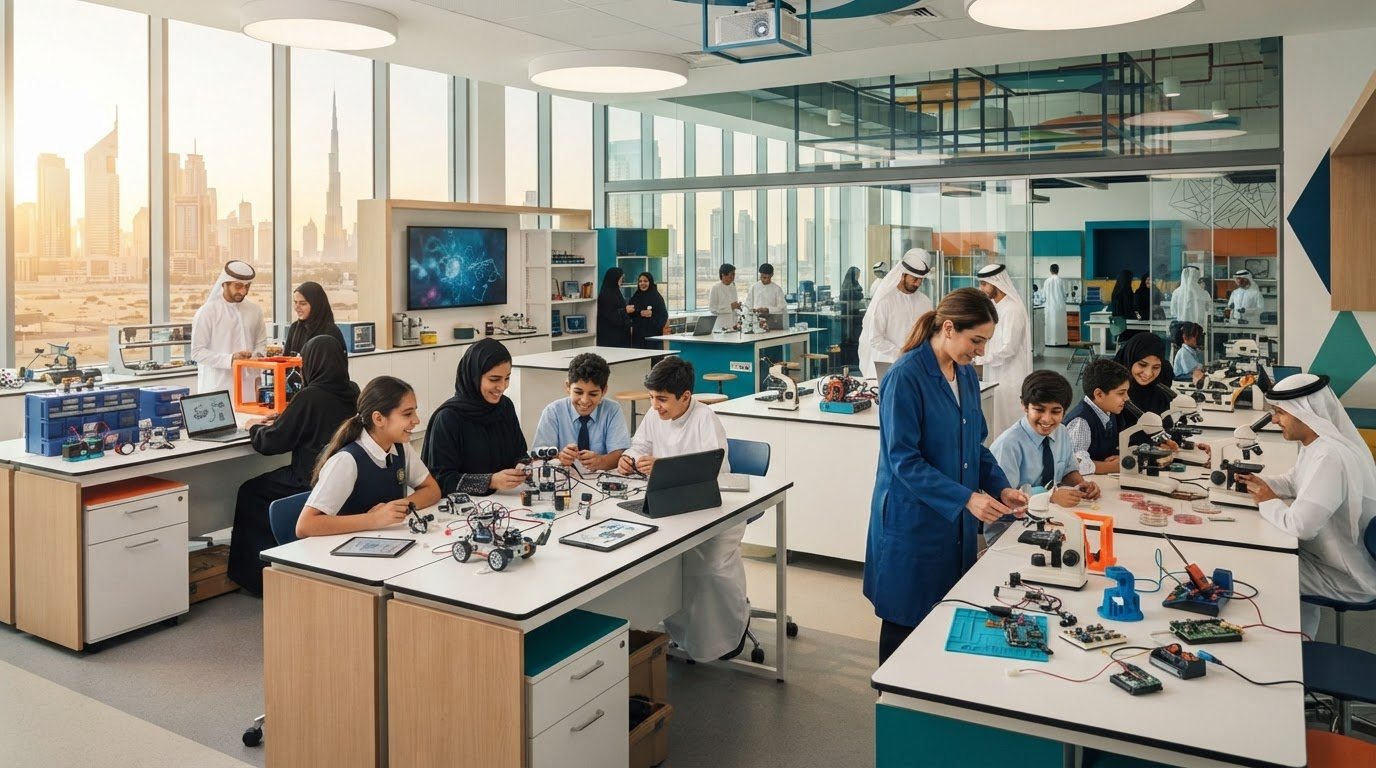
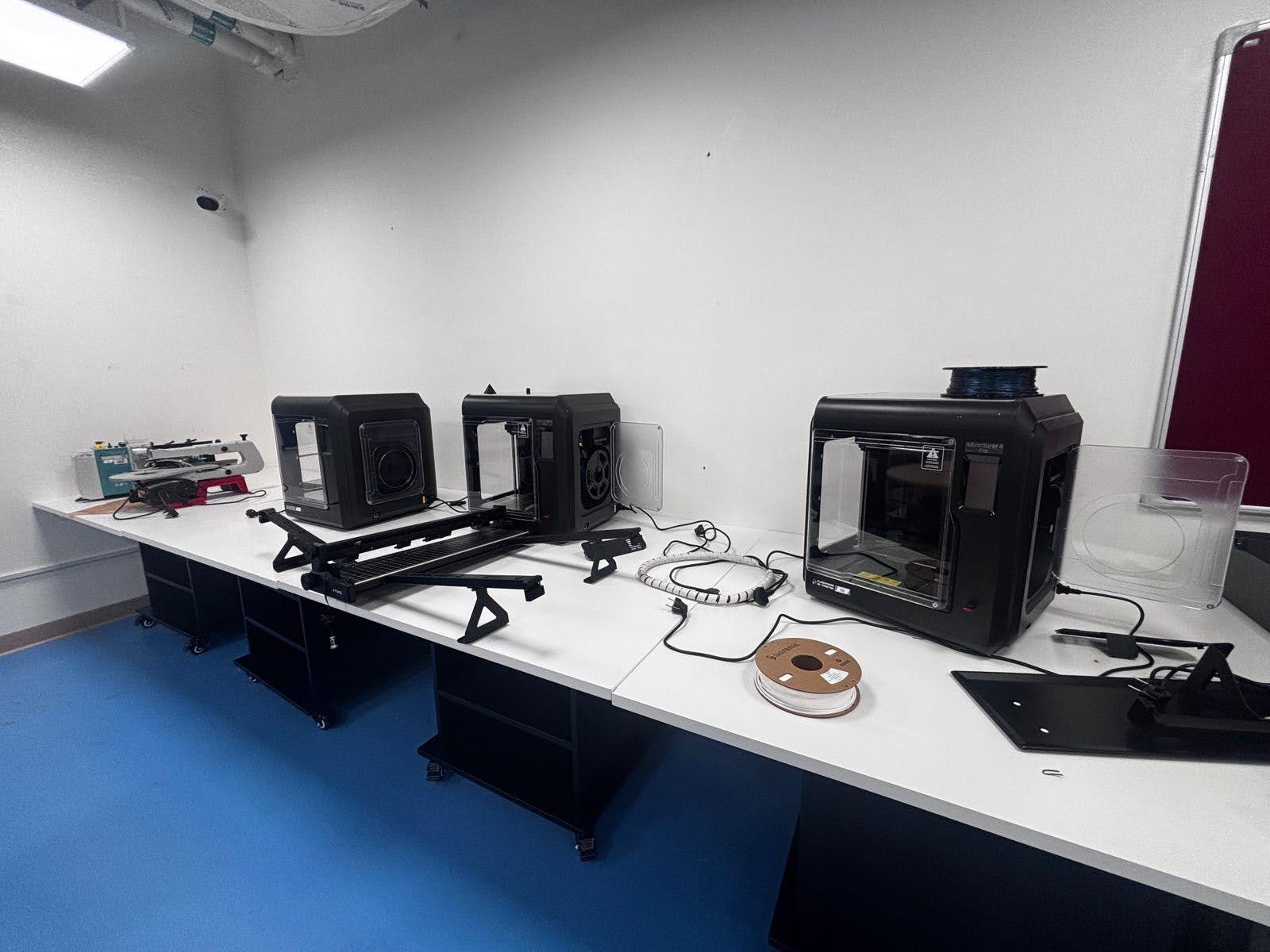
Ednex designs and equips educational laboratories, including Future Science Lab setups for K-12 institutions in the UAE. A lab can provide a setting for hands-on experiments, data collection and analysis while connecting practical activities with a school’s wider educational direction. Planning around that ecosystem helps schools consider how students move between asking questions, gathering evidence and applying what they learn in new contexts.
This approach brings teaching, space and equipment into the same conversation. A sensor investigation may be one part of a science lesson; related STEAM, robotics and coding experiences can give students further opportunities to apply ideas. The aim is a coherent environment where practical learning has a clear purpose, rather than a collection of disconnected activities.
Schools can explore how these considerations fit into a broader future science lab setup, including the role of hands-on learning and laboratory planning. Ednex’s STEAM programs, Arduino Education and lab solutions can connect classroom inquiry with wider practical experiences. Explore the guide to consider how a future-focused science environment can support your institution’s learning priorities.
Build the Next Step into Your Learning Pathway
The value of sensor learning grows when a classroom investigation becomes a starting point for deeper questions. As your school considers educational sensor kits for schools UAE, look beyond the first activity. Consider how students can build on what they discover and carry their curiosity into future science and technology learning.
That pathway can take different forms across year groups and institutional goals. Ednex brings together school STEAM, robotics and coding programs with Arduino Education and Future Science Lab setups. These offerings let schools consider sensor investigations as part of a broader educational vision rather than a standalone activity. The next step is to connect that vision with your school’s priorities.
Explore Ednex’s STEAM and educational lab solutions and discuss how practical learning can support the experiences your students need next. Every strong learning pathway begins with a thoughtful question, and your school can build from there.
Frequently Asked Questions
What are educational sensor kits for schools?
Educational sensor kits bring measurement tools into structured classroom investigations. Their value depends on how well the activity connects to what students are learning, rather than how many components are included. Before planning a lesson, teachers can identify the concept, the evidence students should produce and what they’ll need to document. This helps distinguish a purposeful learning resource from equipment used only for a one-off demonstration.
Which sensors are useful for school science lessons?
The most useful sensor measures something relevant to the lesson’s question and suits students’ experience. A class exploring how a material responds to its surroundings, for example, needs a measurement that helps compare conditions. Consider whether students can understand the resulting readings and whether the activity supports the science concept, rather than adding technology without a clear learning purpose.
How do students use sensors in a classroom experiment?
Students use sensors as part of a planned investigation, following a shared method so their observations can be compared meaningfully. A useful classroom record notes the measurement, the conditions under which it was taken and any changes to the procedure. Afterward, students can explain how those conditions might affect the results. This helps distinguish a conclusion supported by the investigation from an assumption that needs more evidence.
Can educational sensor kits be used without coding?
Yes. A lesson can focus on measurement and data discussion without making coding a learning requirement. Students might use an available reading method to examine values, organise them and describe what they suggest. Coding can be introduced when it serves the objective, such as extending a technology or problem-solving activity. The right balance depends on the equipment, student readiness and what the lesson is designed to teach.
How can schools choose a sensor kit for different age groups?
Choose educational sensor kits for schools UAE by matching the investigation to learners’ confidence with equipment, data and independent work. For an introductory activity, teachers can provide a clear procedure and a prepared recording sheet. Older or more experienced learners can take greater responsibility for planning comparisons and explaining results. Also consider how the same learning theme could develop across year groups without requiring every class to use the same level of complexity.
How can teachers assess learning from a sensor activity?
Assess the quality of students’ reasoning as well as their completed records. A short exit response can ask each learner to state the investigation’s purpose, cite one observation and explain what it supports. Group work can show collaboration, while individual responses reveal understanding that may be hidden in a shared result. Keep assessment criteria aligned with the objective, so students know whether the focus is accurate recording, interpretation or explanation.
How do sensor kits fit into a wider STEAM program?
Sensor activities can provide a practical link between scientific investigation and wider technology or design work. For instance, students might use a measurement to identify a problem, then discuss how a designed system could respond to it. Schools can build that connection through planned STEAM experiences and offerings such as Arduino Education. The important step is to make the activity part of a learning progression, with a clear purpose beyond using equipment.
Related Posts ...

Comments are disabled