




School laboratory modernization in the GCC: Building technical capacity
A lab filled with new equipment can still leave students unprepared. Effective school laboratory modernization across the GCC aligns facilities and equipment with curriculum goals, safe practical learning, and the technical skills students need to develop. The priority is building capability, not simply adding technology.
Schools need laboratories that support meaningful hands-on learning and keep pace with changing fields. That takes more than upgrading a room: educators, learning objectives, equipment, and the spaces students use must work together. This article explains how technical capacity building, quality infrastructure, and purpose-designed laboratory solutions can help schools in the UAE plan modernization with clarity.
Explore the key considerations for planning a school laboratory, from matching capabilities to learning outcomes to creating a foundation for future-ready technical education. You’ll also see how integrated lab solutions can connect practical instruction with robotics, engineering, and emerging technologies.
Key Takeaways
- Build technical capacity alongside facilities and equipment so practical learning can develop with the laboratory.
- Match laboratory solutions to curriculum goals, student activities, and the skills each learning environment needs to support.
- Plan safety and approval requirements around the laboratory’s location, design, equipment, and intended use.
- Assess modernization costs by defining the project scope, infrastructure needs, equipment, and implementation priorities.
- Explore how integrated STEAM, robotics and coding, Arduino Education, and future science lab setups can support hands-on learning.
Laboratory technical capacity building
Modernization succeeds when people can operate equipment, teach practical skills, and maintain reliable routines. A school laboratory modernization GCC roadmap should connect facilities, curriculum, staff capability, and equipment use. In the UAE, technical and engineering facilities should reflect the activities they support. A robotics lesson, for example, requires different preparation from an electronics exercise.
Primary laboratories generally support observation and guided experiments. Secondary facilities can enable subject-specific techniques and more independent projects. University laboratories typically require specialized equipment and advanced technical applications. These distinctions shape staff preparation, equipment selection, and the support each facility needs.
Laboratory staff and technicians have complementary responsibilities. Teachers connect equipment use to learning outcomes, while technicians prepare work areas, manage inventory, and follow maintenance procedures. School leaders can assign clear ownership for setup, training, inspections, and procurement. This helps teams identify gaps before new equipment enters regular lessons.
GCCLAB full membership has defined eligibility criteria. Governmental and private laboratories in GCC member states must have conducted laboratory activities for more than 2 years to qualify. Full-member laboratories must demonstrate independence, integrity, and impartiality, with ISO/IEC 17025 or ISO/15189 given as standards. They also need a quality management system conforming at least to ISO 9001 or a similar standard. These are membership criteria, not universal school-laboratory rules.
Training and technical courses should match the equipment and tasks students will use. In a sensor activity, for example, learners can practise connecting components, recording readings, interpreting results, and documenting errors. Teachers and technicians also need instruction in setup, troubleshooting, storage, and routine care. A technical training center can provide structured practice and demonstrations for specific laboratory disciplines.
Typical project steps include curriculum assessment, facility planning, equipment procurement, installation, staff training, and operational review. Timelines depend on project scope, building changes, equipment integration, and procurement sequencing. Establishing these stages early helps schools coordinate decisions and organize training before lessons begin.
Funding may come through school capital planning, education authority procurement, or institutional partnerships. Build a proposal around learning outcomes, staff development, equipment use, and ongoing maintenance. A school laboratory modernization GCC plan is easier to assess when every requested resource is tied to a defined educational purpose.
Common risks include equipment staff aren’t prepared to use, unclear maintenance ownership, and procedures that don’t match classroom activities. Set inspection routines, keep equipment records, and establish clear fault-reporting steps. These practices help teams respond to wear and keep equipment aligned with its intended use.
Laboratory solutions
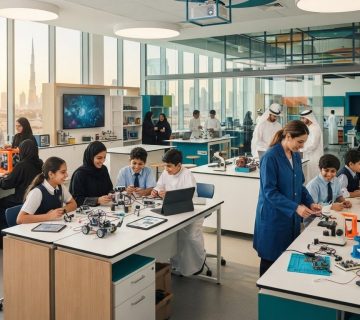
A modern school laboratory is a connected learning environment, not a collection of isolated instruments. In the UAE, map each curriculum activity to the space, equipment, power, connectivity, and storage it requires. A sensor investigation, for example, needs suitable work surfaces, measurement tools, and a way to record and interpret readings.
Design the room around how learners move through practical work. Place shared equipment where groups can access it without crossing active work zones. Separate preparation and storage from student work areas, and provide clear routes between demonstration points and benches. These choices help teachers manage activities and make equipment easier to return, inspect, and maintain.
Digital and immersive tools can extend what a physical lab supports. AR and VR activities can help students visualize systems, explore simulated environments, or rehearse procedures before working with physical components. They work best when each simulation supports a defined lesson objective and leads to a follow-up task, such as comparing a virtual observation with a measured result.
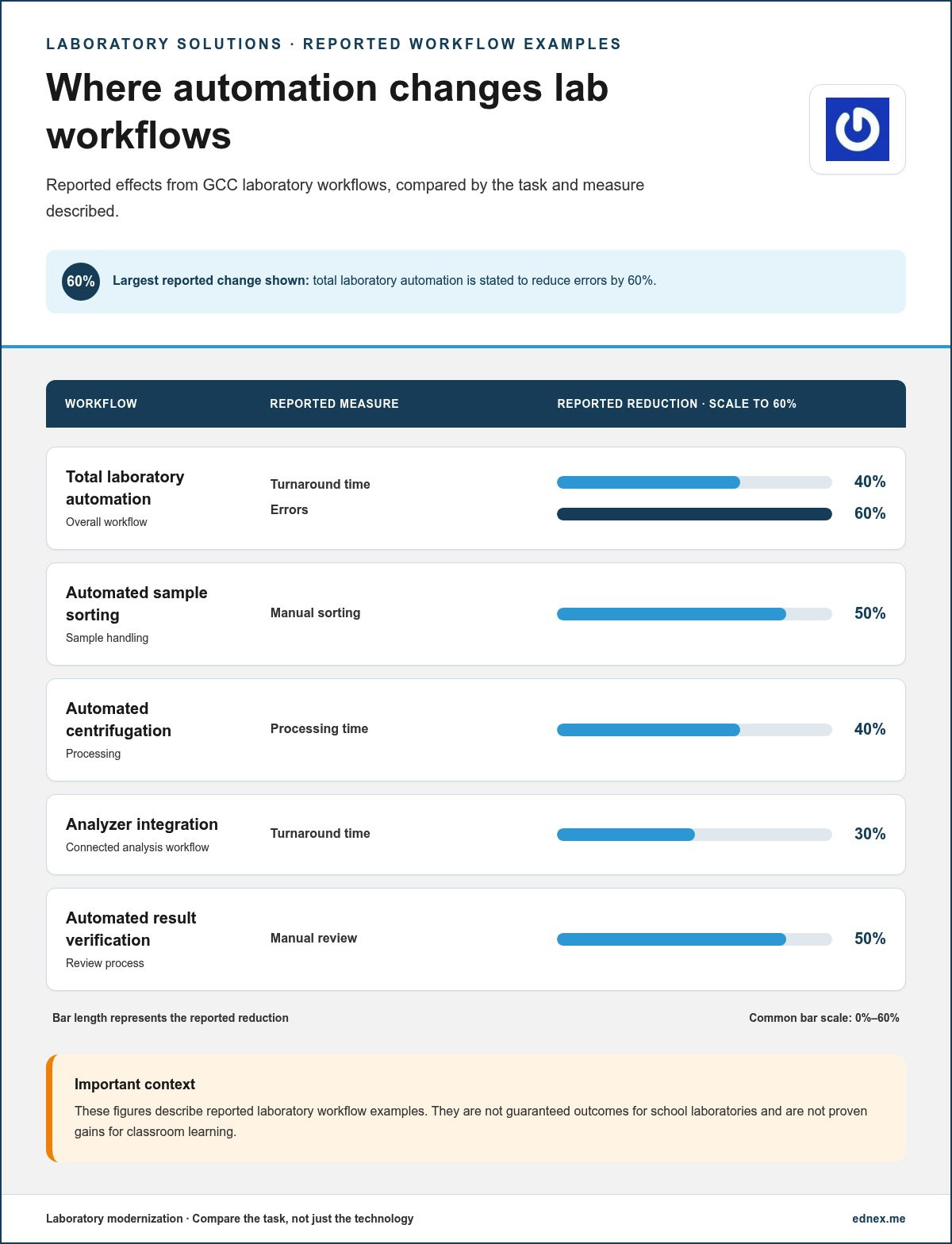
Automation figures from GCC laboratories offer useful context, but they should not be treated as guaranteed school outcomes. Reported results include total laboratory automation reducing turnaround time by 40% and errors by 60%. Automated sample sorting is stated to reduce manual sorting by 50%, while automated centrifugation is stated to reduce processing time by 40%. Analyzer integration is stated to reduce turnaround time by 30%, and automated result verification to reduce manual review by 50%. These examples concern laboratory workflows, not proven gains for school classrooms.
For an educational setting, choose technology by matching the solution to the task:
- Measurement: Choose sensors and instruments that let students collect data and explain how they obtained it.
- Visualization: Use AR or VR to make complex structures or processes easier to explore before practical work.
- Integration: Connect equipment to a clear learning sequence, with suitable instructions for setup, use, and result recording.
- Future readiness: Consider a futuristic engineering lab solution when curriculum plans include emerging technical disciplines.
Plan commissioning as part of the solution, not as a final handover detail. Test equipment in its intended location, confirm that connections and software work together, and prepare operating instructions for teachers. A representative class activity can reveal practical issues, such as inaccessible controls or unclear data displays, before regular lessons begin.
Finally, define how the laboratory will be supported after installation. Assign ownership for equipment records, routine checks, updates, and fault reporting. A simple inventory showing each item’s location and condition gives school teams a practical starting point for maintaining a dependable learning environment.
What are the latest GCC school laboratory safety standards and regulations?
For UAE schools, safety planning should start with the activities, materials, and equipment each laboratory will use. Distinguish school requirements from rules for other laboratory types. Document relevant local requirements alongside design and approval decisions, rather than treating a medical laboratory accreditation standard as a school safety code.
Separate operational safeguards from formal accreditation. GCCLAB full-member laboratories must demonstrate independence, integrity, and impartiality, with ISO/IEC 17025 or ISO/15189 given as standards. They also need a quality management system conforming at least to ISO 9001 or a similar standard. These are GCCLAB membership criteria, not stated as universal requirements for school laboratories.
ISO 15189 is a medical laboratory standard, not a general school science-lab specification. Requirements attached to health-authority licensing concern the licensed laboratories covered by those rules. They should not automatically be applied to school science rooms or educational equipment without establishing that the requirement governs the specific facility.
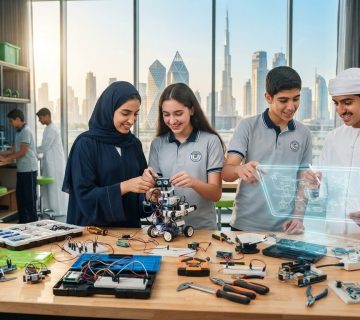
For a school project, make safety part of the documented design. Identify each activity, then record the equipment, materials, user instructions, and supervision it requires. A robotics lesson, for example, may involve batteries, hand tools, and moving parts, while a chemistry activity may need separate controls for substances, storage, and disposal. The activity determines which controls to plan.
Use a practical review sequence before lessons begin:
- Map activities: List planned experiments and equipment, such as glassware, electrical circuits, or small robots.
- Review the room: Check access routes, work surfaces, storage, ventilation needs, and emergency arrangements against planned activities.
- Set procedures: Prepare equipment-specific instructions, supervision expectations, incident reporting, and storage routines.
- Train users: Walk teachers, technicians, and students through procedures before they handle unfamiliar equipment.
- Review records: Log inspections, maintenance, incidents, and corrective actions so teams can identify recurring issues.
According to ASTM International, more than 13,000 ASTM standards operate globally. This figure reflects the breadth of technical standards, not a claim that every standard applies to schools. Select references by equipment and activity, then have the project team map them to applicable UAE requirements.
For school leaders, the essential safeguard is traceability: connect each activity to its risks, controls, responsible staff, and review records. This gives laboratory teams a clear basis for daily operation without confusing GCC laboratory accreditation with school-specific obligations. Keep records accessible to staff, and update procedures when equipment or activities change.
Which GCC authorities approve school laboratory designs and equipment?
There is no single GCC-wide approval route for every school laboratory. In the UAE, identify the relevant review bodies for the school’s location and project scope before finalizing the design or purchasing equipment. Refurbishing an existing room may require different coordination from building a new laboratory, and Ednex LLC recommends mapping these requirements early.
Start with the school’s education authority and facilities team. They can clarify the project’s curriculum, intended users, and internal approval process. Then map each design element to the relevant review process: room alterations, electrical changes, ventilation, fire arrangements, and equipment installation. This is a planning framework, not a claim that one authority approves every item.
Keep healthcare laboratory rules separate from school requirements. Medical and diagnostic laboratories are subject to strict clinical licensing and are required to hold ISO 15189 accreditation alongside annual regulatory inspections. These specific clinical standards apply to licensed medical facilities, not automatically to school science rooms or educational equipment.
That distinction matters when a school evaluates technical standards. ISO 15189 concerns medical laboratories; it should not be presented as a blanket school laboratory approval. Regional conformity and testing laboratories also have membership requirements involving independence, integrity, impartiality, and a quality management system. Those criteria do not establish which authority approves a school’s design.
Prepare a project file that makes the intended use clear. Include a room plan, equipment schedule, utility requirements, activity descriptions, and operating procedures. For example, a design with robotics workstations should identify power needs, moving components, storage, and supervised student activities. A chemistry teaching room needs its own review of activities and materials.
Use a step-by-step coordination process before procurement:
- Define the location: Record the jurisdiction, school operator, room type, and planned changes.
- Describe the use: List curriculum activities, equipment, users, and any building modifications.
- Map review responsibilities: Ask the school’s facilities and education teams to identify relevant approval channels for each project element.
- Submit coherent documents: Keep drawings, equipment specifications, and safety procedures aligned.
- Record decisions: Track approvals, design revisions, and commissioning checks in one project file.
For a UAE school, the practical approach is to map approvals by location, building scope, and laboratory use. Do not treat healthcare accreditation or clinical testing memberships as a substitute for project-specific school approvals. A clear responsibility matrix helps the school coordinate design decisions before installation begins.
What is the cost of modernizing a school science laboratory in the UAE and wider GCC?
There is no single cost for every school laboratory modernization project in the UAE or wider GCC. A refresh that replaces benches and basic instruments differs from a complete redesign involving building work, specialist equipment, and staff training. Define the scope before comparing proposals.
The price depends on the project and is provided after a quote request. Key cost factors include the room’s condition, design changes, equipment type and quantity, installation requirements, training, and ongoing maintenance. In the UAE, budget and compare project costs in UAE dirhams, written as AED or د.إ.
Start by separating essential costs from optional enhancements. A school might prioritize replacing damaged work surfaces, then add digital measurement tools or robotics equipment later. A materials science room may need different instruments and storage from a general science classroom. Let the curriculum and planned activities guide those choices.
Infrastructure can change the project scope. Check whether the room needs new electrical points, improved ventilation, additional storage, or adjustments to existing services. For comprehensive facility overhauls in the UAE, working with turnkey specialists such as Verve Interior Design & Build can help manage interior modifications and space planning efficiently. List building modifications and equipment integration as separate budget items.
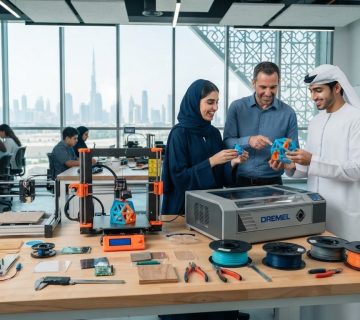
Also account for costs beyond the initial purchase. Include delivery, installation, commissioning, teacher and technician training, consumables, maintenance, and replacement planning. A microscope-based lesson, for instance, needs suitable storage and routine care as well as the instrument itself. A robotics activity may require replacement components and setup time.
Use this sequence to build a practical budget:
- Set learning priorities: Identify the curriculum outcomes and practical activities the laboratory must support.
- Audit the room: Record existing furniture, utilities, equipment condition, and required building changes.
- Specify equipment: Match each item to a lesson, user group, and maintenance responsibility.
- Separate project costs: Distinguish design, procurement, installation, training, and continuing operational needs.
- Plan phases: Prioritize essential upgrades, then schedule enhancements according to educational value and available budget.
For GCC projects, procurement practices, delivery logistics, and local facility requirements can also shape quotations. Compare proposals using the same equipment specifications and scope. Check that each covers installation, training, and maintenance planning, so a lower initial figure does not hide differences in project coverage.
A clear scope helps school leaders make trade-offs without weakening the learning objectives. To develop a tailored laboratory plan, discuss your school laboratory upgrade and its curriculum priorities.
Ednex: STEAM Programs
Ednex LLC supports UAE schools planning to connect laboratory upgrades with practical, curriculum-focused learning. Its STEAM Programs and Robotics and Coding for schools help create structured opportunities for students to explore concepts through projects and technical activities.
Turn to Ednex LLC when your school is shaping a new learning programme, aligning practical instruction with upgraded facilities, or planning a Future Science Lab Setup. Arduino Education can support hands-on exploration of electronics, coding, and prototyping. The right combination depends on your curriculum priorities and the learning experiences you want students to develop.
Share your school’s laboratory and programme goals with Ednex LLC. Visit ednex.me to start a conversation.
Turn Laboratory Vision into Lasting Learning
The next step in school laboratory modernization in the GCC is to turn a facility plan into a learning vision: what should students be able to investigate, build, test, and explain? Start with those outcomes, then shape the learning programme and practical environment around them. This keeps future decisions focused on student capability, not equipment alone.
Ednex supports schools with STEAM Programs, Robotics and Coding for schools, and Arduino Education. These offerings connect hands-on activities with technical learning goals, whether a school is refining an existing programme or planning a new direction. Start with the educational ambition your team wants the laboratory to serve.
Share your school’s priorities and explore a pathway for practical learning. Contact Ednex about school laboratories. With a clear vision and purposeful next steps, your school can create new opportunities for students to learn by doing.
Frequently Asked Questions
What does school laboratory modernization include in GCC countries?
It combines learning goals, suitable spaces, practical equipment, staff readiness, and a plan for ongoing use. In a UAE primary school, this might mean creating a flexible area for guided science investigations, while a secondary school could add project-based robotics activities. Coordinate curriculum planning, room design, equipment selection, staff preparation, and procurement so each decision supports how students will learn and work.
Which laboratory equipment and technologies are most suitable for GCC schools?
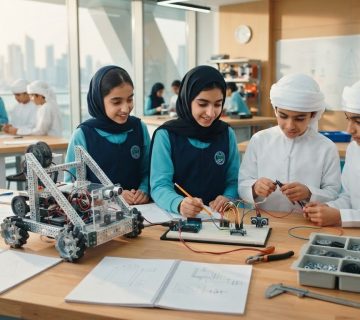
The best fit depends on student age, curriculum, teacher capability, and planned activities. Core options may include measurement instruments, sensors, robotics kits, coding tools, and suitable storage for shared equipment. For example, Arduino Education can support lessons combining coding with electronics, while robotics tools suit design-and-test projects. AR and VR can add simulated exploration when it strengthens a specific learning objective rather than replacing hands-on practice.
Related Posts ...
Comments are disabled