





Electrical Engineering Lab Equipment in the UAE: A Selection Checklist
What if the best electrical engineering lab isn’t the one with the longest equipment list? A search for electrical engineering lab equipment UAE institutions can rely on should begin with curriculum outcomes, learner level, and the practical skills students need to develop, not catalogue breadth.
It’s understandable to focus first on product lists and specifications. Yet equipment only creates value when it fits the way learners will use it, the lab’s infrastructure, and the institution’s capacity to maintain and expand it. Supplier comparisons should account for implementation and long-term support, not just what appears on a quotation.
This practical checklist will help you prioritise equipment against learning outcomes, assess suitability for different users, and identify infrastructure requirements before procurement. It will also guide you through consistent supplier questions, from design and implementation to training, maintenance, and future expansion. The result: a more relevant, usable learning environment, planned with fewer avoidable gaps. For institutions developing a broader engineering education environment, Ednex provides electrical and electronics engineering lab solutions as part of its specialized lab design and implementation capabilities.
Key Takeaways
- Start with courses, learner levels, practical outcomes, and expected lab capacity before defining equipment needs.
- Organize requirements by practical activity, then identify which measurement, circuit, power, control, and digital instrumentation capabilities to evaluate.
- Compare electrical engineering lab equipment UAE proposals against the same curriculum requirements, specifications, integration needs, and support criteria.
- Use a readiness checklist to review space, power, connectivity, furniture, storage, and supervision before the lab is operational.
- See how coordinated lab design and implementation can connect equipment choices to a functional learning environment.
Electrical Engineering Lab Equipment in the UAE: Start with Learning Outcomes
Start with the decision that shapes every later purchase: who will use the lab, what will they study, and what should they be able to demonstrate by the end of a practical session? Before comparing electrical engineering lab equipment UAE suppliers offer, define learner levels, courses, expected class capacity, and the practical outcomes the institution needs to support.
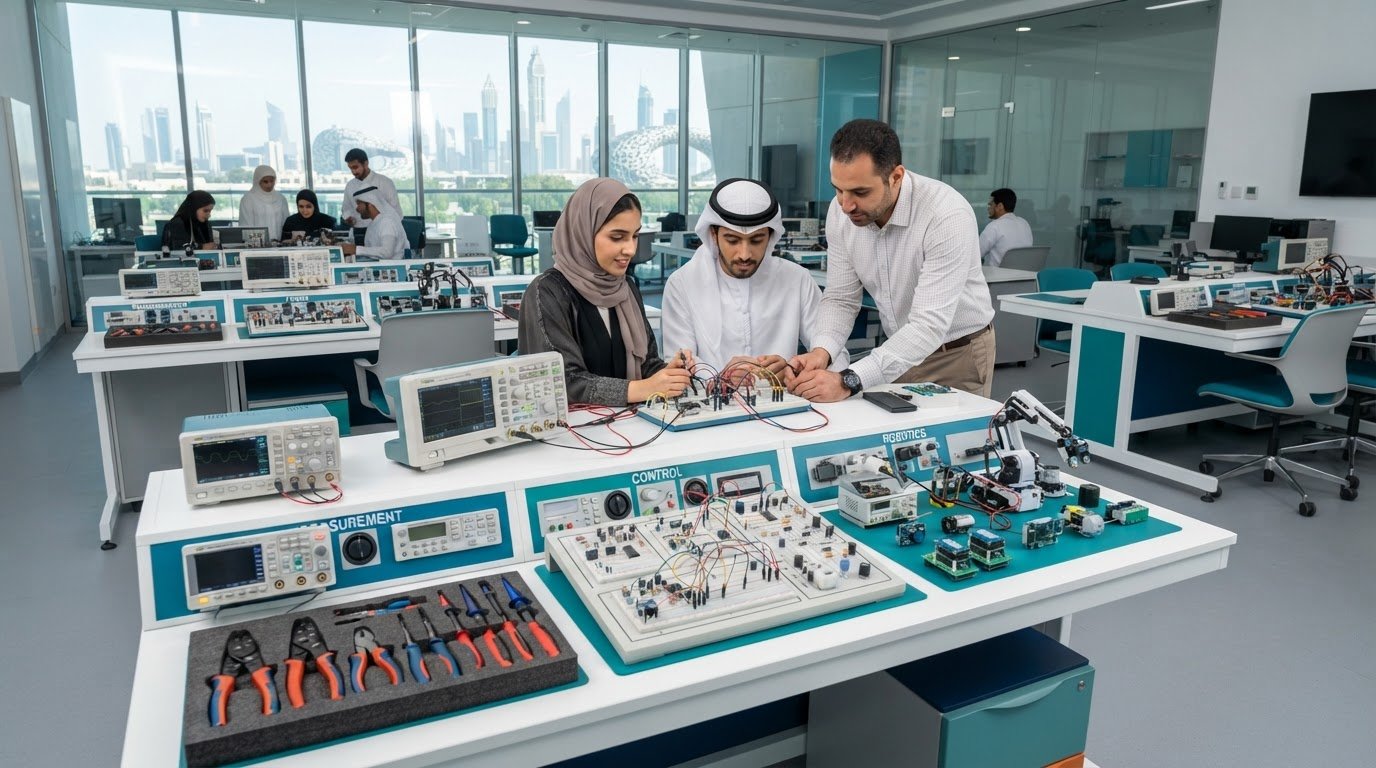
A fit-for-purpose electrical engineering teaching lab is a learning environment where equipment enables students to practise relevant skills through repeatable demonstrations, supervised experiments, and project-based work. The discipline spans areas such as power, electronics, and control systems; a high-level overview of Electrical engineering can help curriculum teams map that breadth to their own programme priorities.
Which learners and courses will the lab serve?
Introductory teaching may focus on building confidence with foundational concepts and guided practical tasks. Undergraduate practicals can require more structured experimentation and interpretation, while vocational or advanced training may centre on applying competencies to realistic technical challenges. These are planning distinctions, not fixed equipment prescriptions: course outcomes should determine the final requirements.
Map each course to the experiments students will perform, the competencies they must demonstrate, and how instructors will assess their work. Then identify class sizes, groupings, supervision needs, and timetable constraints. If several groups share equipment, consider whether the proposed setup supports the planned rotation and allows learners enough hands-on time.
What should a lab checklist establish before procurement?
Build a short requirements record before requesting proposals. Capture learning outcomes, available space, utilities, digital requirements, planned capacity, and priorities for future expansion. Separate essential equipment needed to deliver current courses from optional additions that may support later modules. This makes phased planning more deliberate and gives suppliers a consistent brief to respond to.
Use these six checks to test each proposed solution:
- Curriculum fit: Does it support specified practical outcomes?
- Usability: Can the intended learners use it with appropriate supervision?
- Compatibility: Does it work with the lab’s existing infrastructure and digital requirements?
- Safety: Have qualified institutional stakeholders reviewed relevant requirements for the intended use?
- Support: Are training, maintenance, and support arrangements clearly described?
- Expansion: Can the plan accommodate identified future priorities?
Confirm applicable institutional, facility, and UAE requirements with qualified stakeholders rather than assuming a standard applies. A clear checklist turns procurement from a catalogue exercise into a practical decision about teaching readiness.
Core Electrical Engineering Lab Equipment: Match Tools to Practical Work
Organize equipment requirements around what students will do in the lab, then check which categories support those activities. For electrical engineering lab equipment UAE institutions are evaluating, a practical framework can include measurement, circuit experimentation, power and control training, and digital instrumentation. These are categories to assess against the curriculum, not a universal shopping list or a claim that every lab needs every type of equipment.
Which measurement tools support foundational experiments?
Oscilloscopes, multimeters, and related instruments can help students observe, measure, and interpret electrical behaviour. Compare proposed instruments against planned experiments, including measurement range, accuracy, interface, data-capture options, and ease of use for the intended learners. Ednex describes PC oscilloscopes among its technology solutions. Confirm current specifications, configuration, compatibility, and any required accessories for the specific proposal. Determine quantities based on group size, teaching workflow, and budget.
How should institutions assess circuit, power, and control equipment?
For circuit experimentation, specify the practical tasks students must complete, such as assembling a circuit, taking measurements, and explaining observed results. For power and control training, check that the proposed configuration matches course content and can work with the institution’s existing infrastructure. Treat model details, capabilities, interfaces, and safety features as items for supplier confirmation, not assumptions based on a category name.
Use a comparison table to connect each equipment category to its instructional role and project requirements:
| Equipment category | Learning use | Selection questions | Dependencies to confirm |
|---|---|---|---|
| Measurement instruments | Observe and record electrical quantities during practical tasks. | Are range, accuracy, interface, and usability suitable for the planned experiments? | Quantity, accessories, storage, and connections. |
| Circuit experimentation | Assemble and investigate circuits through guided work. | Does the setup support the course activities and assessment tasks? | Bench space, components, supervision, and workflow. |
| Power and control training | Explore relevant electrical principles and control concepts. | Does the configuration align with the syllabus and learner level? | Utilities, facility readiness, and requirements confirmed by qualified stakeholders. |
| Digital instrumentation | Capture, display, and review experimental observations. | Are the specifications and configuration appropriate for intended use? | Computer connectivity, software needs, and compatibility. |
Ask suppliers to respond to the same practical tasks and dependencies so proposals are easier to compare. Institutions exploring a coordinated lab solution can review Ednex’s electrical and electronics lab solutions as a point of reference.
How to Compare Electrical Engineering Lab Equipment and Suppliers
A useful supplier comparison begins with a shared brief, not a contest between headline features. Give each supplier the same course outcomes, practical activities, user groups, infrastructure details, and expansion priorities. Then assess how clearly each proposal responds. This makes it easier to compare electrical engineering lab equipment UAE institutions are considering on instructional fit and project readiness, rather than catalogue size alone.
What should an equipment comparison table include?
Record the intended learning use alongside the proposed configuration. A measurement setup, for example, should be assessed against the experiments it must support, relevant specifications, required accessories, and compatibility with existing systems. Keep quantities and assumptions visible so that omissions don’t disappear inside a broad package description.
| Scorecard area | What to compare | Clarification to request |
|---|---|---|
| Curriculum alignment | Courses, practical tasks, and learner level addressed | Which stated outcomes does each proposed item support? |
| Specifications | Required performance, configuration, accessories, and compatibility | Which details are confirmed, and which remain subject to verification? |
| Integration | Fit with the planned lab layout, utilities, and digital environment | What infrastructure or additional work is assumed? |
| Training and handover | User instruction, documentation, and handover arrangements | Who provides each element, and what is included? |
| Support and readiness | Maintenance, technical assistance, and future expansion options | What commitments, coverage, and timelines can be documented? |
Also record delivery assumptions, commissioning responsibilities, and any dependencies on the institution. Mark information as confirmed, unverified, or not comparable. Ask suppliers to clarify gaps before evaluation, rather than treating missing details as equivalent offers.
How can institutions assess support and future readiness?
Look beyond initial supply. Ask how educators and technical staff can access documentation, training, technical assistance, and maintenance support, and identify who is responsible for each. Check whether the proposed configuration can accommodate planned courses or phased expansion without assuming that future additions will be compatible.
Evaluate the whole project pathway, too. Clarify who coordinates design, equipment supply, installation, commissioning, and handover, and what the institution must provide at each stage. Verify warranty terms, service coverage, delivery timelines, and support commitments in writing. These are supplier-specific details to confirm, not assumptions to carry into procurement.
For institutions assessing a connected approach to lab planning, Explore Ednex’s engineering lab solutions. Ednex’s confirmed capabilities include electrical and electronics engineering lab solutions, alongside specialized lab design and implementation.
Electrical Engineering Lab Planning Checklist for UAE Institutions
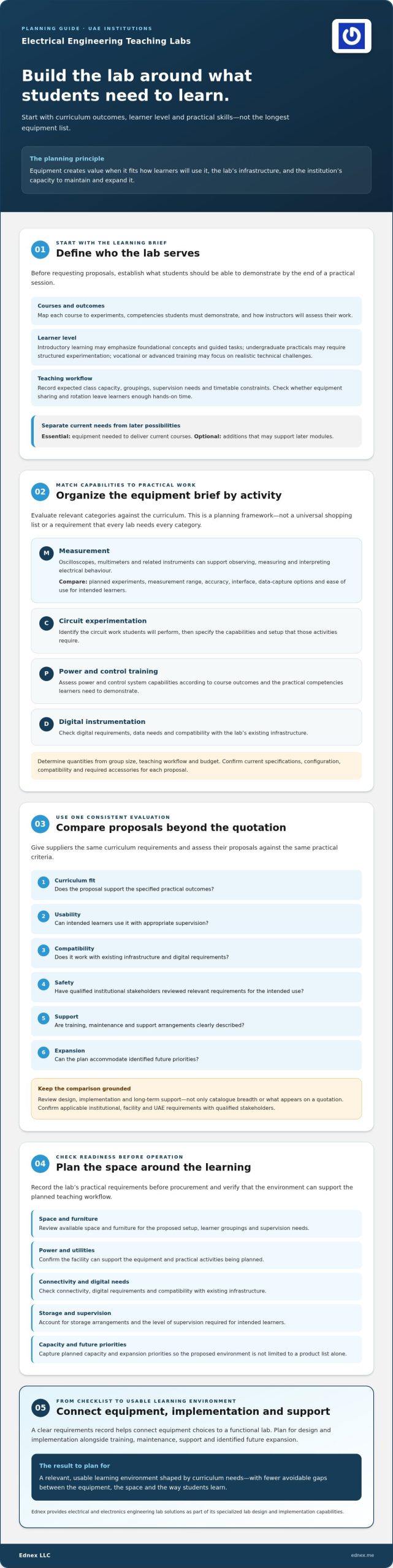
A well-prepared project brief gives suppliers a clear basis for designing a lab around institutional priorities. For electrical engineering lab equipment UAE projects, move through these steps before procurement:
- Gather teaching requirements: Compile course outlines, learner numbers, teaching schedules, practical activities, and assessment requirements.
- Document the site: Record room layouts, available utilities, network access, storage, furniture, accessibility needs, and any known facility constraints.
- Set priorities: Separate essential equipment from future phases, and identify training needs and who will own day-to-day operations.
- Verify requirements: Ask qualified institutional and facility stakeholders to confirm which UAE requirements apply to the institution, site, and intended equipment. Don’t assume a standard or approval applies without verification.
- Review proposals: Compare supplier responses against the same brief, clarify gaps, and confirm responsibilities before selecting a solution.
- Prepare for operation: Agree on delivery, installation, commissioning, acceptance, training, documentation, and handover arrangements.
What should the institution confirm before requesting proposals?
Make the brief practical and specific. Alongside course and learner information, describe the room and its constraints so proposals account for the actual teaching environment. Identify priorities for future phases and decide who will manage equipment, coordinate access, and oversee routine use. This preparation helps suppliers distinguish current requirements from aspirations that can be planned for later. Institutions planning other discipline-specific facilities may also find it useful to review guidance on civil engineering lab setup UAE approaches, which addresses similar questions around learning outcomes, facility constraints, and procurement readiness. Those developing hands-on engineering programmes more broadly may also benefit from reviewing the mechanical engineering lab UAE strategic guide, which applies a comparable outcome-first framework to equipment selection and facility planning.
- Space: Is the layout suitable for equipment, learner groups, movement, and supervision?
- Power and connectivity: Have relevant requirements and available capacity been reviewed by qualified stakeholders?
- Furniture and storage: Are work surfaces and secure storage needs documented?
- Supervision: Can educators oversee the planned practical activities and learner groupings?
What belongs in delivery, commissioning, and handover?
Before work begins, document who handles delivery and installation, what commissioning checks will be completed, and how the institution will decide the lab is ready to use. Define acceptance criteria in advance. Plan educator orientation, user documentation, equipment inventory, and maintenance responsibilities so operational ownership doesn’t begin as an afterthought.
For broader planning that connects institutional needs with lab design and implementation, explore Ednex’s engineering lab solutions. Ednex’s confirmed capabilities include electrical and electronics engineering lab solutions and specialized lab design and implementation.
From Equipment Checklist to an Operational Lab: Ednex’s Integrated Approach
Equipment selection is one part of a larger institutional decision: how the lab will support teaching within its actual space and implementation plan. Ednex’s confirmed offering includes electrical and electronics engineering lab solutions, alongside specialized lab design and implementation for higher education and vocational training institutions in the UAE. That provides a starting point for discussing how the institution’s curriculum needs and lab environment may be brought together.
An integrated project pathway can be useful when equipment choices, room planning, and implementation responsibilities need to be coordinated. Early input from educators helps clarify the practical work the lab must support; input from facilities stakeholders can surface space, utility, and access constraints before proposals are finalized. This collaborative planning can help identify mismatches in the project brief, but the scope and responsibilities for each project should be confirmed directly.
When does an integrated lab solution make sense?
Consider a coordinated approach if the institution is developing a new lab, adapting an existing space, or planning equipment in phases. Bring educators and facilities stakeholders into early discussions so the learning requirements and site conditions inform the same brief. Confirm which design and implementation activities are included, and verify equipment scope, delivery, training, and support for the specific project. Avoid treating any element as included until it is documented.
What information should institutions share to start a discussion?
A concise project brief makes an initial conversation more focused. Include:
- Learner levels, courses, expected users, and practical learning priorities.
- Room details, known infrastructure or technical constraints, and existing equipment.
- Preferred implementation phases and any institutional requirements already verified by qualified stakeholders.
These details help establish the context for evaluating electrical engineering lab equipment UAE institutions may need, without presuming a particular configuration or product model. Institutions can then clarify which requirements need further technical review and what project scope should be documented in a proposal.
To discuss your institution’s requirements and potential lab design and implementation needs, Discuss your electrical engineering lab requirements with Ednex.
Build a Lab Ready for Practical Learning
A strong lab plan starts with what learners need to do, then connects those outcomes to equipment, facilities, and implementation requirements. Use a consistent checklist to compare proposals on curriculum fit, specifications, integration, training, and support. Before procurement, confirm site readiness and applicable institutional requirements with qualified stakeholders.
These steps help institutions evaluate electrical engineering lab equipment UAE options with a clearer view of both teaching value and project responsibilities. The right selection is not simply a collection of tools; it’s a considered learning environment designed around intended use and operational readiness.
Ednex provides specialized engineering lab design and implementation, with electrical and electronics engineering lab solutions among its confirmed offerings. The company serves institutional customers nationally across the UAE. To discuss your requirements and explore how your institution’s needs could inform a lab project, discuss your electrical engineering lab requirements with Ednex.
With clear priorities and a well-prepared brief, your institution can take the next step toward practical, future-ready engineering education.
Frequently Asked Questions
What equipment is needed in an electrical engineering lab?
The required equipment depends on the courses and practical skills the lab must support. A teaching environment may assess measurement instruments, circuit experimentation resources, power and control training equipment, and digital instrumentation. Start by identifying the experiments students will perform, then confirm the necessary equipment categories and configurations with suppliers. Requirements can differ between introductory instruction, undergraduate practicals, and vocational training, so there is no universal equipment list.
How do I choose electrical engineering lab equipment for a university?
Choose equipment by mapping each course outcome to practical activities, assessment methods, and the learner level. For a university programme, consider whether students need to observe, measure, analyse, or build systems, and whether the proposed configuration supports those tasks. Check room and infrastructure requirements, compatibility with existing resources, and the institution’s intended capacity. Invite educators and facilities stakeholders to review requirements before comparing proposals.
Which instruments are essential for an electrical engineering teaching lab?
Oscilloscopes and multimeters are common instruments to evaluate, but whether they are essential depends on the experiments and measurement outcomes in the curriculum. Compare proposed instruments by relevant measurement range, accuracy, interface, data capture, and ease of use for learners. Also assess accessories, quantities, and compatibility with other equipment. Ednex lists PC oscilloscopes among its technology solutions; confirm current specifications and configuration for any proposed setup.
What is the difference between an electrical engineering lab and an electronics lab?
An electrical engineering lab may cover a broad range of topics, including electrical principles, power, measurement, and control, depending on the programme. An electronics lab generally emphasizes electronic circuits and components, such as examining circuit behaviour and signals. The two areas can overlap, and institutions may combine activities in one teaching space. Define the curriculum scope first, then select equipment to support the actual experiments rather than relying on the lab’s label.
How can an institution compare electrical lab equipment suppliers in the UAE?
Compare suppliers using the same written requirements, not catalogue breadth or headline features. The electrical engineering lab equipment UAE proposals should be assessed for curriculum alignment, confirmed specifications, accessories, compatibility, integration assumptions, training, and support. Record missing or unverified details and request clarification before evaluation. Also establish who is responsible for delivery, installation, commissioning, and handover, and ask that warranty, service coverage, timelines, and other commitments be documented.
What should be checked before installing electrical engineering lab equipment?
Before installation, confirm that the room, utilities, connectivity, work surfaces, storage, and supervision plan suit the proposed configuration. Have qualified institutional and facilities stakeholders review applicable requirements for the site and intended use; don’t assume a standard or approval applies. Clarify the installation scope, commissioning checks, acceptance criteria, and responsibilities in advance. Keep relevant equipment documentation and inventory information ready for handover to the people who will operate the lab.
Can electrical engineering lab equipment be expanded later?
Expansion may be possible, but it depends on the original configuration, available space and infrastructure, and compatibility with future equipment. Identify likely course additions or new practical activities during initial planning, then ask suppliers which interfaces, capacity limits, or facility dependencies need consideration. Treat future compatibility as something to verify, not assume. A phased plan can distinguish what the institution needs now from later priorities while keeping each proposed phase grounded in confirmed requirements.
Related Posts ...




Comments are disabled