







Civil Engineering Lab Setup in the UAE: A Strategic Buying Guide
What makes a civil engineering lab useful is not the length of its equipment list, but how well it supports teaching. A civil engineering lab setup UAE institutions plan should begin with the skills learners need to practise, from understanding material behaviour to interpreting observations and applying testing concepts in coursework.
Choosing the right capabilities can be challenging. Course requirements differ, supplier proposals may be hard to compare, and suitable equipment still needs to fit the available space, utilities, and teaching workflows. Address these questions before procurement by assessing learning outcomes, facility constraints, and requirements the institution needs to verify.
This guide offers a practical way to compare lab requirements, equipment categories, and implementation approaches. It also identifies details to clarify before purchasing, including how the proposed setup will work with existing facilities and day-to-day teaching. Ednex designs and implements specialized educational laboratories for higher education and vocational training institutions in the UAE. Confirm the civil engineering capabilities and project scope collaboratively during planning.
Key Takeaways
- Start with course outcomes and practical learning needs to distinguish a teaching lab from a commercial testing facility.
- Use a capability matrix to connect proposed lab areas with courses, practical activities, and learner outcomes.
- Compare a civil engineering lab setup UAE proposal by curriculum fit, coordination, installation scope, training, documentation, and support, not only by its equipment list.
- Ask facilities stakeholders to check space, access, storage, utilities, ventilation, and equipment movement before procurement.
- Use a partner scorecard to clarify responsibilities and confirm which design, implementation, and support elements are included.
Civil Engineering Lab Setup in the UAE: Define the Learning Need First
A successful civil engineering lab begins with a teaching brief, not a shopping list. The civil engineering discipline covers areas such as structures, materials, geotechnical engineering, and surveying. An educational lab does not necessarily need to cover them all equally. Its purpose is to help learners practise the concepts and methods their courses teach, through activities suited to their level and assessment requirements.
For a civil engineering lab setup UAE institutions can use effectively, involve the right decision-makers early. Academic leads and faculty define course outcomes and teaching methods. Facilities teams assess the space and building services. Procurement compares proposals and clarifies deliverables. Health-and-safety stakeholders review how planned activities can be conducted responsibly. A shared brief gives suppliers a consistent basis for proposals and helps the institution identify details to verify with relevant authorities and stakeholders in the UAE.
Which learning outcomes should the lab support?
List relevant modules, practical competencies, and student outputs before evaluating equipment. A course, for example, may ask learners to interpret test observations, document a procedure, or present findings from a supervised practical. Translate each outcome into an activity and assessment method. Then identify the resources that activity requires instead of assuming a broad equipment catalogue is necessary.
Separate introductory demonstrations from advanced experimentation and project-based learning. Ask faculty whether an activity calls for individual stations for repeated practice, shared resources for small teams, or an instructor-led demonstration. This helps determine how the room will be used, how lessons will flow, and how to balance access with supervision.
How does an educational lab differ from a testing facility?
A teaching lab prioritizes student practice, understandable procedures, and clear instructional workflows. Learners need opportunities to take part in activities and interpret results as part of their coursework. A commercial testing facility may instead prioritize client-specific services, sample throughput, or accreditation requirements. These purposes can overlap, but they are not interchangeable.
Before procurement, specify whether the facility is intended for teaching, research, commercial testing, or a defined combination. Do not assume that equipment suitable for a demonstration also supports a particular testing or accreditation claim. Ask the institution and proposal provider to verify intended capabilities, applicable requirements, and project scope.
Record the decisions before comparing proposals: what students must learn, what they will do, how their work will be assessed, and which institutional requirements need confirmation. This concise brief provides a foundation for selecting lab capabilities that match the curriculum.
Choose Civil Engineering Lab Capabilities That Match Your Curriculum
Once learning outcomes are defined, translate them into a capability matrix before comparing proposals. This keeps the civil engineering lab setup UAE focused on teaching value rather than the number of listed items. For each proposed lab area, record the relevant course, practical activity, learner outcome, assessment evidence, and expected level of student access.
For example, a soil mechanics module may require students to observe and interpret soil behaviour, while a surveying course may focus on measurement, recording, and spatial accuracy. Structural concepts and construction materials may call for different practical activities. Treat these as planning categories, not a confirmed equipment list for any supplier. Include them only when faculty confirms that they support the curriculum.
Which civil engineering disciplines may need dedicated lab activities?
Review geotechnical and soil mechanics activities against course outcomes. Will students practise procedures, compare observations, or analyse results? For surveying, consider whether learners need to work indoors, outdoors, or in both settings, and how equipment, movement, and class workflows fit the available space. To explore advanced geospatial mapping and survey solutions used across the region, click here. Include materials and structural learning activities when instructors can define their practical scope and assessment purpose. Institutions planning construction materials testing activities may also benefit from reviewing the material science lab setup strategic guide to understand how outcome-led planning applies to material properties testing and sample workflow design.
Some institutions may also have related electrical engineering teaching needs. If that is part of the wider plan, consult this electrical engineering lab equipment checklist to consider the discipline separately rather than treating it as an automatic extension of the civil lab. Institutions planning across multiple engineering disciplines may also find it useful to review the mechanical engineering lab UAE strategic guide to understand how outcome-led planning applies to adjacent lab environments.
How should institutions compare equipment categories?
Evaluate each proposed category by its educational purpose, learner access, instructional value, and compatibility with planned activities. Ask suppliers to explain which course outcomes an item supports and connect it to a specific practical exercise. The proposal should make that connection clear rather than leaving faculty to infer it from product descriptions.
- Specifications: Check that proposed capabilities suit the intended activity and learner level.
- Use requirements: Identify consumables, utilities, safety controls, and implications for space or workflow.
- Ongoing needs: Clarify maintenance expectations and the documentation included in the proposal.
Keep the matrix available during supplier discussions. It helps stakeholders identify gaps, overlaps, and assumptions before procurement. Ednex designs and implements educational engineering laboratories, and lists Civil Engineering Lab Setup among its offerings. Institutions can review Ednex’s educational lab services and confirm which civil capabilities, equipment categories, and project scope are relevant to their curriculum.
Compare Civil Engineering Lab Setup Proposals Beyond the Equipment List
Two proposals may list similar equipment but differ in the coordination and implementation they cover. For a civil engineering lab setup UAE institutions should compare responsibilities as well as items and specifications. Ask every supplier to identify exclusions, dependencies, assumptions, and resources the institution must provide.
| Evaluation area | Equipment-only procurement | Coordinated lab setup | Phased implementation |
|---|---|---|---|
| Curriculum fit | The institution maps items to teaching needs. | Request a proposed capability map linked to courses and activities. | Confirm how each phase supports current and later course needs. |
| Design coordination | Clarify whether layout advice is included or excluded. | Check the scope of layout and facilities coordination. | Ask how future phases affect current layout decisions. |
| Installation and commissioning | Confirm who handles delivery, installation, and checks. | Require responsibilities and commissioning scope in writing. | Define these responsibilities separately for each phase. |
| Training and documentation | Verify whether either is included. | Specify the training audience, format, and handover documents. | Clarify what is provided at each stage. |
| Ongoing support | Ask what support, if any, is available. | Record the agreed support scope and exclusions. | Check how support applies to completed and upcoming phases. |
What should a civil engineering lab proposal include?
Request a needs assessment, proposed capability map, layout considerations, and itemized scope. The proposal should state timelines and identify who is responsible for installation, commissioning, and training, or explicitly mark these items as excluded. Ask suppliers to flag technical assumptions and details that need confirmation by your institution, including facility readiness and institution-provided resources. Clear documentation makes bids easier to compare and reduces ambiguity before procurement.
How can institutions assess adaptability and long-term usability?
Consider whether the proposed arrangement can accommodate planned class sizes, student movement, and instructor supervision. Ask how consumables, maintenance, calibration, software, and replacement needs will be managed, and which responsibilities fall to the institution. If curriculum changes may lead to expansion, compare the options and dependencies without relying on vague promises of future-proofing.
For broader planning context, explore futuristic engineering lab solutions, then evaluate each proposal against your institution’s brief. Ednex designs and implements educational engineering laboratories. Institutions considering educational engineering lab services should confirm the civil lab capabilities and project-specific implementation scope directly.
Plan the UAE Civil Engineering Lab Project: Space, Safety, and Delivery
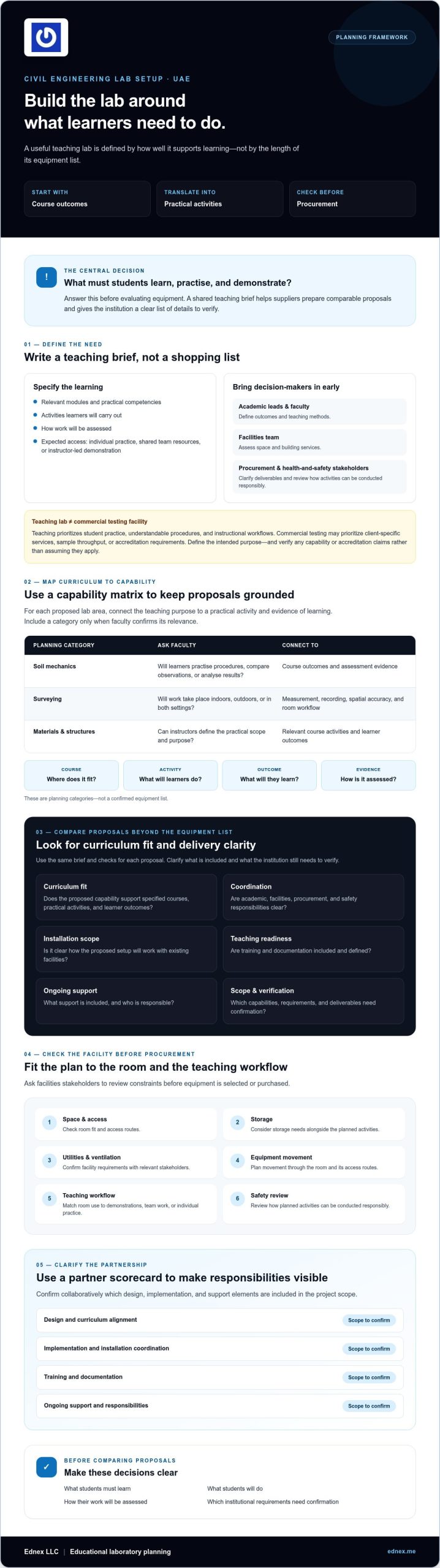
A clear delivery plan connects the approved learning brief to a room that works for teaching. For a civil engineering lab setup UAE institutions should coordinate academic, facilities, procurement, and safety stakeholders from requirements gathering through handover. Verify applicable institutional and authority requirements with qualified project stakeholders. Do not assume one standard or approval process applies to every institution or project.
What should a site and facilities review cover?
Assess planned activities against the actual space before finalizing the layout. Facilities teams should review floor area, circulation, workstation access, instructor supervision, storage, and routes for moving equipment into and through the room. Consider how learners will gather around demonstrations and move between activities without obstructing work areas.
Then check selected equipment specifications against available utilities and environmental conditions. Record what needs confirmation, including ventilation, service connections, delivery access, and any storage or safety provisions relevant to planned activities. Qualified institutional stakeholders should determine which safety and facilities requirements apply and what approvals are needed.
What are the main implementation and handover stages?
Use a staged sequence to keep decisions and responsibilities visible:
- Requirements gathering: Confirm courses, practical activities, room constraints, and institutional requirements to verify.
- Site review and design approval: Document layout assumptions, access needs, utilities, and stakeholder approvals before procurement.
- Procurement and readiness: Confirm the agreed scope, delivery responsibilities, site readiness, and access arrangements.
- Installation and checks: Define who coordinates installation and which testing or acceptance checks are included.
- Orientation and handover: Agree on staff orientation, documentation, maintenance guidance, and handover evidence before work begins.
Put responsibilities in writing. Clarify who prepares the site, receives deliveries, arranges installation access, and signs off on acceptance checks. If training, commissioning, or ongoing support is proposed, confirm its scope instead of assuming it is included.
A project checklist can keep open questions visible between teams. Track each decision, its owner, dependencies, required approvals, and verification status. For example, record a utility requirement alongside the person responsible for confirming it and the project stage by which it needs to be confirmed. Review the checklist at each stage.
Ednex designs and implements specialized educational engineering laboratories, including civil engineering labs, with project scope confirmed collaboratively. Discuss your civil engineering lab project with Ednex and clarify the capabilities, delivery responsibilities, and handover requirements relevant to your institution.
Select a Civil Engineering Lab Partner for Long-Term Learning Impact
A suitable partner should help translate institutional priorities into a defined educational lab scope and make responsibilities and assumptions visible. For a civil engineering lab setup UAE institutions should evaluate proposals against a shared scorecard, not rely on broad capability claims or an equipment list alone.
- Curriculum alignment: Does the proposal connect capabilities to courses, practical activities, learner outcomes, and assessment needs?
- Design coordination: Does it explain how faculty input, facilities constraints, and institutional approval checkpoints shape the plan?
- Implementation scope: Are equipment supply, installation, commissioning, and site responsibilities clearly identified as included or excluded?
- Support clarity: Does the proposal state what training, documentation, maintenance guidance, and technical support are covered?
Ask for relevant evidence of work with educational institutions and comparable laboratory requirements. Establish who coordinates each project element and how the partner will collect faculty feedback, record decisions, and respond to approval requirements. A clear responsibility map helps decision-makers compare proposals fairly and identify gaps before they affect delivery.
Which partner capabilities should decision-makers verify?
Confirm the proposed division of responsibilities in writing. Ask who coordinates design, confirms equipment suitability, manages installation, and provides any agreed training or technical support. Clarify how institutional stakeholders review layouts and approve key decisions. A provider’s general educational lab experience does not, by itself, confirm the equipment scope or delivery arrangements for a particular civil engineering project.
Ednex designs and implements specialized educational engineering laboratories for higher education and vocational training institutions in the UAE, and its offerings include Civil Engineering Lab Setup. It may be a potential design and implementation partner, subject to confirming project requirements and scope directly. Verify which civil lab capabilities and equipment categories are relevant, who is responsible for each project stage, and whether installation, training, commissioning, maintenance, or after-sales support is included.
What should happen before requesting a proposal?
Prepare a concise brief with course outcomes, expected learner numbers, available space, known utility information, and institutional priorities. Separate essential capabilities from optional or later-phase requirements so providers can respond to a defined scope. If interdisciplinary planning is relevant, explore robotics lab setup in the UAE as a separate consideration. Institutions planning engineering labs across multiple disciplines may also benefit from reviewing the mechanical engineering lab UAE planning framework to compare how outcome-led approaches apply to different lab types.
With those inputs ready, contact Ednex to discuss your institution’s lab requirements and confirm the civil engineering project scope, responsibilities, and support arrangements that would apply.
Build a Lab That Moves Learning Forward
A strong civil engineering lab setup UAE institutions can rely on starts with learning outcomes, not an equipment catalogue. Connect proposed capabilities to courses and practical assessments, then compare proposals by design coordination, delivery responsibilities, and support clarity. Reviewing space, utilities, safety considerations, and project-specific requirements helps turn an academic vision into an implementable plan.
The right partner should make scope and responsibilities clear while working with institutional stakeholders to shape a lab that serves learners. Ednex provides educational lab design and implementation, lists Civil Engineering Lab Setup among its offerings, and serves higher education and vocational training institutions in the UAE. Confirm the civil lab equipment scope and which project elements are included directly with the provider.
Discuss your institution’s civil engineering lab requirements with Ednex to explore how a defined project brief could support your teaching goals. With thoughtful planning and collaborative decisions, your institution can create a purposeful foundation for hands-on engineering education.
Frequently Asked Questions
What equipment is needed for a civil engineering teaching lab?
The right equipment depends on the institution’s courses, student activities, and intended learning outcomes. A planning brief may assess needs across soil mechanics, surveying, structural concepts, and construction materials, but these are capability categories, not a standard package. Ask faculty and suppliers to link each proposed item to practical exercises. Also verify space, utility, safety-control, and maintenance requirements before procurement.
How do you plan a civil engineering lab setup for a university?
Start by documenting courses, learning outcomes, class sizes, and practical activities. For a civil engineering lab setup UAE institutions should also review available space, utilities, storage, supervision, and safety needs with relevant teams. Use these findings to compare proposals by curriculum fit, equipment scope, installation responsibilities, training, and support. Before procurement or installation, confirm requirements for the specific institution and project with relevant authorities and stakeholders.
What is the difference between a civil engineering teaching lab and a materials testing lab?
A teaching lab primarily helps learners practise course concepts and develop practical skills. A materials testing facility may instead focus on testing services, client requirements, sample throughput, or specific technical procedures. Some capabilities can overlap, but the users and operating priorities may differ. Define the institution’s intended purpose first. Then independently verify any claims about testing capability, accreditation, or certification against the intended use and relevant requirements. Institutions evaluating materials testing capabilities may also find it useful to review the material science lab setup strategic guide to understand how learning outcomes and testing workflows shape equipment selection.
How should institutions compare civil engineering lab suppliers?
Compare more than catalogue size. Ask each supplier to connect proposed capabilities to course outcomes and explain design coordination, installation scope, site dependencies, training, documentation, and ongoing support. Check what the proposal includes and excludes, and ask for clarification on specifications and institutional responsibilities. A transparent, itemized response makes it easier to assess curriculum fit and delivery readiness without assuming every supplier provides the same services.
What should be included in a civil engineering lab setup proposal?
A useful proposal describes assessed requirements, intended lab capabilities, proposed scope, relevant specifications, layout considerations, and delivery responsibilities. It should clarify site prerequisites, exclusions, installation and commissioning arrangements, staff training, documentation, and support terms. Check that the proposal reflects the institution’s courses and facilities. Ask for written clarification wherever assumptions remain unresolved, and verify project-specific institutional and authority requirements before approving procurement or installation.
How do UAE institutions check civil engineering lab safety requirements?
Applicable requirements depend on the institution, facility, planned activities, and equipment. Involve academic, facilities, procurement, and health-and-safety stakeholders early, then consult qualified professionals or relevant authorities to verify what applies to the project. Review equipment instructions, utilities, access, storage, supervision, and operating procedures. A generic checklist alone does not establish compliance. Record each requirement, who verified it, and any decisions or approvals still needed.
Can a civil engineering lab be installed in phases?
Phased implementation may be worth assessing if budgets, space, or course needs will develop over time. Begin with an overall capability plan, then separate activities needed in the initial phase from those that can wait. Check that early decisions will not create avoidable layout, utility, compatibility, or procurement constraints. Ask faculty, facilities teams, and the proposed implementation partner to clarify each phase’s scope, responsibilities, and dependencies before proceeding.
Related Posts ...




Comments are disabled