






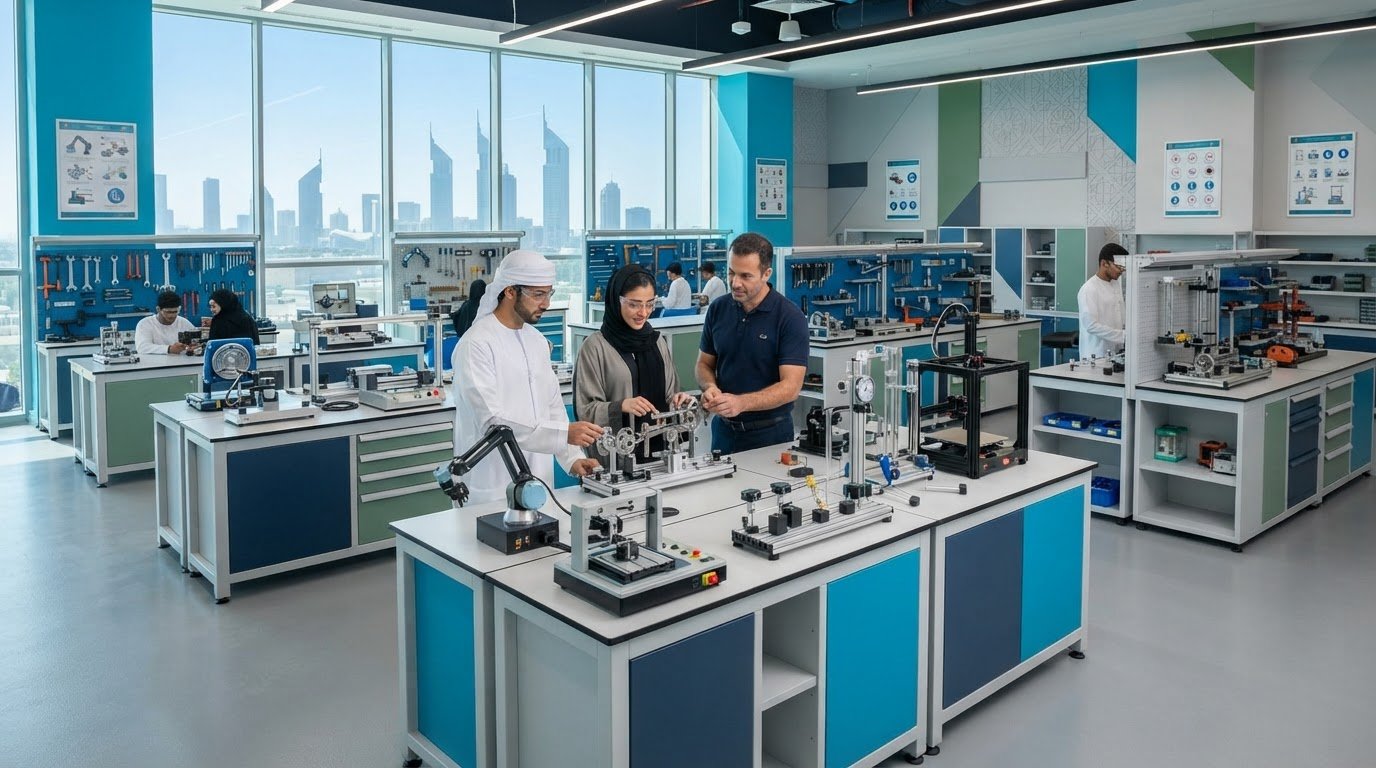
Mechanical Engineering Lab UAE: Strategic Guide
What if the best mechanical engineering lab UAE solution starts with a course outcome, not an equipment list? Institutions often know they need more hands-on learning, yet choosing equipment that fits the curriculum, learner levels, available space, and future plans can be challenging. A collection of capable machines is not enough if the systems do not work together or are difficult to operate and maintain.
A well-planned lab connects classroom learning with practical engineering experience. Start by defining what learners should be able to do, then shape the lab around those outcomes, the facility, and applicable UAE safety and readiness requirements. Ednex designs and implements specialized educational laboratories, helping institutions plan beyond standalone equipment choices.
This guide offers a framework for comparing lab approaches and providers, aligning the scope with course objectives and learner needs, and evaluating integration, facility, safety, training, and implementation considerations. It also explains how to plan for future growth without overbuilding today. The result is a more coherent, scalable lab strategy grounded in learning outcomes.
Key Takeaways
- Begin with course outcomes and learner levels to define what the lab needs to support before selecting equipment.
- Compare equipment categories by learning purpose, space requirements, and how each component will integrate with the wider lab.
- Evaluate providers against a consistent brief covering design capability, equipment integration, installation coordination, and staff familiarization.
- Plan the mechanical engineering lab UAE institutions need by assessing room layout, utilities, equipment movement, learner access, and supervision.
- Use a staged planning process to align scope, provider fit, and implementation readiness while leaving room for future development.
Mechanical Engineering Lab UAE: Define the Institution’s Teaching and Training Goals
A mechanical engineering lab is a learning environment where students apply engineering principles through practical investigation, measurement, design, and testing. Its purpose is not simply to house equipment. It should help learners connect concepts from mechanics, materials, thermal systems, and design with the decisions engineers make in practice. A foundational overview of Mechanical engineering can help stakeholders consider the discipline’s breadth before deciding which areas the lab will serve.
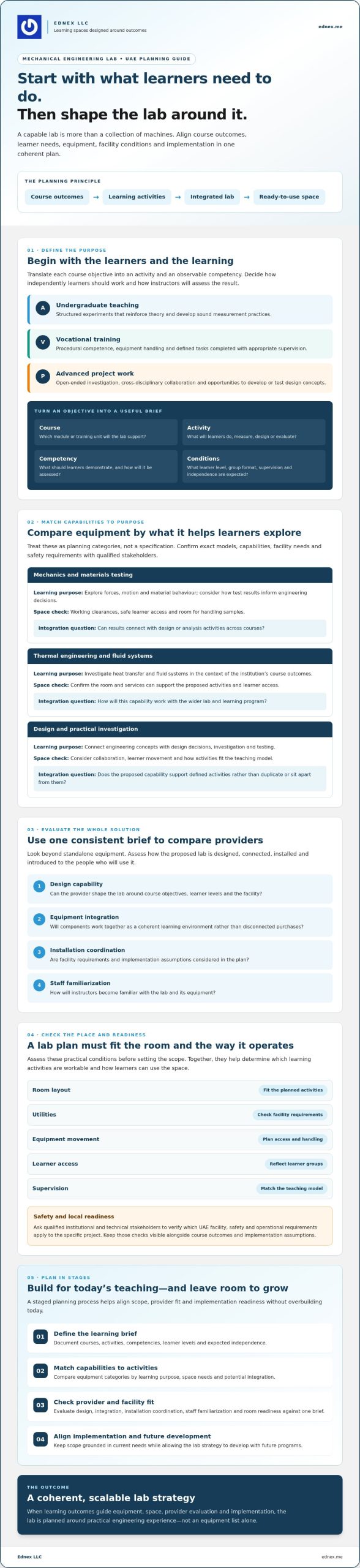
Start by distinguishing the institution’s learner groups. Undergraduate teaching may emphasize structured experiments that reinforce theory and develop sound measurement practices. Vocational training may prioritize procedural competence, equipment handling, and completing defined tasks with appropriate supervision. Advanced project work calls for opportunities to investigate open-ended problems, collaborate across disciplines, and develop or test design concepts. A mechanical engineering lab UAE plan should reflect these differences rather than assume one setup will suit every cohort.
Which learning outcomes should a mechanical engineering lab support?
Translate each course objective into an activity and an observable competency. For example, a materials topic could involve comparing test results and explaining what they indicate. A thermal systems activity could ask learners to record and interpret measurements. Specify the expected level of independence too: will learners follow a guided procedure, select an appropriate method, or plan the investigation themselves?
Include individual experiments, collaborative projects, and assessment needs in the brief. A useful planning sequence is:
- Course: Identify the module or training unit the lab will support.
- Activity: Define what learners will do, measure, design, or evaluate.
- Competency: State what learners should demonstrate and how instructors will assess it.
- Conditions: Record learner level, supervision, group format, and expected independence.
This outcome-first structure gives equipment decisions a clear purpose. It also helps prevent disconnected purchases that serve no defined activity, duplicate existing capability, or remain unused because they do not fit the teaching model.
How does the UAE institutional context shape the brief?
Ground the plan in how the institution actually teaches. Document cohort sizes, timetable patterns, instructor capacity, and planned program development. Then assess the proposed room, utilities, access, equipment movement, and operational capacity before setting the lab scope. These factors help determine which activities are practical and how learners will use the space.
Ask qualified institutional and technical stakeholders to verify which local facility, safety, and operational requirements apply to the specific project. Keep those checks visible in the brief alongside course outcomes and implementation assumptions. With this shared foundation, the institution can evaluate lab options against educational goals and real operating conditions, not an equipment list alone.
Mechanical Engineering Lab Equipment: Compare Categories by Learning Purpose
Equipment selection should translate teaching goals into practical capabilities, not turn the lab into a catalogue of machines. For a mechanical engineering lab UAE institution, compare categories by the activities they enable, the space and services they may require, and how they could connect with other learning areas. The table offers a planning framework, not a specification. Confirm exact models, capabilities, facility needs, and safety requirements with qualified stakeholders before procurement.
| Equipment category | Learning purpose | Space considerations | Integration questions |
|---|---|---|---|
| Mechanics and materials testing | Explore forces, motion, material behaviour, and how test results inform engineering decisions. | Consider working clearances, safe learner access, and room for handling samples. | Can results be used in design or analysis activities across courses? |
| Thermal engineering and fluid systems | Investigate heat transfer, energy, flow, and the interpretation of measured data. | Check equipment footprint, utilities, ventilation, and safe circulation as applicable. | Will learners compare practical observations with theoretical models? |
| CAD and 3D printing | Support design-to-prototype work, from developing a model to reviewing a physical part. | Assess workstations, printer placement, material handling, and shared access. | Can designs move into project work or connect to manufacturing activities? |
| CNC machining | Introduce manufacturing processes and the relationship between design and production. | Confirm machine footprint, utilities, movement routes, supervision, and safety provisions. | Does the facility support the required operation, and have applicable requirements been verified? |
What equipment categories support core mechanical engineering teaching?
Mechanics, materials testing, thermal engineering, and fluid systems can form a foundational teaching scope when they map directly to course activities. Institutions planning a material science lab setup alongside mechanical engineering provision will find that defining learning outcomes and testing workflows first helps clarify which equipment categories each lab should include. CAD and 3D printing may extend that foundation by letting learners develop and review prototypes. CNC machining is a possible category, not an automatic requirement. Assess the curriculum, facility readiness, and safety needs before including it. Local program references, such as top mechanical engineering programs in the UAE, can help inform curriculum comparisons.
When should institutions consider advanced or integrated equipment?
Consider mechatronics or Industry 4.0 integration when it advances defined outcomes, such as connecting mechanical systems with sensing, control, or automated processes. Decide whether shared-use equipment can support several courses or whether a specialist activity requires dedicated access. For broader cross-discipline planning, see the futuristic engineering lab solutions guide.
Ednex designs and implements specialized engineering laboratories, including mechanical engineering and advanced manufacturing labs. Ednex’s engineering lab capabilities can be one input when shaping a connected scope around program needs.
How to Compare Mechanical Engineering Lab Solutions and Providers
A provider comparison is most useful when every candidate responds to the same institutional brief. For a mechanical engineering lab UAE project, compare how each proposed solution supports teaching and implementation, not how many items appear in a product catalogue. A large inventory may offer breadth, but it does not guarantee that equipment fits the curriculum, works as a coherent system, or can be accommodated by the facility.
Assess each proposal against consistent criteria: design capability, integration across equipment categories, installation coordination, and how staff will become familiar with the setup. Ask providers to show how proposed equipment relates to specific experiments, course outcomes, and learner levels. If a proposal lists equipment without explaining its teaching role, request that connection before treating it as a good fit.
What questions should an institution ask prospective providers?
Use focused questions to uncover scope and dependencies before decisions are finalized. Ask about the teaching or training purpose of each proposed category, as well as the facility information and institutional decisions needed to proceed. Clarify what commissioning, documentation, staff training, and after-installation support are included. Request the terms in writing, verify each commitment, and identify who is responsible.
- Educational fit: Which planned activities and learner competencies does each category support?
- Integration: How will components work together, and what interfaces or dependencies should the institution plan for?
- Readiness: What room, utility, access, or operational information is needed before implementation?
- Handover: What commissioning records, operating documentation, and staff familiarization are specified?
Safety and facility claims also need careful review. OSHA’s page on lab safety and implementation standards provides a reference to U.S. laboratory standards; it should not be treated as a statement of UAE requirements. Confirm applicable local requirements with qualified institutional and technical stakeholders.
How can engineering labs complement one another?
Some projects cross disciplinary boundaries, but shared activity does not erase distinct requirements. Compare mechanical needs with electrical engineering lab equipment selection when projects involve electrical interfaces, and use civil engineering lab setup planning to clarify discipline-specific needs. Then identify potential shared spaces or interfaces while preserving each lab’s purpose, equipment needs, and operating considerations.
Ednex designs and implements specialized engineering laboratories, including mechanical engineering labs. Institutions considering an integrated approach can review Ednex’s engineering lab solutions alongside their brief and provider evaluation criteria.
Plan the Mechanical Engineering Lab: Space, Safety, and Implementation
A sound implementation plan connects the approved teaching scope to the realities of the facility and the people who will operate it. For a mechanical engineering lab UAE project, distinguish confirmed requirements from assumptions. Document what the institution has verified, what still needs assessment, and who is qualified to resolve open safety or compliance questions. This keeps design decisions grounded without treating general guidance as a substitute for project-specific review.
What should the facility assessment cover?
Review the proposed equipment against the room and its infrastructure before finalizing layouts. Check room dimensions, access routes, utilities, existing infrastructure, and the practical route for moving equipment into position. Then work with instructors, facilities teams, and other institutional stakeholders to plan work zones, storage, learner circulation, and supervision sightlines. Verify equipment-specific installation and safety requirements with qualified providers and relevant institutional specialists.
Look beyond whether equipment physically fits. The layout should support the intended teaching activity, allow learners to access work areas appropriately, and give instructors a workable view of practical sessions. Record unresolved facility questions clearly so they become assigned actions rather than hidden assumptions.
Which implementation steps reduce avoidable disruption?
Use a staged sequence, with a named owner for each decision and dependency:
- 1. Confirm the brief: Agree on learning scope, proposed equipment categories, and the institution’s priorities.
- 2. Assess site readiness: Verify dimensions, access, utilities, infrastructure, and any work needed before delivery.
- 3. Assign responsibilities: Clarify institutional and provider roles, decision points, and dependencies.
- 4. Coordinate installation: Align delivery and installation activities with site access and readiness.
- 5. Commission and document: Confirm the agreed handover process, records, and operating information.
- 6. Prepare staff and review: Plan staff familiarization and operating procedures, then review whether the setup supports intended teaching activities.
Keep installation, commissioning, documentation, and staff familiarization as distinct workstreams. A completed installation alone does not establish that staff understand operating procedures or that the lab is ready for its planned learning activities. Confirm what each handover stage includes, who is responsible, and how any outstanding actions will be addressed.
Once institutional requirements are defined, review Ednex’s engineering lab solutions for design and implementation of specialized educational laboratories.
Build a Future-Ready Mechanical Engineering Lab with an Integrated Partner
A future-ready lab is not defined by how much equipment it contains. It is defined by how well the learning outcomes, equipment categories, provider capabilities, and implementation plan work together. For a mechanical engineering lab UAE project, use that framework to check whether each proposed element has a clear educational purpose, fits institutional and facility constraints, and can be integrated into the institution’s teaching model.
Integration can also support carefully defined connections with advanced manufacturing or mechatronics. For example, an institution may explore how a mechanical engineering activity relates to a manufacturing process or a mechatronics project, while preserving the distinct learning objectives and requirements of each area. Include these connections only when they support program goals and the facility can accommodate them.
What information should an institution prepare before discussing a lab?
A concise discovery brief helps institutions and potential partners discuss the same priorities. Bring the information below, noting open questions rather than presenting assumptions as confirmed requirements.
- Program objectives: Identify courses, intended competencies, learner profiles, and planned experiments or projects.
- Teaching model: Describe how practical work will be delivered, including group activities, individual tasks, and assessment needs.
- Facility and current assets: Document available space, known infrastructure constraints, and existing equipment that may be relevant.
- Decision-making: Identify institutional stakeholders involved in planning, technical review, and approval.
- Readiness priorities: Record integration goals, staff familiarization needs, future expansion considerations, and expectations for operational handover.
This brief gives the institution a consistent basis for evaluating proposed scope. It also helps distinguish essential capabilities from optional additions, keeping planning focused on current needs while making future development visible.
How can Ednex support a coordinated lab project?
Ednex designs, installs, and equips specialized educational laboratories for higher education and vocational training institutions in the UAE. Its engineering lab scope includes mechanical engineering, advanced manufacturing, and mechatronics. These capabilities are relevant for institutions planning how these areas relate to their courses and facilities. They do not mean that every discipline should be combined or guarantee a particular outcome.
Use the discovery conversation to clarify proposed scope, facility inputs, responsibilities, and implementation details that need confirmation, including commissioning, staff familiarization, and handover. A well-prepared brief turns a general equipment request into a structured planning exercise.
Prepare your objectives, facility notes, and integration priorities, then discuss your mechanical engineering lab requirements with Ednex.
Turn Your Lab Vision into a Practical Plan
A strong mechanical engineering lab UAE strategy starts with learning outcomes, then selects equipment categories that serve those outcomes and fit the institution’s learners, facility, and plans. Comparing providers against the same brief helps reveal whether a proposal offers a connected learning environment or simply a collection of equipment.
Implementation matters as much as selection. Confirm facility readiness, responsibilities, safety considerations, commissioning, documentation, and staff familiarization before moving ahead. These decisions help institutions build a lab that supports practical learning while leaving a considered path for future development.
Ednex provides design and implementation for specialized educational laboratories for higher education and vocational training institutions. To discuss how a lab scope could align with your courses and facility, discuss your mechanical engineering lab requirements with Ednex.
Start with clear outcomes, plan for integration, and contact Ednex to discuss a lab scope built around your learners’ needs.
Frequently Asked Questions
What is included in a mechanical engineering lab?
A mechanical engineering lab is defined by its teaching and training objectives, not by a fixed equipment list. Depending on the program, it may support practical work in mechanics, materials, thermal or fluid systems, design, and manufacturing. Before finalizing a scope, map each equipment category to planned experiments, learner levels, facility capacity, and supervision needs. This outcome-led approach helps institutions select relevant capabilities instead of purchasing equipment without a clear educational purpose.
How do we choose equipment for a mechanical engineering lab?
Start with course outcomes, learner profiles, and the practical activities students must complete. Then compare equipment categories for educational relevance, space and utility needs, integration, supervision, and staff readiness. Ask providers to explain how each proposed item supports a specific learning activity. Before approval, have qualified technical stakeholders verify equipment capabilities, installation requirements, and safety considerations for the institution’s facility and operating context.
Can a mechanical engineering lab support mechatronics and advanced manufacturing courses?
Yes, a mechanical engineering lab can support related learning when the curriculum, facility, and equipment scope are coordinated deliberately. Shared projects may connect mechanical principles with mechatronics or manufacturing, but each discipline retains distinct learning and operational requirements. Define the intended outcomes first, then confirm compatibility, space, infrastructure, and supervision needs with institutional stakeholders and the proposed implementation partner. Integration should strengthen the program, not blur its purpose.
How much space does a mechanical engineering lab need?
There is no single space requirement that suits every institution. The area depends on proposed equipment, room layout, learner numbers, access routes, utilities, storage, and supervision needs. Assess the actual facility against a defined equipment scope before committing to a layout or purchase. Have qualified professionals verify equipment-specific installation and safety requirements, including whether existing infrastructure and routes can accommodate the planned setup.
What should UAE institutions check before setting up a mechanical engineering lab?
For a mechanical engineering lab UAE institutions should clarify program goals, learner levels, planned experiments, facility readiness, equipment integration, staffing, and implementation responsibilities. They should also confirm applicable safety, facility, and procurement requirements with qualified institutional and technical stakeholders. Avoid relying on generic assumptions: what applies can depend on the equipment, facility, and institution’s operating context. Record open questions and assign them for review before approving the proposed scope.
Should we choose a complete lab solution or buy equipment separately?
The right approach depends on institutional capacity, existing assets, integration needs, and how clearly the scope is defined. Separate purchases may suit a carefully planned project that fills specific gaps. Coordinated design and implementation may help align equipment with facility conditions and learning outcomes. Compare both approaches using the same brief, responsibilities, support expectations, and verified scope. Consider not only acquisition, but also installation coordination and staff readiness.
How can we assess a mechanical engineering lab provider?
Ask each provider to connect its proposed scope to your courses, experiments, learner levels, facility conditions, and implementation plan. Clarify design and installation responsibilities, commissioning, documentation, staff familiarization, and any after-installation support, then verify each commitment in writing. Request evidence for specific capabilities and confirm relevant requirements with institutional technical and safety stakeholders before approval. A clear, consistent brief makes provider comparisons more meaningful than product lists alone. Institutions planning adjacent provision may also find it useful to review guidance on material science lab setup to understand how outcome-led planning applies across related engineering disciplines.
Related Posts ...



Comments are disabled