



Material Science Lab Setup: A Strategic Guide
A lab can be well equipped and still be poorly designed. The right material science lab setup starts with learning outcomes and testing workflows, not a catalogue of instruments. What should your lab include, and how can you choose a setup that fits your courses, research priorities, learner level, and facility?
Equipment choices affect more than testing capability. They shape sample flow, space and utility needs, safety planning, staff training, maintenance, and how effectively learners connect material properties to practical tests. A clear scope gives your team a consistent basis for comparing options and identifying unknowns before implementation.
This guide explains how to define your lab around curriculum and intended tests, compare equipment categories against institution-specific criteria, and plan for facility, safety, training, and operational needs in the UAE. You’ll also see how to move from initial requirements to a coordinated design and implementation plan. Ednex designs and implements educational laboratories, including material science and wider engineering labs. Start by defining your priorities, then select the capabilities that support them.
Key Takeaways
- Use course level, disciplines, class size, and research ambitions to define what the lab needs to enable.
- Organize equipment decisions around the questions students will investigate, from material observation to mechanical, thermal, and structural testing.
- Compare focused, broader, and phased material science lab setup options against your institution’s curriculum, capacity, expertise, and flexibility needs.
- Map readiness from requirements review through commissioning, including room layout, utilities, ventilation, storage, and sample movement.
- Prepare a clear procurement brief and assess potential partners for design coordination, equipment fit, implementation, training, and support scope.
Material Science Lab Setup Starts with Learning Outcomes and Testing Workflows
A material science lab gives students a place to investigate how a material’s structure relates to its properties and performance. Its scope can range from introductory observation and practical testing to advanced characterization or research, depending on the institution’s goals. The field is interdisciplinary: Materials science draws on areas such as physics, chemistry, and engineering. A useful lab plan turns that breadth into specific activities learners can perform.
A lab’s capabilities are the investigations it enables; its inventory is the equipment it contains. Start by defining what learners should be able to observe, test, compare, and explain. Then map the workflows needed to meet those outcomes before drafting an equipment list. This helps distinguish equipment that directly supports a course from items that are interesting but not essential to its activities.
Which learning outcomes should the lab support?
Identify the intended learners, course modules, practical competencies, and assessment methods. An introductory class might focus on identifying material types and relating observable properties to applications. Advanced courses may require learners to interpret test results, compare material behaviour, or undertake research activities. Each objective affects the depth of instruction, supervision, and practical work the lab needs to support.
Bring faculty from relevant disciplines into the planning discussion. Course level, class size, and research ambitions affect how activities are sequenced and how many learners need access to each capability. Ask faculty to rank capabilities as:
- Essential: directly supports required learning outcomes and assessments.
- Desirable: broadens instruction or enables additional investigations.
- Future-phase: may support later courses or research priorities.
This ranking gives the institution a shared basis for comparing options. It also helps prevent every possible capability from becoming an immediate procurement requirement.
Which materials and workflows belong in scope?
List the materials learners are expected to study. Metals, polymers, ceramics, and composites are examples for planning, not a universal specification. Confirm the relevant material categories against institutional courses and intended investigations, including sample preparation and handling needs.
Next, map each sample’s route through the lab. A workflow might move from preparation to testing, observation, and interpretation. For each step, record who performs it, what information they need, and how the results connect to an assessment or research question. This can reveal practical needs that an equipment list alone misses, such as where samples are prepared, how they move between work areas, and when learners can discuss findings.
Once outcomes and workflows are defined, the institution can shape a material science lab setup around its teaching priorities and users. The next step is to match those requirements to the capabilities the lab should provide.
Match Material Science Lab Equipment to the Tests Students Will Perform
When workflows are clear, translate each investigation into a capability. Start with the question students need to answer: What can they observe? How does a sample respond to force or temperature? What can they infer about its structure? This method-led approach keeps a material science lab setup focused on teaching and research needs instead of turning procurement into an unprioritized equipment list.
How do testing methods translate into lab capabilities?
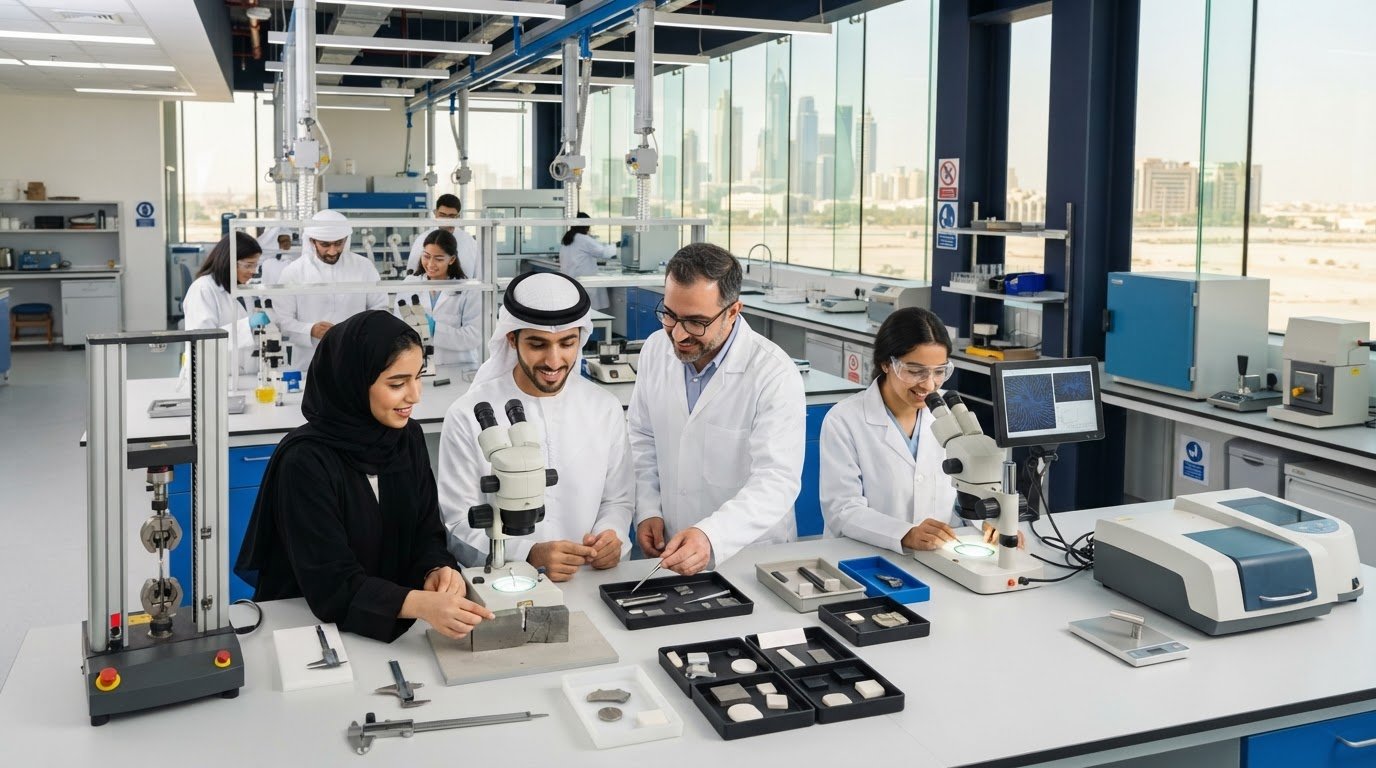
Observation, mechanical testing, thermal analysis, and structural characterization are distinct capability areas. A microscope can support examination of surface features, while a universal testing machine can demonstrate how a sample responds to applied force. Differential scanning calorimetry is one example of a method for studying thermal transitions. To see how benchtop and scanning electron imaging methods are applied in material analysis, discover Electron Optics Instruments, LLC. These examples are illustrative, not confirmed Ednex products or a universal lab specification. Verify method suitability, instrument specifications, utilities, and availability against institutional requirements.
| Teaching activity | Sample type | Capability to assess | Space needs to review | Verification questions |
|---|---|---|---|---|
| Examine surface features | Prepared metal, polymer, ceramic, or composite samples | Optical observation or microscopy; consider advanced imaging where learning goals justify it | Bench area, sample preparation, environmental requirements | What level of detail do learners need to observe? What preparation and training are required? |
| Compare response to force | Samples suited to the planned mechanical test | Mechanical testing, such as tension or compression | Floor or bench footprint, sample access, clearance for safe operation | What measurement range and sample dimensions fit the course? |
| Investigate material response to heat | Samples selected for thermal study | Thermal analysis, with differential scanning calorimetry as one example | Instrument location, utilities, ventilation, and sample handling | Which thermal properties are relevant, and what operating conditions must be supported? |
| Relate structure to properties | Samples requiring more detailed characterization | Structural characterization, potentially using advanced imaging methods | Space, environmental control, utilities, and specialist workflow needs | Is this capability essential now, or better suited to a future phase? |
How should institutions compare equipment options?
Compare options against measurement range, repeatability, sample compatibility, operating complexity, and intended learner level. Then review the full operating picture: software and data handling, consumables, service support, and staff training. Check the room layout and utilities against equipment requirements. Lab Manager’s guidance on MEP design strategies can help frame facility questions alongside instrument selection.
If a course or research activity calls for standardized methods, use relevant ASTM International or ISO standards as evaluation references, and confirm that each applies to the intended material and test. Institutions planning a coordinated educational lab can also review Ednex material science lab solutions, then verify specific equipment and configuration requirements through a requirements discussion.
Compare Material Science Lab Setup Options Before Selecting a Configuration
With capabilities defined, compare configurations against the institution’s operating model. A focused teaching lab, a broader instructional lab, and a phased capability plan can each be appropriate, but they serve different priorities. Evaluate curriculum fit, learner capacity, staff expertise, available space, and flexibility together. The strongest material science lab setup is not necessarily the broadest; it is the one your institution can use effectively and sustain.
When does a focused teaching configuration make sense?
A focused configuration suits institutions with defined courses and repeatable practical activities. It concentrates on capabilities learners need to meet course outcomes, which can simplify scheduling, supervision, and everyday use. The trade-off may be less scope for advanced characterization or cross-disciplinary projects. Before finalizing the configuration, check class timetables, supervision arrangements, and how many samples need to move through each activity during a teaching session.
When should institutions plan a phased or broader setup?
A broader instructional lab can support more varied learning activities, while a phased plan can sequence capability development around priorities, space, or staffing. Neither guarantees that future equipment will integrate with the initial configuration. Confirm compatibility, facility requirements, and availability before assuming expansion will be straightforward. For related planning considerations, explore this futuristic engineering lab solutions guide and consider how testing needs may connect with mechanical engineering lab planning.
Use a comparison matrix to separate confirmed requirements from assumptions before procurement discussions:
- Curriculum fit: Which courses and assessments does the configuration support?
- User capacity: Can planned activities fit class schedules and sample throughput?
- Staff expertise: What supervision, training, and operational knowledge will each capability require?
- Space and flexibility: Does the available facility support the configuration, and what changes would expansion require?
Mark each item as confirmed, pending verification, or an assumption. This helps prevent decisions from relying on untested expectations, including assumptions about lifecycle costs or future procurement. Assess safety and training for the planned activities as well. The University of Oregon’s materials science lab page offers an example of one-on-one safety training; use it as a planning reference, not as a substitute for applicable UAE institutional procedures.
Choose a configuration that meets verified needs while leaving a deliberate path for growth. Review each proposed phase against curriculum priorities, staffing, and facility readiness before committing to it.
Plan the Facility, Safety, Staffing, and Operations Before Procurement
A capable lab depends on more than its instruments. The room, utilities, safety procedures, staffing, and daily workflows must work together. Before procurement, assign owners to these workstreams and verify applicable institutional and UAE requirements with qualified facility and safety professionals. Requirements can vary by institution and activity, so have the design and procedures reviewed rather than assuming they are compliant.
What should a material science lab site assessment cover?
Document room dimensions, entrances, delivery routes, work zones, power, ventilation, storage, utilities, and any environmental controls relevant to planned activities. Consider how learners, staff, samples, and waste move through the room. Check equipment-specific specifications with manufacturers, then review their implications with qualified facility and safety professionals. Where facilities overlap, coordinate the review with relevant civil engineering lab setup considerations.
Use a staged readiness sequence to connect planning with implementation:
- Confirm requirements: Document intended activities, users, sample workflows, and institutional priorities.
- Assess the site: Record room conditions, access, utilities, ventilation, storage, and delivery constraints.
- Review risk and operations: Plan risk assessment, supervision, user training, sample handling, waste management, and incident escalation.
- Verify specifications: Confirm equipment requirements with manufacturers and facility or safety specialists before procurement.
- Commission and hand over: Check installation and agreed functions, complete relevant user training, and transfer procedures, maintenance responsibilities, and operational records to assigned staff.
How can the institution prepare for reliable daily operation?
Assign clear ownership for training, supervision, maintenance, calibration, and inventory management. Document who may access equipment, how samples are received and handled, how incidents are escalated, and who reviews maintenance needs. Plan waste handling around the materials and activities in scope. These operational decisions should inform the layout and procurement brief, not be left as last-minute additions.
Readiness checklist: Before procurement, confirm requirements, room and utility information, risk-review ownership, and equipment specifications. At commissioning, verify installation against agreed requirements, complete planned training, and hand over documented procedures and operational responsibilities. This separates decisions needed before ordering from tasks to complete before routine use.
Ednex provides specialized educational laboratory design and implementation, including material science labs. Discuss your lab requirements with Ednex as part of a coordinated planning process.
Move from Requirements to a Material Science Lab Setup Partner
A clear project brief turns planning decisions into a scope that institutions and potential partners can assess. For a material science lab setup, capture learning and research outcomes, intended methods, user groups, facility conditions, and priorities. Separate confirmed requirements from open questions so assumptions do not become specifications by default.
What should institutions include in a lab project brief?
Make the brief practical and specific. Identify the learners and courses the lab will serve, the sample workflows it must support, and the capabilities needed for planned activities. Note user groups and how teaching or research use may be scheduled. Include available site information, utility constraints, safety review needs, staffing considerations, and procurement milestones.
Flag decisions that still need faculty, facility, or safety input. For example, note whether a capability is essential for current teaching or only a possible future requirement. This helps potential partners respond to institutional priorities without mistaking an unresolved question for a fixed technical specification.
How can a partner support coordinated delivery?
Look beyond the equipment list. Ask how responsibilities are defined for design coordination, equipment selection, site coordination, implementation, training, and handover. Clarify what is included in the proposed scope, what the institution must provide, and which support arrangements are available. Confirm equipment specifications, configuration, and integration claims directly before relying on them in a project plan.
Ednex designs and implements specialized educational laboratories for schools, higher education, and vocational training, and its portfolio includes Material Science Lab Setup alongside broader engineering lab solutions. Institutions can discuss their requirements and planning needs with Ednex. Confirm specific equipment and delivery details against the agreed project scope.
A useful discussion can start with a concise brief and a list of priorities, constraints, and unresolved questions. Not every decision needs to be final. The aim is to clarify what the lab must enable, what the facility can support, and which next steps need validation.
Discuss your material science lab requirements with Ednex and use the conversation to define a practical project scope for your institution.
Turn Your Lab Vision into a Practical Plan
A strong material science lab setup starts with purpose, not a catalogue. Define learning outcomes and sample workflows first, then select capabilities that support the tests learners will perform. Compare configurations against curriculum needs, user capacity, staff expertise, facility readiness, and room to grow. Before procurement, confirm site requirements, safety reviews, training responsibilities, and operational ownership with the appropriate institutional and facility specialists.
With these decisions documented, your team can approach partner discussions with a clearer scope and fewer assumptions. Ednex designs and implements specialized educational laboratories, and Material Science Lab Setup is among its offerings. Its work serves K-12, higher education, and vocational training institutions. Confirm specific equipment and project requirements through discussion.
Ready to explore how your priorities can shape a coordinated lab plan? Discuss your material science lab requirements with Ednex. Start by sharing your institution’s goals, constraints, and open questions.
Frequently Asked Questions
What equipment is needed for a material science lab?
Equipment depends on the materials, tests, and learning outcomes the lab must support. A teaching scope might include tools for sample preparation, visual observation, mechanical testing, or thermal analysis. Advanced characterization may require different capabilities and facility conditions. Treat instruments such as microscopes or testing machines as examples, not a standard checklist. Confirm specifications, utilities, training, and availability against institutional requirements before procurement.
How do you plan a material science laboratory?
Plan a material science lab setup by defining intended learners, courses, practical competencies, sample workflows, and assessment methods before selecting equipment. Identify the materials and tests in scope, then document users, room conditions, utilities, safety review needs, staffing, and priorities. Separate confirmed requirements from open questions. This gives the institution a useful basis for comparing configurations and discussing project scope with potential partners.
What tests can students perform in a material science lab?
Students can investigate material properties by observing surface features, comparing samples’ responses to applied force, or studying how materials respond to temperature. Appropriate tests depend on course level, sample types, available capabilities, and supervision. Introductory classes may focus on guided observation and interpreting results, while advanced courses may explore more detailed characterization. Confirm that each method suits the learning objectives and facility.
What is the difference between a teaching lab and a research lab for materials science?
A teaching lab is generally scoped around course outcomes, practical instruction, learner access, and repeatable activities. A research lab is planned around specific investigations, methods, sample requirements, and research workflows. Some institutions may need capabilities for both purposes, but should carefully assess user access, staff expertise, scheduling, and facility requirements. The distinction is about intended use and capability needs, not simply the number of instruments.
How much space does a material science lab need?
There is no single footprint that suits every material science lab. Space needs depend on selected capabilities, equipment dimensions, work zones, sample preparation and movement, storage, learner capacity, and installation or delivery access. Gather room measurements and equipment-specific requirements before confirming a layout. Ask qualified facility professionals to review utilities, ventilation, access, and any environmental conditions needed for planned activities.
What safety considerations should a material science lab include?
Safety planning should reflect the materials, sample preparation, equipment, and activities planned for the lab. Consider risk assessment, appropriate supervision, user training, access procedures, storage, ventilation, personal protective equipment, waste handling, and incident escalation. Assign responsibility for reviewing and maintaining procedures. Institutions should verify applicable safety and facility requirements in the UAE with qualified specialists rather than assuming a general checklist establishes compliance.
How should an institution compare material science lab suppliers?
Compare suppliers against a written brief covering learning outcomes, methods, user groups, site conditions, and priorities. Ask how each proposed scope addresses equipment fit, design coordination, implementation, training, handover, and support, and clarify which responsibilities belong to the institution. Verify specifications and service claims directly before treating them as commitments. Ednex designs and implements educational laboratories, including Material Science Lab Setup. Discuss project requirements to confirm the relevant scope.
Related Posts ...
Comments are disabled