

Setting Up a School STEAM Lab: 2026 Guide for Leaders
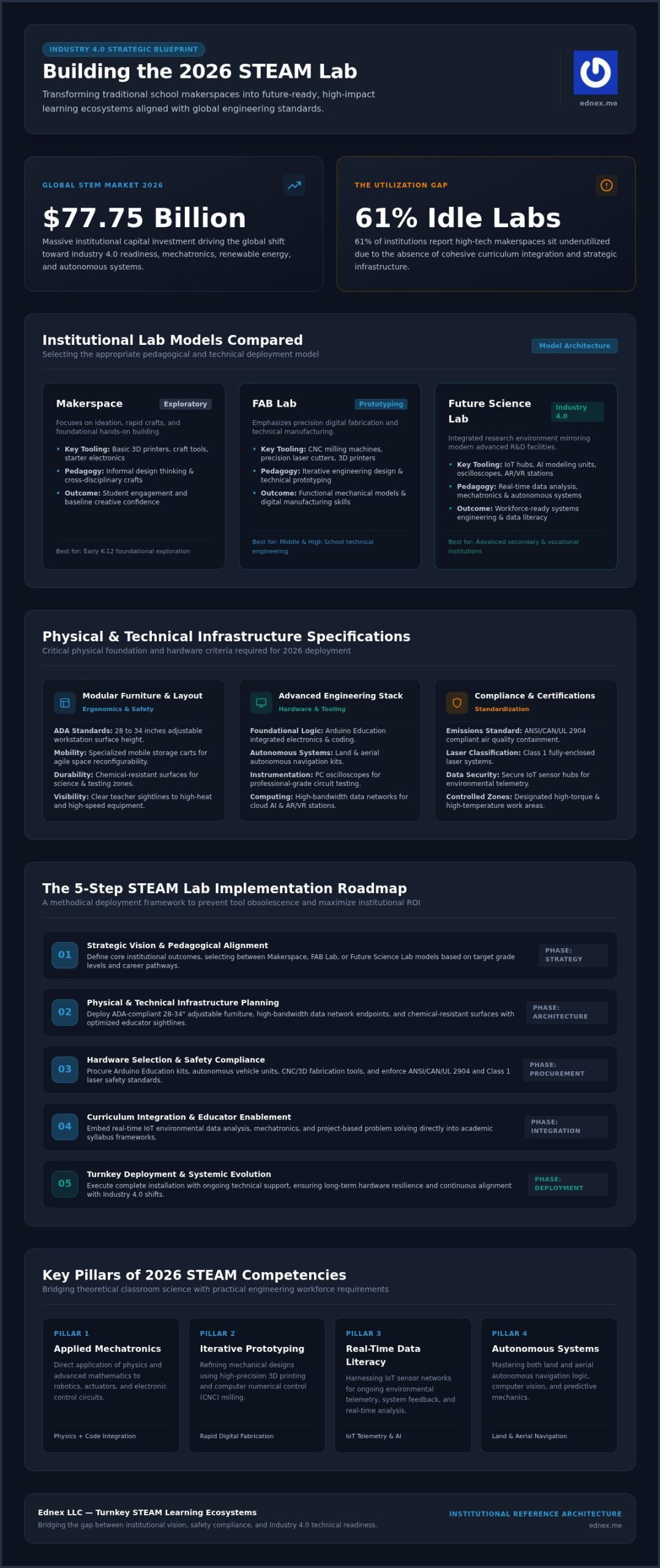
By 2026, the global STEM education market will exceed $77 billion, yet 61% of institutions report that their high-tech makerspaces sit idle because they lack a cohesive integration strategy. You likely recognize that simply filling a room with 3D printers and robotics kits doesn’t guarantee innovation. It’s a valid concern to fear investing in sophisticated hardware that becomes obsolete or fails to align with curriculum needs. You need more than a vendor; you need a strategic roadmap. This guide reveals how to set up a STEAM lab in school that functions as a future-ready ecosystem, bridging the gap between K-12 learning and the rigorous standards of Industry 4.0.
We’ll explore the technical infrastructure, safety certifications like ANSI/CAN/UL 2904, and the pedagogical frameworks required to transform your physical space into a hub of systemic transformation. From IoT-enabled data hubs to Class 1 laser systems, discover how to build a laboratory that fosters the elite engineering skills the future demands. We’re moving beyond isolated toolkits toward a methodical journey of informed confidence and institutional progress. This is about building a bridge between current capabilities and the vast potential of the coming decade.
Key Takeaways
- Understand the evolution of the 2026 STEAM lab from a traditional workshop into a sophisticated ecosystem driven by AI, IoT, and advanced manufacturing.
- Identify essential technical infrastructure requirements, from modular furniture layouts to high-bandwidth data networks, that support specialized robotics and AR/VR workstations.
- Evaluate the distinct pedagogical goals of Makerspaces, FAB Labs, and Future Science Labs to select the model that best serves your student population.
- Follow a comprehensive, five-step implementation roadmap on how to set up a STEAM lab in school that prioritizes safety compliance and long-term curriculum integration.
- Explore the advantages of a strategic, turnkey partnership that bridges the gap between ambitious institutional vision and successful technical deployment.
Defining the Vision: What is a 2026 STEAM Lab?
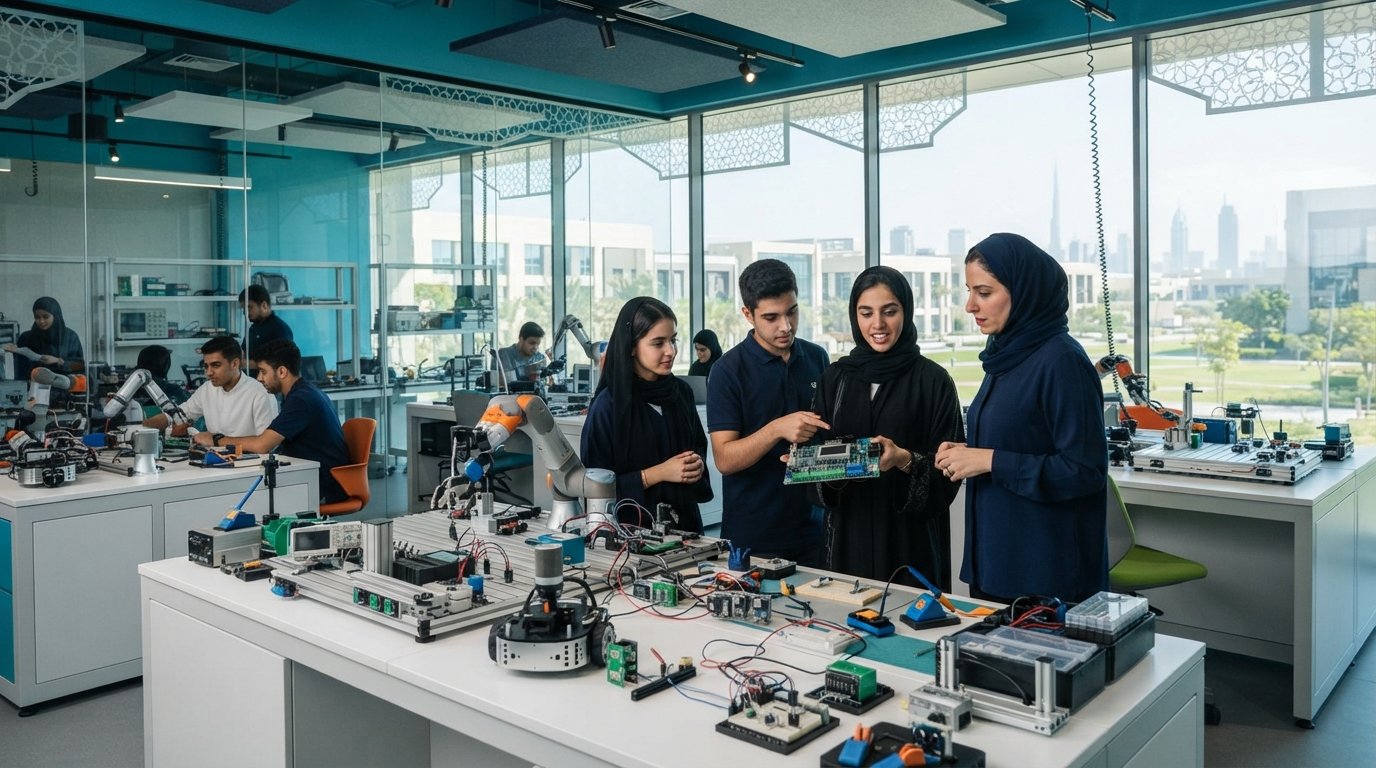
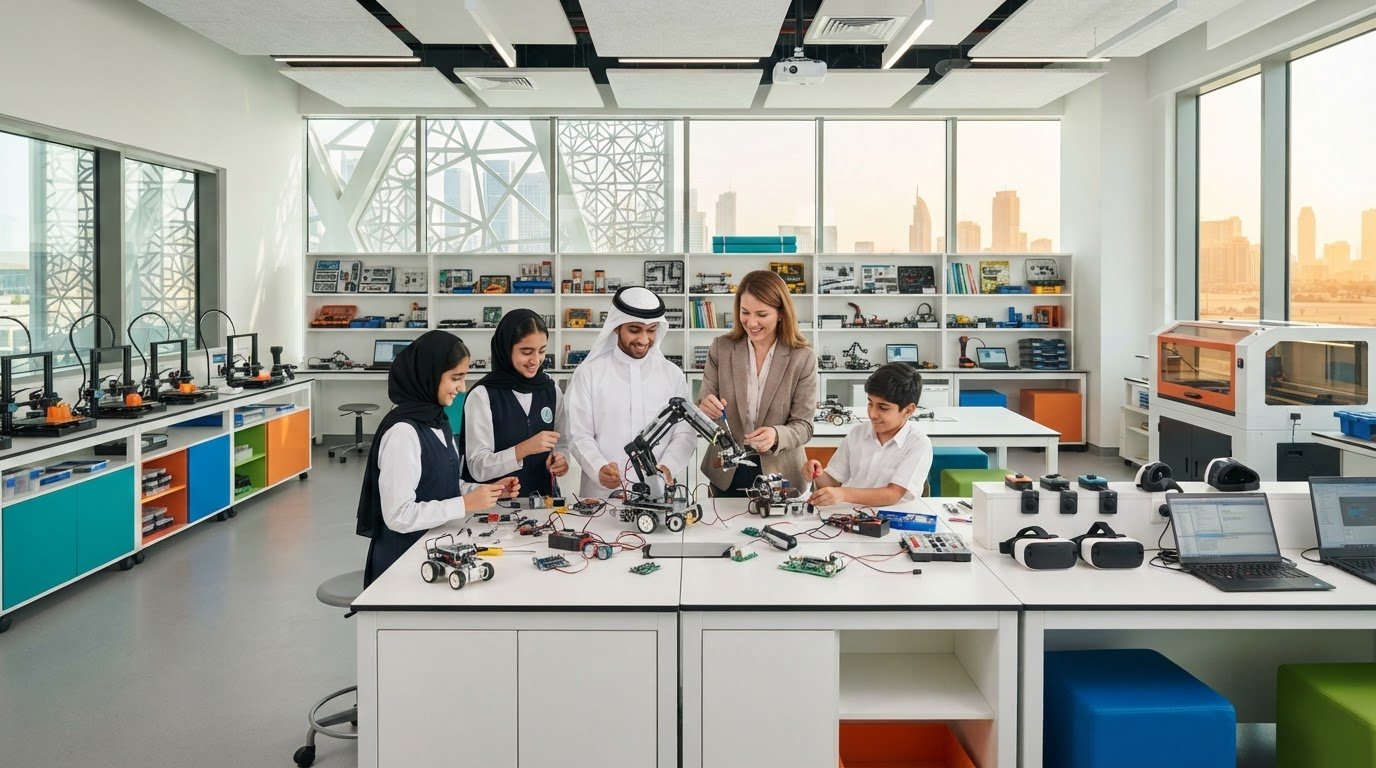
A 2026 STEAM lab isn’t just a classroom; it’s a multidisciplinary hub where Science, Technology, Engineering, Arts, and Mathematics converge into a unified strategic asset. The days of simple woodshops and basic craft tables are over. Today’s labs are high-tech environments where AI and IoT aren’t just buzzwords; they’re active tools for discovery. Leaders asking how to set up a STEAM lab in school must look beyond the hardware. They must envision a space that mirrors the technical workforce students will enter upon graduation. This shift toward a Future Science Lab model ensures your institution remains relevant in an era of rapid technological acceleration.
The Core Purpose of Institutional STEAM Centers
These centers foster critical thinking through advanced project-based learning. It’s about bridging the gap between theoretical science and practical engineering, ensuring students don’t just memorize formulas but apply them to real-world challenges. A well-designed lab provides a collaborative environment for cross-disciplinary innovation. It transforms passive learners into active problem solvers who understand the systemic nature of modern innovation. Key objectives include:
- Practical Integration: Applying physics and math to robotics and mechatronics.
- Iterative Design: Using 3D printing and CNC milling to refine prototypes.
- Data Literacy: Utilizing IoT sensors for real-time environmental analysis.
Aligning with Global Educational Benchmarks
By 2026, the global STEM education market is projected to reach $77.75 billion, a figure that underscores the massive institutional shift toward high-level technical readiness. This growth isn’t just about spending; it’s about meeting international standards for technical and vocational training. When evaluating how to set up a STEAM lab in school for 2026, the focus must remain on Industry 4.0 readiness. This means preparing students for higher education paths in Mechatronics, Renewable Energy, and Autonomous Systems.
Digital literacy and familiarity with autonomous systems have become the new baseline for student success. Institutions that adopt these standards aren’t just teaching skills; they’re building a foundation for future leaders. Strategic alignment with global benchmarks ensures that your graduates are ready for the complexities of the modern workforce, from smart manufacturing to sustainable engineering solutions.
Physical and Technical Infrastructure Requirements
Infrastructure is the silent driver of institutional innovation. Leaders planning how to set up a STEAM lab in school often overlook the critical synergy between physical casework and digital endpoints. It’s not just about desks; it’s about a resilient foundation that accommodates high-torque robotics, cloud-intensive AI modeling, and immersive simulation. A truly future-ready lab functions as a unified ecosystem where the furniture is as technologically integrated as the hardware it supports.
Ergonomic and Modular Lab Furniture
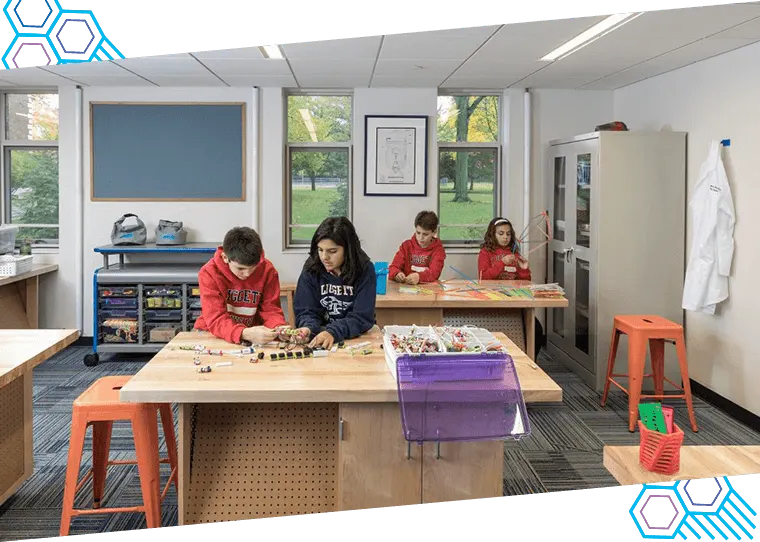
Flexibility defines the modern lab. Stationary rows hinder the agile nature of design thinking and cross-disciplinary projects. Instead, opt for adjustable workstations that meet ADA standards, providing a surface height of 28 to 34 inches to ensure inclusivity. Mobile storage carts allow specialized tools to move wherever students need them. In science-focused zones, chemical-resistant surfaces are mandatory for long-term durability. High visibility is equally crucial; teachers must maintain clear sightlines to all students, particularly when they’re operating high-heat or high-speed equipment. This layout encourages collaboration while maintaining a controlled, safe environment for experimentation.
Advanced Technology and Engineering Kits
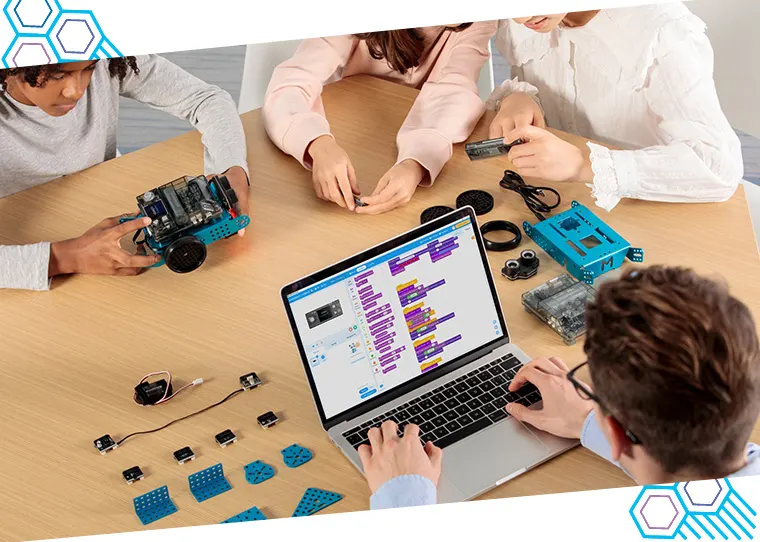
High-tier hardware requires a deliberate, curriculum-aligned selection process. Integrating Arduino Education provides the foundational electronics and coding logic necessary for complex systemic thinking. From this base, students can transition to autonomous vehicle kits, exploring the nuances of both land and aerial navigation. For electrical engineering zones, PC oscilloscopes and precision instrumentation turn a simple workbench into a professional-grade testing environment. These tools allow students to move beyond “toy” robotics and into the realm of authentic mechatronics and Industry 4.0 prototyping.
Technical requirements for these kits are demanding. High-bandwidth endpoints for AR/VR zones and wireless robotics telemetry require enterprise-grade Wi-Fi 7 or Wi-Fi 6E (IEEE 802.11be) to handle multi-gigabit throughput with low latency. Electrical infrastructure must be equally robust; use ceiling-mounted retractable cord reels adhering to NEC 406.12 standards to keep floors clear of trip hazards while providing 20A circuits where needed.
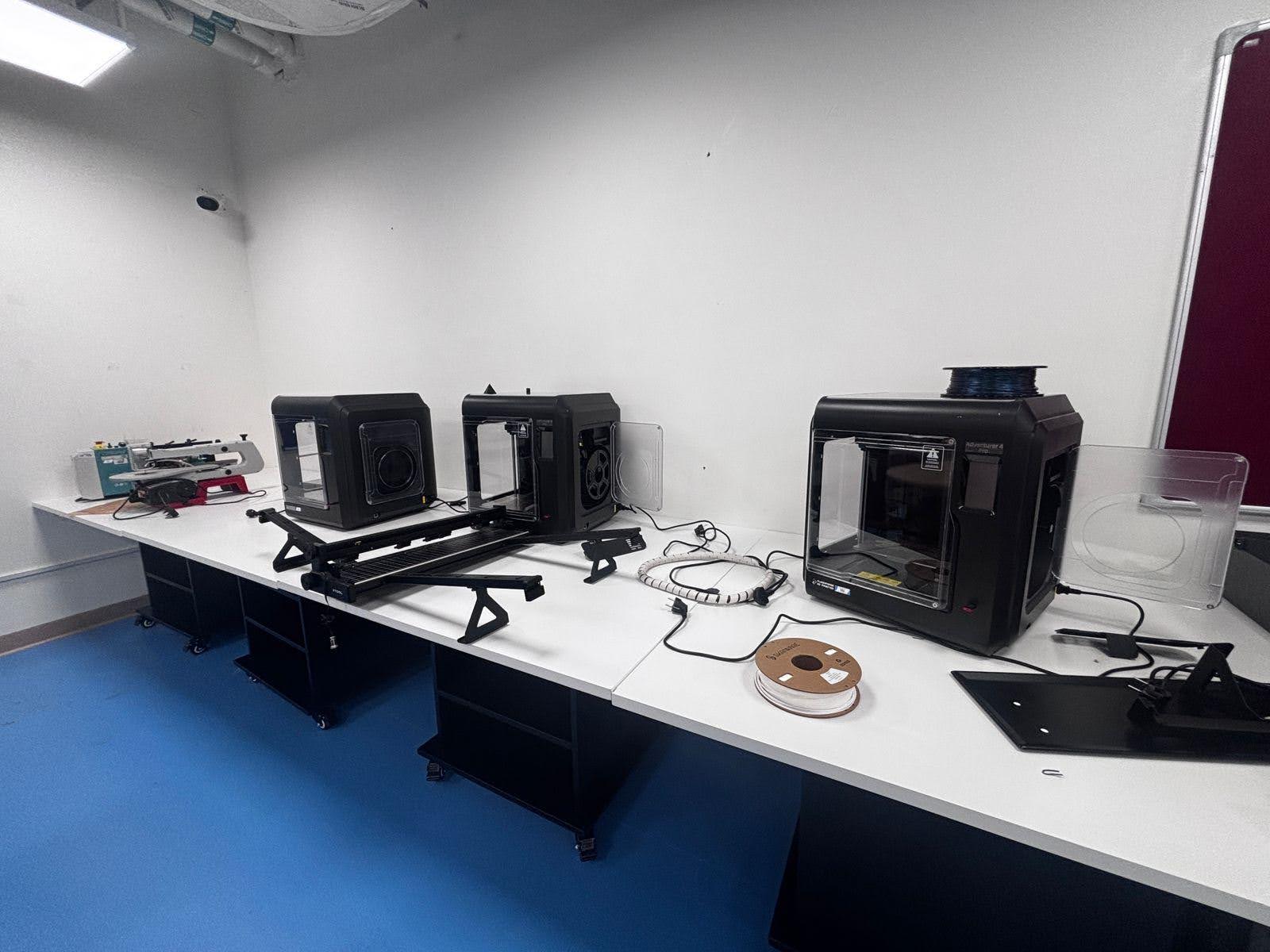
Safety remains the ultimate priority. Freestanding 3D printers must meet ANSI/CAN/UL 2904 standards to certify low particle and VOC emissions. For laser cutters, institutional leaders must insist on Class 1 Laser Systems equipped with safety interlocks. Ventilation systems must comply with ASHRAE 62.1, providing dedicated mechanical exhaust to ensure indoor air quality remains pristine. Integrating these complex systems requires a strategic ally. You may consider exploring turnkey engineering lab solutions to ensure every safety code and technical benchmark is met with precision. This holistic approach ensures your investment remains relevant as 2026 standards continue to evolve.
Choosing Your Lab Model: Makerspace vs. FAB Lab vs. Future Science Lab
Selecting the right model isn’t merely a matter of terminology; it’s a strategic decision that aligns your physical environment with your pedagogical intent. Many leaders researching how to set up a STEAM lab in school find themselves at a crossroads between creative exploration and technical rigor. The choice you make will dictate your equipment stack, safety protocols, and the level of Industry 4.0 readiness your students achieve. Understanding the nuances between these environments is essential for building a space that scales with your institution’s vision.
Makerspaces and FAB Labs for K-12
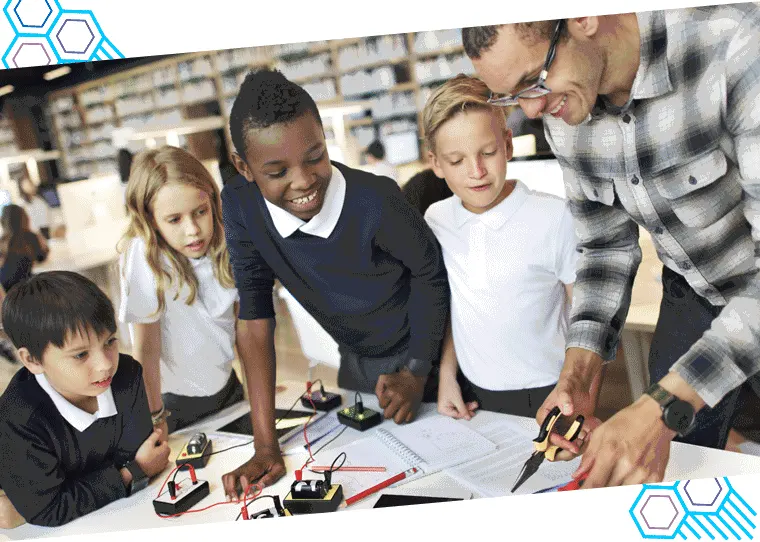
For primary and middle school levels, the focus is often on lowering barriers to entry. Makerspaces provide an informal, highly flexible environment centered on design thinking and rapid prototyping. These spaces prioritize creative coding and introductory circuitry, utilizing 3D printers and vinyl cutters to bring student ideas to life. It’s a student-led “design and technology” environment where the goal is to spark curiosity and build confidence.
In contrast, a FAB Lab (Fabrication Laboratory) follows a more structured framework established by the MIT Center for Bits and Atoms. These labs require a standardized suite of digital fabrication tools, including CNC routers and precision milling machines for circuit board production. While more capital-intensive, the FAB Lab model builds foundational mechatronics skills through a rigorous, globally recognized curriculum. It’s an excellent choice for schools aiming to join an international network of innovators.
Specialized Engineering Labs for Higher Secondary
As students advance toward higher education, the lab must evolve into a professional-grade research hub. Specialized engineering labs transition away from “toy” robotics toward advanced manufacturing zones. These areas feature collaborative robotic arms, autonomous vehicle testing grounds, and AI-driven IoT sensors. For institutions in the GCC region, aligning with robotics lab setup UAE standards is a critical step for ensuring competition readiness and university-level technical mastery.
The “Future Science Lab” represents the pinnacle of this evolution. These data-driven environments integrate renewable energy stations where students can test thermal and solar systems using real-time analytics. By combining traditional scientific methodology with AR/VR simulations and digital probeware, these labs prepare students for the complexities of modern engineering. The trade-off involves higher costs and more demanding infrastructure, with turnkey engineering labs often requiring investments between $100,000 and $250,000. When deciding how to set up a STEAM lab in school, evaluate whether your goal is broad-based creative literacy or elite technical specialization. Both paths are valuable, but they require distinct spatial and financial commitments.
The 5-Step STEAM Lab Implementation Roadmap
Implementing a high-tier laboratory requires a methodical transition from high-level inspiration to structured execution. When leaders ask how to set up a STEAM lab in school, they’re often looking for a checklist, but the reality is a strategic journey. This roadmap ensures your investment doesn’t just sit in a room but becomes a driver of systemic transformation. Success lies in the alignment of physical space, technical infrastructure, and human capability.
- Step 1: Curriculum Audit. Conduct a comprehensive needs assessment to align hardware with specific academic goals. Don’t buy technology for its own sake; buy it to solve a pedagogical challenge.
- Step 2: Spatial Design. Map the layout with a focus on “flow” and safety. This includes acoustic partitions for “dirty” zones and dedicated filtration for “clean” digital fabrication areas.
- Step 3: Strategic Procurement. Secure equipment that meets 2026 global standards, prioritizing Industry 4.0 readiness and safety certifications like ANSI/CAN/UL 2904.
- Step 4: Technical Integration. Execute the installation with a focus on network resilience. Ensure your Wi-Fi 7 or 6E infrastructure can handle 30+ simultaneous high-bandwidth endpoints without latency.
- Step 5: Professional Development. Launch intensive teacher training. A lab is only as effective as the educators who facilitate it.
Strategic Design and Spatial Planning
Modern lab architecture enforces a clear “student journey” through distinct zones. You must balance open collaboration areas, featuring reconfigurable dry-erase tables, with quiet research stations for deep coding or CAD work. Designing for scalability is vital. As AI and IoT capabilities expand, your floor plan must accommodate new sensors and autonomous systems without requiring a total renovation. This foresight ensures your lab remains a bridge-builder between current student skills and future potential.
Teacher Empowerment and Curriculum Support
Research indicates that 61% of educational institutions cite a lack of teacher professional development as the primary barrier to lab success. To avoid the “kit trap,” you must implement comprehensive STEAM programs that align with classroom goals. This isn’t a one-time workshop; it’s a commitment to ongoing mastery. Establishing a long-term technical support and maintenance contract is equally essential to ensure uptime and reliability. To secure your institution’s future, you should partner for institutional modernization with a strategic ally who understands the gravity of large-scale implementation. This collaborative approach transforms a simple room into a prestigious center of progress.
Partnering for Excellence: The Ednex Advantage in Lab Setup
Institutional excellence requires more than a procurement list. It demands a partnership with a strategic visionary capable of translating ambitious goals into a functional, future-proof reality. While the previous sections detailed the technical and spatial requirements of how to set up a STEAM lab in school, the final step is choosing an ally that understands the gravity of large-scale implementation. Ednex positions itself as this essential bridge-builder, moving schools from current capabilities to the cutting edge of global Industry 4.0 standards.
The advantage of a turnkey approach cannot be overstated. Ednex provides end-to-end engineering and science lab solutions that remove the operational friction of institutional modernization. By integrating specialized labs for Mechatronics, Renewable Energy, and Advanced Manufacturing, we ensure your institution remains at the forefront of the educational evolution. This isn’t a transactional exchange. It’s a systemic transformation backed by a comprehensive national installation and support network, ensuring that your lab remains operational and peak-performing long after the initial setup.
End-to-End Design and Implementation
Every institution has a unique identity and specific academic objectives. Ednex delivers customized lab layouts that reflect these goals while adhering to the highest global benchmarks. We don’t just supply hardware; we orchestrate the seamless integration of Arduino Education platforms, AR/VR solutions, and specialized technical curriculum. This holistic design ensures that every square foot of your lab serves a deliberate pedagogical purpose, fostering the elite engineering skills required for the 2026 technical landscape. We focus on the impact of technology and the importance of staying ahead of global benchmarks without becoming bogged down in overly dense technical jargon.
A Futuristic Ecosystem of Support
A modern lab is a living ecosystem that requires ongoing attention to remain relevant. Ednex provides a sustained framework of support, offering everything from autonomous vehicle research kits to blockchain training. Our commitment extends beyond the initial launch, encompassing critical maintenance, firmware updates, and the latest in IoT lab technology. We view your lab as a long-term investment in the nation’s technical future, preparing students for the $77.75 billion STEM market of 2026. It’s time to move beyond the “kit trap” and embrace a professional-grade environment that inspires confidence and progress. Request a Consultation for Your Future-Ready STEAM Lab today and begin your journey toward institutional modernization.
Leading the Industry 4.0 Educational Evolution
Establishing a future-ready laboratory is a transformative commitment to your students’ readiness for a complex, tech-driven world. You’ve seen that success requires more than just hardware; it demands a strategic alignment of spatial design, safety standards, and teacher empowerment. By prioritizing Industry 4.0 benchmarks, from mechatronics to autonomous systems, you ensure your institution remains a prestigious leader in development. Navigating how to set up a STEAM lab in school becomes a methodical journey toward progress when you have a seasoned expert as your bridge-builder.
As a national leader in educational laboratory infrastructure, Ednex offers turnkey solutions that span from initial design to comprehensive professional development. We’re specialists in mechatronics and Industry 4.0, dedicated to modernizing your campus with precision and confidence. Don’t let the technical complexity of 2026 standards deter your vision. Partner with Ednex for a Visionary STEAM Lab Setup and transform your school into a hub of systemic innovation. The future of science and engineering starts within your walls.
Frequently Asked Questions
How much space is required for a standard school STEAM lab?
A standard school laboratory typically requires 800 to 1,200 square feet to accommodate 20 to 25 students comfortably. This footprint allows for distinct “clean” and “dirty” zones while maintaining the mandatory 36 to 48 inch circulation aisles required for accessibility. When planning how to set up a STEAM lab in school, prioritize modular floor plans over static rows. This ensures the space can scale as your hardware and student enrollment grow over time.
What is the difference between a STEM lab and a STEAM lab?
The primary distinction lies in the integration of the Arts to drive creative problem solving and human centric design. While a STEM lab focuses on technical proficiency, a STEAM lab utilizes artistic principles to bridge the gap between pure engineering and aesthetic functionality. This approach encourages students to view technology as a tool for expressive innovation. It’s a move toward a more holistic, multidisciplinary hub that prepares learners for the design intensive demands of Industry 4.0.
What are the most essential tools for a first-year robotics program?
A foundational robotics program should prioritize versatile, curriculum aligned hardware like Arduino Education kits and entry level autonomous vehicle sensors. These tools allow students to master the basics of logic and circuitry before moving to advanced mechatronics. You’ll also need reconfigurable workbenches and reliable power drops to support simultaneous testing. Starting with these essentials ensures your program builds momentum without overwhelming faculty or students with overly complex industrial machinery too early in the implementation journey.
How do we ensure our teachers are qualified to run a high-tech lab?
Ongoing professional development is the single most critical factor in lab longevity. Ednex provides structured teacher certification and curriculum support via the STEMNet platform to ensure faculty are confident with Industry 4.0 tools. We recommend a multi-year training roadmap that covers everything from 3D printer safety to advanced IoT sensor integration. This strategic approach transforms educators into expert facilitators who can guide students through complex, real world engineering challenges with institutional authority.
Can a STEAM lab be integrated into an existing school building?
Yes, existing classrooms can be retrofitted into high performance labs through strategic spatial planning and MEP upgrades. The process involves installing dedicated 20A circuits and specialized ventilation systems to meet ASHRAE 62.1 standards for air quality. If space is limited, modular furniture and mobile makerspace carts provide a flexible solution that doesn’t require structural changes. This allows institutions to modernize their facilities without the need for a completely new building wing or massive construction projects.
What safety certifications are required for school engineering equipment?
Safety is a non-negotiable benchmark for any modern laboratory. All 3D printers must meet ANSI/CAN/UL 2904 standards for low chemical emissions, while laser cutters must operate as Class 1 systems with safety interlocks. Electrical installations must adhere to NEC 406.12 codes for tamper resistant receptacles and ground fault protection. By following these rigorous global standards, school leaders protect their students and ensure their facility remains compliant with the highest international safety and environmental health benchmarks.
How does a STEAM lab support student career readiness in the UAE?
A professional grade lab functions as a bridge between K-12 education and the UAE’s ambitious Industry 4.0 goals. By mastering tools like robotic arms and IoT sensors, students gain the technical mastery required for careers in mechatronics, renewable energy, and autonomous systems. This early exposure to futuristic engineering solutions gives graduates a competitive edge in both higher education and the global workforce. It’s about building a skilled national workforce ready to lead systemic transformation across the country.
What is the typical timeline for a complete lab design and installation?
A comprehensive lab deployment generally spans 12 to 24 weeks from the initial needs assessment to the final teacher training launch. This timeline accounts for custom spatial design, procurement of high tier hardware, and technical network integration. When you’re researching how to set up a STEAM lab in school, remember that the installation phase is only one part of the journey. A methodical approach ensures that every safety code is met and that faculty are fully prepared to inspire their students.
Related Posts ...
Comments are disabled