






Mechatronics & Robotics Lab: 2026 University Buying Guide
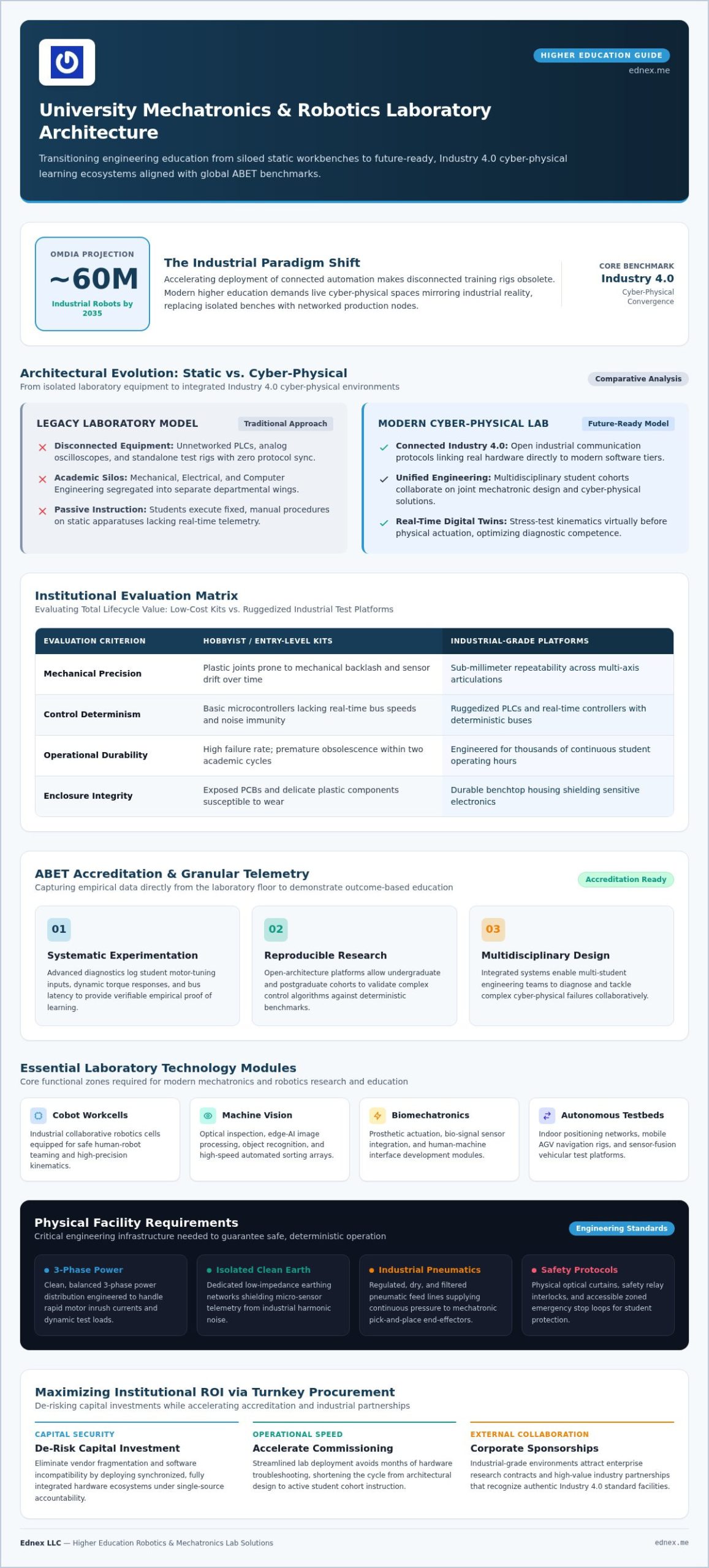
With Omdia projecting roughly 60 million industrial robots deployed by 2035, the traditional static workbench has become an educational dead end. Building a high-impact mechatronics and robotics lab for universities is no longer about filling floor space with disconnected training rigs; it demands an adaptable, cyber-physical ecosystem that directly mirrors Industry 4.0 manufacturing environments.
You already know the institutional strain of siloed mechanical, electrical, and computer engineering departments, accelerating technology obsolescence, and juggling disparate hardware vendors without cohesive technical support. Aligning hands-on pedagogy with rigorous international accreditation benchmarks like ABET shouldn’t require risking premature obsolescence on multi-million-dirham capital investments.
This 2026 university buying guide shows engineering deans, department chairs, and lab managers how to design, specify, and procure future-ready laboratory environments that bridge foundational theory with advanced industrial practice. Discover the modular architectures, cross-disciplinary integration frameworks, and streamlined turnkey procurement strategies necessary to establish a world-class center of engineering excellence.
Key Takeaways
- Understand the architectural shift from isolated benchtop trainers toward a fully integrated mechatronics and robotics lab for universities that unifies mechanical, electrical, and software disciplines.
- Apply a rigorous institutional evaluation matrix to select modular, industrial-grade hardware that adapts across evolving undergraduate courses and advanced postgraduate research.
- Identify core technology zones, including collaborative robotics cells, machine vision platforms, biomechatronics modules, and autonomous vehicle testbeds built to meet rigorous accreditation standards.
- Master physical facility requirements, from clean three-phase power distribution and industrial pneumatic lines to comprehensive safety protocols and isolated clean earthing.
- Leverage end-to-end turnkey procurement models to de-risk capital investment, accelerate commissioning timelines, and attract high-value corporate sponsorships.
The Evolution of the Mechatronics and Robotics Lab for Universities
Engineering education has outgrown the era of passive instruction. The modern mechatronics and robotics lab for universities has transformed into an active cyber-physical convergence space. Legacy facilities relied heavily on isolated, stand-alone test benches: an analog oscilloscope on one bench, an unnetworked PLC on another, and disconnected mechanical rigs in the corner. In contrast, today’s spaces function as live, interconnected Industry 4.0 production environments where physical hardware communicates directly with software layers via open industrial protocols.
Static apparatuses no longer reflect industrial reality. Modern facilities integrate real-time digital twin simulations, enabling students to design, validate, and stress-test kinematic systems virtually before executing code on physical equipment. This tight loop between virtual modeling and physical actuation accelerates technical competence. Engineering graduates step directly into high-tech sectors equipped to commission, diagnose, and optimize connected manufacturing facilities from day one.
Bridging Mechanical, Electrical, and Computer Engineering
Historically, departmental silos hindered integrated learning. Mechanical, electrical, and computer science programs operated in disparate physical wings, producing graduates unprepared for integrated systems engineering. Foundational mechatronics demands the seamless fusion of precision sensorics, intelligent actuation, and real-time embedded computation. Today’s collaborative university mechatronics and robotics lab breaks down these barriers by providing shared physical environments where multidisciplinary student cohorts design holistic cyber-physical solutions together.
Meeting Global Higher Education Accreditation Standards
Modernization directly reinforces institutional compliance. Aligning a contemporary mechatronics and robotics lab for universities with stringent ABET criteria requires clear, quantifiable documentation of student outcomes. Modern laboratory workstations achieve this by capturing granular telemetry across every experiment:
- Systematic Experimentation: Advanced sensor diagnostics log student motor-tuning inputs, torque responses, and bus latency, yielding empirical data to demonstrate outcome-based learning.
- Reproducible Research: Open-architecture platforms allow undergraduate and postgraduate cohorts to validate complex control algorithms against deterministic physical benchmarks.
- Collaborative Problem-Solving: Integrated workstations enable multi-student teams to tackle complex system failures, demonstrating proficiency across multidisciplinary engineering design.
By capturing empirical data directly from the laboratory floor, academic institutions provide undeniable proof of rigorous, outcome-based engineering education during accreditation cycles.
Institutional Evaluation Matrix: Selecting University Laboratory Systems
Procuring infrastructure for a mechatronics and robotics lab for universities requires balancing open pedagogical access with industrial fidelity. Academic committees often default to low-cost kits to reduce initial outlays, only to face premature obsolescence, component failure, and software fragmentation within two academic cycles. A comprehensive institutional evaluation matrix looks beyond upfront unit costs to calculate total lifecycle value, modular expandability, and long-term durability across consecutive cohorts.
Educational Toolkits vs. Industrial-Grade Test Platforms
Introductory microcontrollers teach entry-level coding, but they lack the determinism, noise immunity, and communication bus speeds required for advanced mechatronic control. Industrial-grade platforms utilize ruggedized programmable logic controllers and real-time controllers housed in durable, benchtop enclosures. While hobbyist plastic arms suffer from mechanical backlash and sensor drift, industrial collaborative units deliver sub-millimeter repeatability. This rugged construction ensures critical hardware withstands thousands of continuous student operating hours without losing calibration.
Software Interoperability and Digital Twin Capabilities
Seamless software interoperability separates future-ready educational systems from rigid legacy trainers. Modern laboratory platforms must offer native support for ROS2, Linux RT kernels, and MATLAB/Simulink workflows to facilitate model-based design. Workstations should bridge CAD models directly with physical actuators for hardware-in-the-loop validation and digital twin synchronization. Capturing real-time bus telemetry through integrated instrumentation like PC oscilloscopes lets students correlate simulated physical parameters with live electrical signals. This capability directly mirrors empirical methodologies documented in the IEEE/ASME Transactions on Mechatronics.
Scalability Across Undergraduate and Postgraduate Research
A sustainable lab architecture supports tiered learning without demanding separate physical spaces. Base modules deliver foundational kinematics and motor-tuning experiments for lower-division undergraduates. The same stations expand via open-architecture interfaces to support novel sensor payloads and complex control theory for doctoral research. Engineering deans can review structured spatial strategies in our robotics lab setup guide to align equipment capabilities with institutional milestones. Institutions looking to modernize their research infrastructure can consult with higher education engineering partners to establish forward-compatible, multi-cohort lab environments.
Essential Workstations and Technology Modules for Higher Education
World-class engineering facilities reject uniform, rows-of-desks layouts. An elite mechatronics and robotics lab for universities structures space into purpose-built, interconnected technology cells. Each zone targets distinct physical competencies while maintaining deterministic digital communication with surrounding modules. This deliberate architecture allows undergraduate cohorts to examine fundamental electromechanical principles while enabling advanced researchers to validate autonomous, multi-agent algorithms on the same floor.
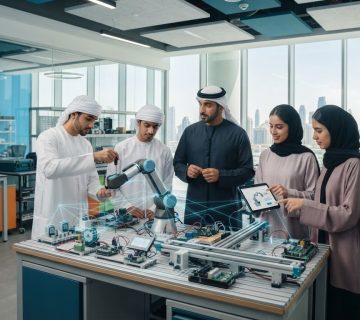
Core collaborative workstations anchor this environment. These stations feature collaborative robotic arms outfitted with integrated machine vision sensors and six-axis compliant force-torque feedback at the end-effector. Adjacent instrumentation benches replace bulky rack-mounted hardware with modular PC oscilloscopes and multi-channel data acquisition units, streaming signal integrity and power consumption data directly into student workstations for real-time analysis.
Industrial Automation and Cyber-Physical Systems
Autonomous Systems and Mobile Robotics Testbeds
Uncrewed mobility demands dedicated, secure testing volumes. Dedicated testbeds deploy wheeled autonomous ground vehicles equipped with solid-state LiDAR, real-time SLAM navigation, and depth-sensing optics. Encircling the ground zone, ceiling-mounted optical motion capture gantries track indoor autonomous aerial platforms with millimeter accuracy, providing an absolute ground truth for custom localization algorithms. Establishing floor-to-ceiling safety netting, optical retro-reflective markers, and centralized fleet coordination stations ensures safe operation during multi-agent drone swarms. These configurations strictly align with institutional standards such as established University Mechatronics Lab Safety Policies.
Biomechatronics and Precision Human-Machine Interfacing
Integrating mechanical devices directly with human biological signals represents a vital frontier for modern robotics education. Biomechatronics stations provide active research modules including:
- Physiological Signal Capture: Surface electromyography (sEMG) arrays capture muscle actuation signals to drive robotic hands and assistive prosthetics.
- Wearable Exoskeleton Evaluation: Instrumented lower-limb and upper-body wearable units allow students to analyze human gait kinematics, load balancing, and joint strain.
- Closed-Loop Biosensing: Low-latency hardware filters decode neural intent, sending deterministic control packets directly to dynamic actuator loops.
Equipping an advanced mechatronics and robotics lab for universities with these high-bandwidth bio-interfacing modules transforms conventional mechanical training into groundbreaking biomedical engineering research.
Engineering the Space: Layout, Safety, and Implementation Steps
Executing an advanced mechatronics and robotics lab for universities demands meticulous civil, electrical, and mechanical planning. Sophisticated cyber-physical equipment cannot deliver reliable pedagogical outcomes if installed within substandard physical spaces. Unmanaged electrical harmonic noise distorts high-bandwidth sensor acquisition, inadequate floor grounding destroys sensitive microelectronics, and unmitigated structural vibration invalidates sub-millimeter robotic arm repeatability. Building an elite environment requires a structured, multi-phase engineering deployment plan.
Step 1 to 3: Spatial Zoning, Electrical, and Utility Infrastructure
Spatial layout must establish clean isolation between theoretical design bays, mechanical prototyping stations, and dynamic robotic testing cells. Facility planners should incorporate dedicated utility infrastructure:
- Electrical Architecture: Balanced three-phase power supplies high-draw motor drives, while isolated clean earthing protects sensitive measurement instrumentation from electrical switching noise.
- Utility Drops: Distributed overhead umbilical drops route power, gigabit ethernet lines, and clean dry compressed air directly to workstations without creating hazardous floor wiring.
- Environmental Controls: Dedicated HVAC systems manage heavy thermal loads produced by multi-agent computing nodes, complemented by static-dissipative ESD epoxy flooring and acoustic dampening panels.
Step 4 to 6: Safety Compliance, Interlocks, and Sensor Barriers
Rigorous safety systems are non-negotiable when housing high-speed machinery. University laboratories must implement multi-layered safety barriers compliant with international robotics safety standards such as ISO 10218:2025. Perimeter safety fencing isolates heavy Cartesian gantries, while optical safety light curtains halt rapid manipulators the instant a student breaches the testing boundary. Dual-channel emergency stop circuits connect directly to master safety relays, providing fail-safe shutdown capabilities across the entire facility.
Step 7 to 8: Commissioning, Digital Calibration, and Faculty Training
Live commissioning verifies that physical kinematic motions match software model parameters. Multi-point calibration protocols confirm arm payload accuracy, coordinate transformation tolerances, and fieldbus communication latencies. Structured faculty enablement workshops integrate the new hardware directly into semester course syllabi, ensuring professors utilize the complete functional envelope of every platform. Institutional planners ready to engineer modern facilities can partner with Ednex for turnkey lab design and commissioning to guarantee international standard compliance from initial layout through full operational launch.
Establishing preventative maintenance schedules for mechanical gearboxes, sensor alignments, and pneumatic seals protects institutional capital investments and sustains uninterrupted operational safety across years of student use.
Maximizing Institutional ROI Through Turnkey Lab Solutions
Capital investments in engineering facilities shouldn’t be treated as sunk cost centers. A modern mechatronics and robotics lab for universities functions as a high-yield asset that drives student recruitment, elevates institutional prestige, and generates sustainable non-tuition revenue. Prospective engineering students actively prioritize universities that offer hands-on immersion in certified cyber-physical environments, giving institutions with modern facilities a distinct advantage in student enrollment and retention.
Attracting Industry Sponsorships and Research Funding
Industrial enterprises face rapid automation pressures and actively seek research partners with industrial-grade equipment. Equipping a laboratory with advanced Industry 4.0 platforms positions an academic institution as a strategic innovation hub capable of contract research, rapid prototyping, and pilot-line testing. Furthermore, universities can monetize laboratory capacity during academic downtimes by hosting executive training and technical workforce upskilling programs. These corporate programs generate recurring revenue streams that offset equipment maintenance costs and replenish departmental research budgets.
The Turnkey Advantage: From Vision to Accredited Operation
Fragmented procurement introduces severe institutional risks. Sourcing sensors from one supplier, robotic arms from another, and software frameworks from third parties invariably leads to integration disputes and delayed commissioning. Partnering with a dedicated educational engineering integrator eliminates vendor finger-pointing. Turnkey execution consolidates architectural design, precision sourcing, physical installation, and curriculum alignment under a single accountable team. This unified approach guarantees that every software stack, safety interlock, and utility connection functions harmoniously from opening day.
Consulting with Strategic Laboratory Architects
Building an elite mechatronics and robotics lab for universities requires strategic foresight rather than generic equipment purchases. Institutional planning begins with comprehensive facility audits that evaluate structural footprints, utility capacity, and targeted academic milestones. Engineering deans and department heads can initiate their modernization initiatives through Ednex Educational Engineering Solutions to formulate custom, future-ready laboratory architectures tailored to their academic vision and institutional growth targets.
By pairing rigorous spatial engineering with unified procurement, higher education leaders secure high-impact facilities that inspire incoming cohorts, accelerate groundbreaking research, and elevate their global academic standing.
Architecting the Future of Academic Robotics
The decisive shift toward cyber-physical Industry 4.0 systems demands a complete rethink of academic engineering infrastructure. Establishing a future-ready mechatronics and robotics lab for universities isn’t merely about refreshing benchtop hardware; it’s a transformative investment that unifies mechanical, electrical, and computer science departments into an integrated research ecosystem. By combining modular workstation cells, robust ISO-compliant safety perimeters, and deterministic data acquisition, institutions protect their capital investments while cultivating exceptional graduate talent.
Turnkey execution eliminates fragmented vendor management and accelerates the journey from initial spatial design to accredited academic delivery. Backed by proven higher education integration across biomechatronics, autonomous systems, and advanced manufacturing, comprehensive lab modernization bridges the gap between academic theory and real-world industrial innovation. Take the definitive step toward world-class technical education. Partner with Ednex to engineer your university robotics lab and build an inspiring, internationally recognized center of engineering excellence today.
Frequently Asked Questions
What is the ideal floor space required for a university mechatronics and robotics lab?
An effective mechatronics and robotics lab for universities typically requires between 150 and 300 square meters of dedicated space. This footprint accommodates modular workstation pods, clear circulation paths, an enclosed flight arena for aerial drones, and segregated zones for fabrication and computer modeling. Standardizing layouts around flexible modular grids ensures institutions can reconfigure equipment dynamically as cohort sizes and research scopes expand.
How does an academic robotics lab differ from an industrial manufacturing cell?
While industrial cells prioritize high-throughput automation, repetitive precision, and enclosed operation, academic laboratories focus on transparent observability, open algorithm design, and reconfigurability. Academic setups expose the underlying control loops, communication buses, and sensor pipelines. This architectural visibility allows students to inspect raw encoder signals, test novel feedback controllers, and simulate system anomalies safely without disrupting rigid commercial production schedules.
What specific equipment is required to support ABET accreditation in mechatronics?
ABET accreditation centers on verifiable student outcomes and empirical data validation. Facilities need real-time digital controllers, multi-axis robotic arms, industrial fieldbus networks, and precision instrumentation capable of capturing deterministic sensor signals. Integrating hardware that records motor torque, tracking errors, and step responses gives faculty concrete telemetry to assess student design experiments, proving rigorous, data-driven mastery across mechanical, electronic, and software competencies.
Can modern mechatronics lab equipment support both undergraduate courses and postgraduate research?
Yes, modern platforms utilize tiered modularity to span multiple academic tiers. Undergraduates utilize pre-configured graphical interfaces and standardized blocks to grasp fundamental kinematics and PID motor tuning. Postgraduate researchers unlock low-level real-time kernels, open ROS2 nodes, and direct motor current controls on the exact same workstations. This dual-use capability maximizes capital efficiency, eliminating the need to procure redundant hardware for separate departmental programs.
Why are PC oscilloscopes preferred over traditional benchtop units in educational labs?
PC oscilloscopes replace bulky benchtop chassis with compact, USB-powered hardware that streams high-bandwidth signals directly to student computers. They integrate multiple measurement tools into one software window, combining multi-channel oscilloscopes, spectrum analyzers, and arbitrary waveform generators. This software integration streamlines data logging, simplifies digital twin validation, saves physical desk space, and allows seamless screen sharing across collaborative student teams.
How long does a complete turnkey university engineering lab installation take?
Turnkey deployment schedules generally span three to six months from initial design approval to live commissioning. The process begins with spatial auditing, 3D zoning, and utility specification, followed by procurement and equipment assembly. On-site installation, safety barrier verification, network integration, and hands-on faculty curriculum workshops usually wrap up within two to three weeks, ensuring the facility opens on schedule for the academic semester.
What safety standards must be enforced when deploying industrial robotics for students?
Modern educational installations enforce global safety standards, primarily ISO 10218:2025 and ANSI/RIA R15.06 for industrial and collaborative robots. Workstations require dual-channel emergency stop circuits wired into certified safety relays, monitored perimeter fencing for high-speed articulators, and optical safety light curtains. In collaborative zones, power-and-force-limiting sensors ensure immediate stops upon unexpected contact, protecting students while maintaining hands-on interaction.
Related Posts ...


Comments are disabled