


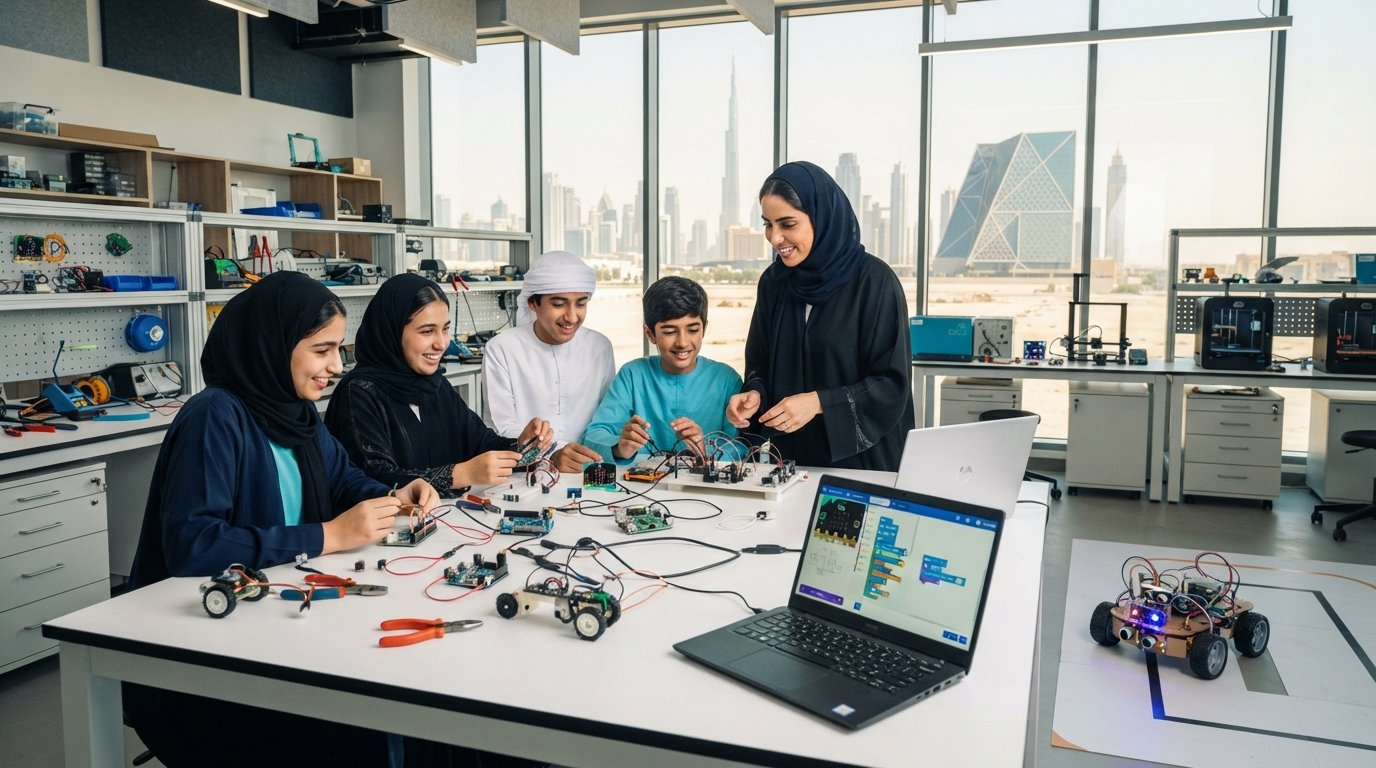
Arduino Education UAE: Transforming STEAM Classrooms into Future Innovation Hubs (2026)
What if the robotics kits gathering dust in school cupboards aren’t failing because learners lack curiosity, but because classrooms lack an authentic engineering bridge? Academic leaders across the country recognize the operational friction: investing in disparate electronic components often sparks short-lived novelty, only to stall when students must transition from visual block coding to industrial, syntax-driven programming. Adopting a unified framework for Arduino education UAE transforms these fragmented exercises into scalable, accredited innovation hubs that connect classroom inquiry directly with practical engineering realities.
You already understand that preparing students for an advanced digital economy requires far more than isolated software simulations; it demands hands-on physical computing and rigorous problem-solving. Discover how Arduino education empowers UAE institutions with scalable STEAM learning, open-source robotics, and structured engineering pathways spanning intermediate grades to university programs. Below, we examine how sustainable laboratory environments, accredited educator upskilling, and modern hardware architectures bridge the divide between theoretical science and measurable student competencies in C++, embedded systems, and IoT fundamentals.
Key Takeaways
- Discover how structured Arduino education UAE programs bridge the gap between abstract coding and hands-on physical computing to meet national innovation benchmarks.
- Identify the core institutional pillars that combine durable microcontroller hardware, browser-based collaborative software, and standards-aligned pedagogical frameworks.
- Explore a scaffolded engineering continuum that transitions learners from basic sensor literacy in intermediate cycles to advanced IoT and mechatronics at the university level.
- Prevent classroom equipment abandonment through accredited educator upskilling and ongoing curricular integration tailored to institutional standards.
- Learn how turnkey lab commissioning with Ednex replaces fragmented component purchasing with sustainable, purpose-built STEAM and robotics learning ecosystems.
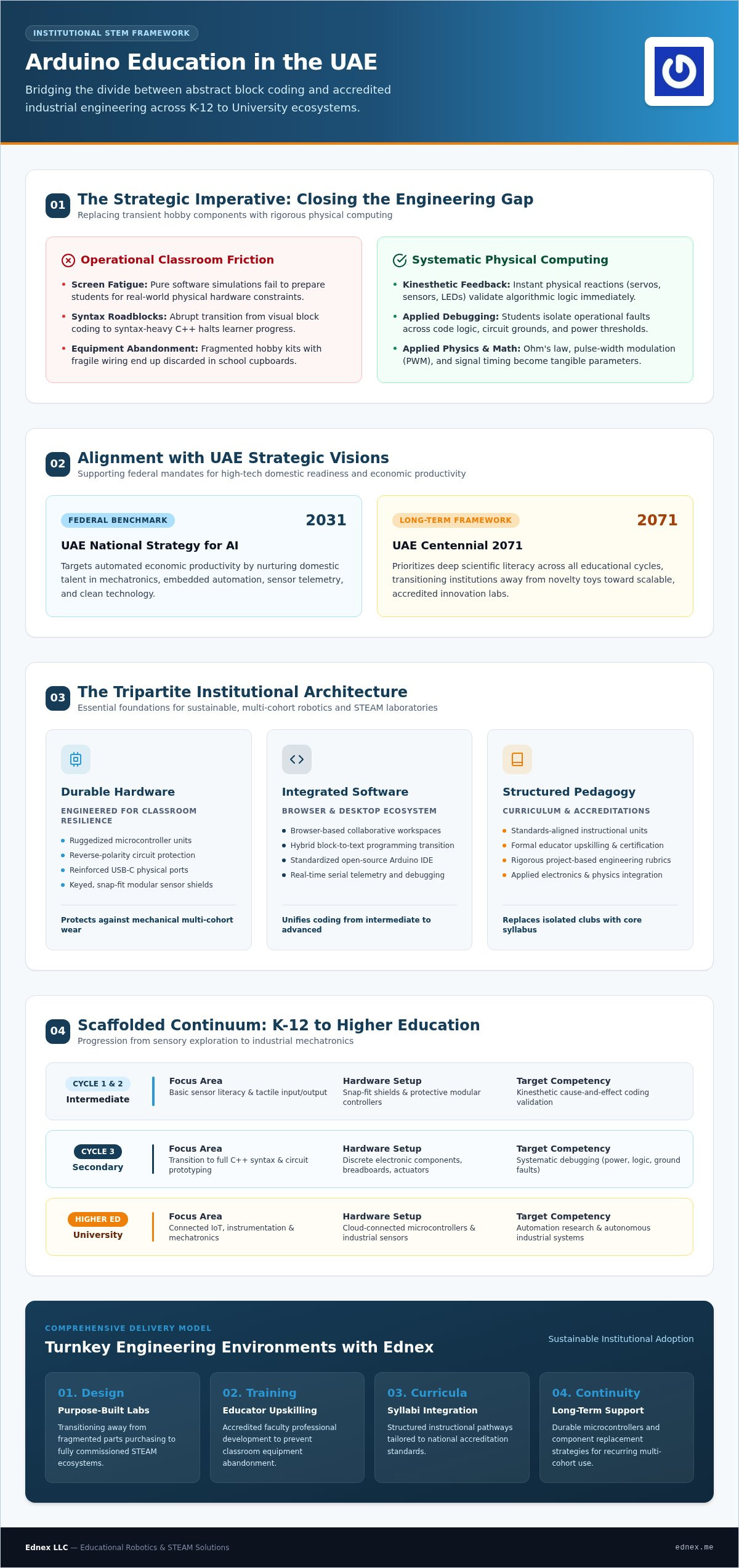
The Strategic Imperative for Arduino Education in Modern UAE Classrooms
Relying on software simulations alone cannot prepare students for the physical realities of modern industrial engineering. While discrete consumer electronics kits often flood classrooms, they frequently end up discarded after basic circuit trials because they lack structured pedagogical continuity. True technological literacy requires a foundational bridge between conceptual mathematics and tactile hardware implementation. Implementing systematic Arduino education UAE programs transforms transient classroom novelty into scalable, standards-driven learning hubs designed for long-term institutional impact.
At its core, Arduino education leverages the globally recognized open-source Arduino microcontroller platform, combining accessible development boards, standardized software environments, and project-based curricula. Instead of treating electronics as an extracurricular hobby, institutional adoption anchors physical computing directly within academic syllabi. Students don’t just learn syntax on a monitor; they learn how code behaves when interacting with the real world.
Bridging the Gap Between Code and Physical Systems
Physical computing breaks through screen fatigue by making algorithmic logic tangible. When learners upload an instruction set that commands a stepper motor, fires an ultrasonic ping, or toggles an LED matrix, abstract programming rules become observable physical laws.
- Kinesthetic Feedback Loops: Immediate physical reactions, like a servo adjusting an angle based on sensor thresholds, validate code logic instantly without relying on theoretical outputs.
- Rigorous Debugging Paradigms: Students must isolate whether an operational fault stems from an ungrounded wire, a depleted power source, or a logic error in their C++ script.
- Applied Physics and Math: Principles like Ohm’s law, pulse-width modulation, and signal timing evolve from passive textbook equations into vital design parameters.
Supporting National Innovation and Advanced Technology Visions
Federal initiatives across the nation set ambitious benchmarks for developing domestic STEM excellence. The UAE National Strategy for Artificial Intelligence 2031 targets significant automated economic productivity, requiring educational ecosystems that cultivate homegrown capabilities in automation, mechatronics, and sustainable energy. Similarly, long-term frameworks such as the UAE Centennial 2071 prioritize deep scientific literacy across all educational cycles.
Meeting these institutional readiness metrics demands moving beyond generic classroom toys. By deploying comprehensive Arduino education UAE frameworks, secondary schools and universities build structured engineering pipelines. These programs equip students with real-world competencies in sensor telemetry, industrial instrumentation, and embedded systems, preparing future engineers to lead regional innovation.
Core Pillars of Institutional Arduino Ecosystems: Hardware, Software, and Pedagogy
Procuring microcontrollers without a structured instructional model rarely yields sustainable learning outcomes. Sustainable technological integration requires a balanced tripartite architecture: resilient hardware, adaptive software platforms, and rigorous curriculum frameworks. When educational institutions deploy comprehensive Arduino education UAE programs, they move past isolated maker activities toward an integrated academic discipline that equips learners for university-level research and high-tech industries.
Ruggedized Microcontrollers and Modular Sensor Architecture
Classroom hardware faces severe mechanical wear that consumer hobby electronics cannot withstand. Institutional platforms resolve this vulnerability by integrating robust power regulation, reverse-polarity protection, and reinforced USB-C interfaces designed for multi-cohort use. Rather than relying entirely on fragile jumper wires during early instructional cycles, educators deploy structured sensor shields featuring keyed, snap-fit connectors. This modular architecture safeguards sensitive microcontrollers while teaching authentic input-output communication protocols like I2C, SPI, and UART, mirroring the architecture students encounter in industrial automation systems.
Scaffolded Programming Environments from Block to Text
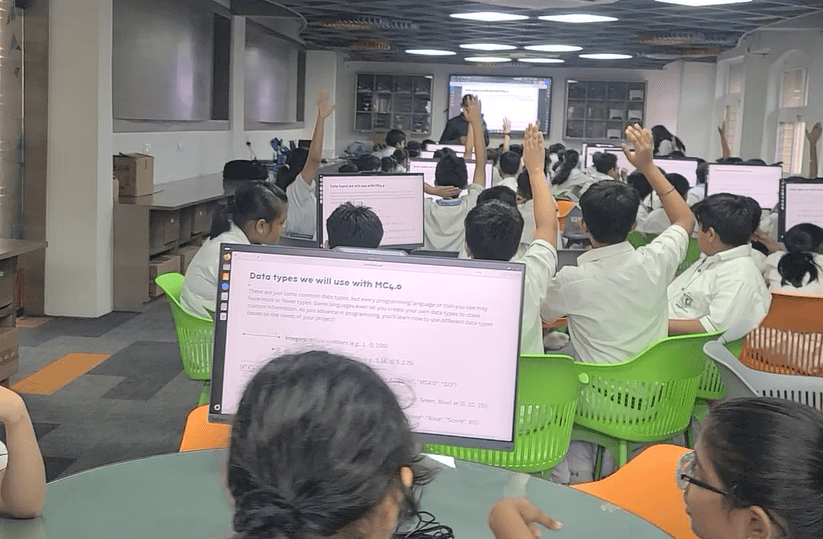
Bridging conceptual visual logic to industrial code syntax remains one of secondary education’s steepest hurdles. Unified development platforms smooth this transition by allowing middle school learners to construct logic through intuitive, block-based structures before viewing the corresponding text-based output. As students advance, they shift seamlessly into standard C++ and MicroPython environments:
- Universal Browser Compilation: Cloud-managed development tools eliminate complex software installations on school devices, enabling secure access across Chromebooks and laptops.
- Disciplined Syntax Architecture: Text-based compiling teaches proper code formatting, variable initialization, and loop optimization.
- Systematic Debugging Routines: Terminal output and serial monitors train students to analyze real-time error logs methodically, turning failed executions into diagnostic investigations.
Standards-Aligned Curriculum and Collaborative Project Frameworks
Sustainable programs anchor classroom challenges to authentic scientific exploration. Projects mirror professional engineering workflows, tasking teams with designing automated irrigation telemetry, environmental monitors, or autonomous mobile robotics. Learners manage project documentation, assign functional responsibilities, and test prototypes iteratively against quantitative performance criteria. These collaborative engineering tasks align directly with national initiatives like the UAE Centennial 2071 education directives, ensuring student inquiry connects meaningfully with future technical disciplines.
Institutions seeking to modernize their technical spaces can explore dedicated STEAM programs and robotics lab setup solutions that integrate these three core pillars into cohesive, sustainable academic environments.
Mapping the K-12 to University Learning Pathway
Fragmented STEM kits often fail because they lack vertical alignment across grade bands. When introductory experiments don’t connect to secondary coursework, student engagement drops and technical progression stalls. A cohesive engineering pathway establishes clear cognitive and technical benchmarks at every stage. Grounded in the official Arduino Education learning continuum, institutions build multi-year academic trajectories that guide students from foundational circuit logic to sophisticated industrial research.
Adopting progressive Arduino education UAE frameworks allows school systems to cultivate cumulative competencies. Rather than restarting with disconnected tools each academic year, students expand their skills within a unified ecosystem of microcontrollers, coding interfaces, and design challenges.
Foundational Physical Computing for Middle School Programs
Intermediate learners in Cycle 2 start by exploring basic electricity, polarity, and digital logic. Students wire modular breadboards, test simple resistive sensors, and manipulate light levels through basic pulse-width modulation. Instead of remaining passive consumers of software, learners construct physical devices like automated plant-watering indicators, burglar alarms, and responsive kinetic art displays. Following practical guidelines for setting up a school STEAM lab helps leadership organize physical spaces, safe power distribution, and modular storage to encourage tactile, open-ended experimentation.
Advanced Mechatronics and Robotics in Secondary Education
Secondary classrooms transition learners from basic input-output controls to closed-loop robotic engineering. High school students tackle complex electromechanical assemblies:
- Actuation and Motor Control: Interfacing dual H-bridge motor drivers with rotary encoders to control precision torque and directional velocity.
- Autonomous Sensor Arrays: Combining time-of-flight distance modules, ultrasonic arrays, and line sensors for competitive navigation tasks.
- Firmware Optimization: Writing lean C++ functions that leverage hardware interrupts, non-blocking timing routines, and memory-efficient data arrays.
Institutions establish the spatial layouts, testing arenas, and diagnostic benches required for these advanced builds by implementing structured blueprints for robotics lab setup UAE programs.
Higher Education Research, IoT, and Industry 4.0 Integration
At the university level, physical computing labs operate as innovation incubators. Engineering undergraduates deploy 32-bit connected microcontrollers capable of running embedded machine learning models directly at the network edge. capstone students gather sensor telemetry across decentralized IoT nodes, routing operational metrics via secure MQTT protocols to live cloud visualization dashboards. This hands-on exposure to industrial communication buses, digital twins, and rapid prototyping equips graduates to lead national advanced manufacturing and automation sectors.
Essential Requirements for Sustainable Institutional Implementation
Educational robotics programs rarely collapse due to hardware limitations. Instead, initiatives stall when schools treat physical computing as a one-time equipment purchase rather than a permanent operational commitment. Without ongoing educator development, structured inventory systems, and reliable technical workflows, advanced hardware quickly becomes shelfware. Establishing an enduring Arduino education UAE framework requires academic institutions to build the logistical infrastructure that supports teachers and safeguards physical assets over multiple school terms.
Teacher Upskilling and Dedicated CTC Instructional Training
Educator confidence represents the single most decisive factor in long-term program adoption. Many general science and computing teachers experience technological apprehension when asked to facilitate open-ended electronics lessons. Comprehensive upskilling programs resolve this friction by immersing educators in structured Creative Technologies in the Classroom (CTC) methodologies.
- Targeted Skill Mastery: Hands-on training sessions demystify circuit prototyping, serial communications, and physical troubleshooting before teachers enter the classroom.
- Facilitation Strategies: Instructors master active group management techniques that guide student collaboration during complex wiring exercises.
- Standardized Assessment Tools: Clear grading rubrics and iterative milestone metrics allow non-specialist teachers to evaluate both code quality and mechanical execution objectively.
Laboratory Architecture, Storage, and Component Management
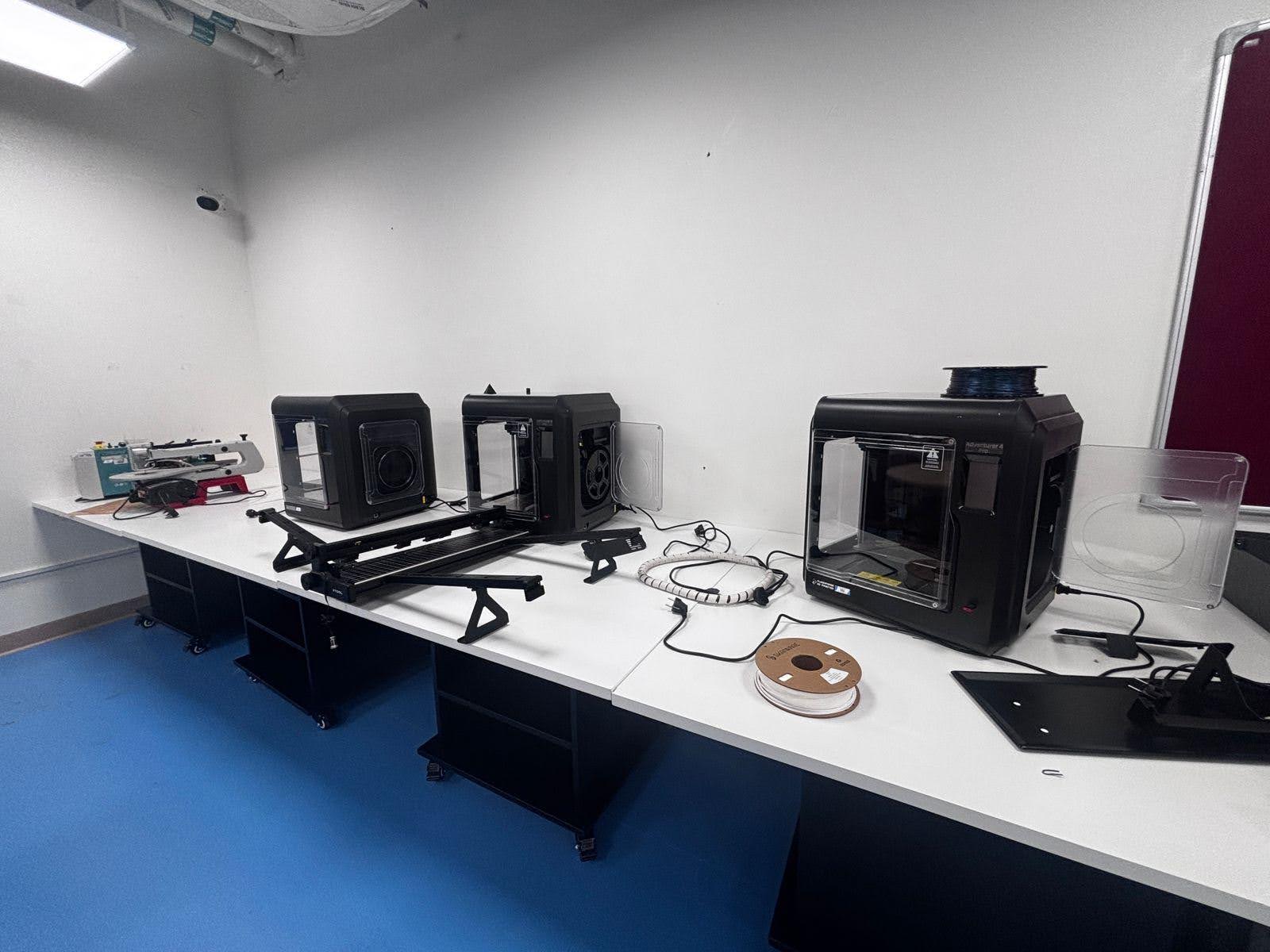
Rapid class rotations make component accountability an acute operational hurdle. Microcontrollers, sensor modules, and jumper wires easily vanish without disciplined laboratory organization. Durable environments incorporate ergonomic workbenches featuring dedicated overhead power distribution, ESD-safe antistatic work surfaces, and color-coded component storage bins. Institutions maintain full asset integrity by establishing strict check-in and check-out routines at the start and end of each session.
Aligning physical safety protocols, ventilation standards, and tool accessibility with institutional guidelines from STEAM programs for schools ensures learning spaces function smoothly. When schools combine organized spatial design with certified educator readiness, their Arduino education UAE deployment evolves from a short-term trial into an enduring campus center of excellence.
Ready to build a resilient computing ecosystem in your school? Connect with Ednex to implement complete lab setups and accredited educator training programs.
Deploying Turnkey Engineering Environments with Ednex
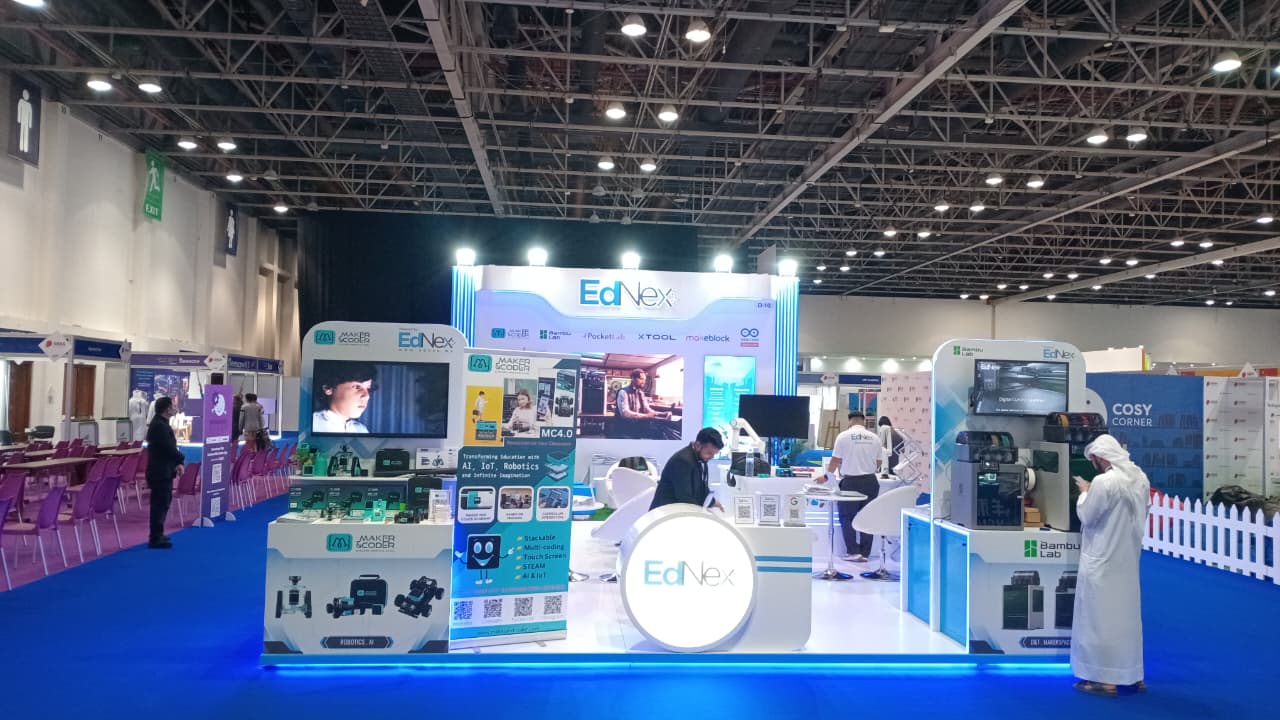
Ordering standalone hardware components from commercial distributors often leaves academic leaders with uncoordinated inventories and underutilized spaces. True institutional transformation requires a comprehensive partner who can engineer physical spaces, curate standards-compliant hardware, and upskill faculty simultaneously. Ednex operates as a strategic educational architect across the UAE, bridging the gap between procurement and high-impact learning. By commissioning integrated learning environments rather than loose microcontrollers, institutions ensure their investment drives measurable academic excellence.
Modern educational strategies demand cohesive spaces where physical computing feeds directly into advanced robotics, IoT labs, and future science spaces. An enterprise-grade implementation of Arduino education UAE connects foundational classroom experimentation directly with the nation’s advanced technology agendas.
End-to-End Educational Space and Technology Integration
Building a future-ready engineering space requires meticulous architectural and pedagogical alignment. Ednex oversees every phase of lab development to ensure seamless day-one operations:
- Acoustic and Spatial Optimization: Conducting detailed room assessments to optimize electrical drops, ergonomics, and acoustic damping for collaborative engineering teams.
- Modular Lab Furniture: Installing reconfigurable workstations that adapt to dynamic project cycles without requiring expensive structural rebuilds.
- Academic-Grade Hardware Deployment: Supplying verified educational hardware paired with comprehensive multilingual instructional collateral.
- Turnkey Lab Commissioning: Delivering fully provisioned spaces configured for immediate instruction, eliminating setup friction for school IT departments.
Empowering Educators through Continuous Strategic Partnership
Delivering cutting-edge equipment solves only half the institutional equation. Sustained success relies on ongoing faculty development. Ednex provides continuous, on-site educator enablement workshops that guide teachers through hardware troubleshooting, project facilitation, and rubric-driven assessment. This close collaboration ensures instructors remain confident as coursework advances into complex embedded systems and industrial automation.
Beyond classroom training, institutions gain access to dynamic curriculum updates that adapt to emerging industry standards. Ednex connects schools directly with regional innovation events and competitive engineering platforms, showcasing student work on national stages. Discover how to transform your school’s technical faculties with Ednex advanced learning ecosystems, establishing sustainable centers of excellence that prepare students for tomorrow’s technical economy.
Architecting the Future of Engineering Education
Moving beyond isolated classroom novelty requires an intentional, systemic strategy. Elevating Arduino education UAE from disparate electronics experiments into an accredited engineering continuum bridges the critical divide between abstract programming and applied physical computing. When institutions combine ruggedized microcontrollers with cloud-enabled collaboration and scaffolded learning pathways, students gain authentic competencies in embedded systems, mechatronics, and IoT fundamentals.
Long-term impact hinges on robust institutional support. Backed by turnkey laboratory deployments delivered across the UAE, certified professional development frameworks empowering educators at all skill levels, and end-to-end curriculum design connecting K-12 basics to Industry 4.0 university pathways, Ednex equips schools with complete, future-ready learning ecosystems. Partner with Ednex to design your institution’s advanced STEAM laboratory and give your students the practical foundation to shape the nation’s technological future with confidence.
Frequently Asked Questions
What is Arduino education and how does it differ from standard retail boards?
Arduino education is a structured institutional ecosystem combining classroom-ready hardware, standards-aligned digital curricula, and dedicated teacher support. Unlike standalone retail microcontrollers aimed at hobbyist DIY tinkerers, educational packages feature student-safe modular components, multi-seat project resources, and cross-platform management software. This structured design eliminates setup friction, ensuring lessons focus on core physical computing concepts rather than component troubleshooting.
Can Arduino programs be successfully integrated into standard K-12 academic curricula?
Yes, schools integrate these programs across international and national frameworks, including British GCSE/A-Levels, International Baccalaureate (IB) Design, and American NGSS standards. By aligning practical physical computing tasks with required science, math, and computer science outcomes, institutions weave hardware experiments directly into standard term schedules. Deploying a structured Arduino education UAE model ensures students meet rigorous academic objectives without disrupting standard course pacing.
How do teachers without an electrical engineering background learn to instruct Arduino?
Instructors learn through certified professional development frameworks that break down electronics and coding into accessible, scaffolded modules. Programs like Creative Technologies in the Classroom (CTC) immerse educators in hands-on workshops, complete with step-by-step facilitation guides, diagnostic strategies, and student evaluation rubrics. These resources give general science and computing faculty the pedagogical confidence to lead advanced robotics and maker sessions effectively.
What physical infrastructure and electrical considerations are required for a school Arduino lab?
A school Arduino lab requires clean electrical routing, adequate ventilation, and antistatic student work surfaces. Facilities should feature overhead power drops or perimeter cable raceways to avoid tripping hazards around collaborative benches. Centralized, compartmentalized component storage prevents parts loss between classes. Providing dedicated testing zones alongside stable Wi-Fi connectivity ensures smooth cloud compilation and reliable device updates during group project rotations.
How does Arduino education prepare students for national university engineering programs?
The program establishes an authentic bridge to tertiary engineering by teaching foundational principles of embedded C++, circuit design, and sensor telemetry. Instead of encountering industrial protocols for the first time at university, students enter higher education already skilled in real-time debugging, firmware deployment, and systems thinking. These hands-on proficiencies align directly with competitive university engineering degree requirements and high-priority national innovation sectors.
Is Arduino programming restricted to text-based code or can visual block coding be used?
Arduino programming supports both visual block coding and text-based syntax. Younger or introductory learners often start with visual, block-based environments to master core logic sequences without stumbling over syntax formatting. As computational literacy develops, students transition smoothly to standard text programming in C++ and MicroPython. This dual capability allows educators to adapt instruction to diverse student skill tiers within a single cohort.
What support does Ednex provide to ensure long-term laboratory adoption across the UAE?
Ednex serves as an end-to-end strategic partner, delivering turnkey lab architecture, certified educator upskilling, and ongoing technical support across the UAE. Rather than simply supplying boxed hardware, Ednex provides sustained curriculum alignment, preventative equipment maintenance, and customized training for school faculties. This comprehensive approach safeguards institutional investments and guarantees that Arduino education UAE programs remain active, high-impact innovation centers across multiple academic years.
Related Posts ...
Comments are disabled