











Blockchain Training for Universities in the UAE: Practical Examples
What if blockchain training began with a university’s own challenges, such as verifying academic records or tracing research data, rather than cryptocurrency headlines? For institutions exploring blockchain training for universities UAE, this approach makes the subject more relevant: students connect core concepts to systems and decisions they may encounter in their fields.
Blockchain can feel abstract when lessons focus only on terminology or token markets. A practical university curriculum builds understanding step by step, then asks learners to examine where shared records, traceability, and controlled access could help, and where another approach may fit better. Examples should suit different starting points, from introductory learners to students with technical experience.
This article explores university-ready training examples across disciplines, core concepts students can learn, and outcomes that applied coursework can support. It also maps a progression from foundational lessons to projects shaped around institutional challenges, connecting blockchain education with the broader Industry 4.0 learning ecosystem. Ednex offers blockchain training for higher education institutions in the UAE, with an applied focus that brings emerging technology into meaningful learning.
Key Takeaways
- Distinguish distributed-ledger records from cryptocurrency, then connect the fundamentals to questions in computing, business, engineering, and public-sector studies.
- Structure blockchain training for universities UAE as a progression from core concepts to system design, application, and critical evaluation.
- Match each discipline-specific learning question with a clear student deliverable, making abstract ideas easier to explore and assess.
- Build a pathway by defining learners and outcomes first, then selecting examples, activities, assessment methods, and review points.
- Connect guided university projects with Ednex’s higher education and advanced technology learning ecosystem, including its broader Industry 4.0 context.
Why blockchain training belongs in UAE university learning
Blockchain gives university students a practical way to examine how groups can maintain and verify shared records. Blockchain is a shared digital record in which transactions are grouped into linked blocks and accepted according to agreed rules. The blockchain concept is distinct from cryptocurrency: cryptocurrency is one possible application, while the underlying record-keeping approach can be studied independently of tokens or trading.
A conventional database can store and share information too. The key distinction is often how updates are authorised and verified. A database may rely on an administrator, while a blockchain network uses agreed validation rules among participants. That does not make blockchain automatically more secure or suitable. It gives students a basis for comparing governance, access, privacy, efficiency, and trust in different systems.
What should blockchain training teach university students?
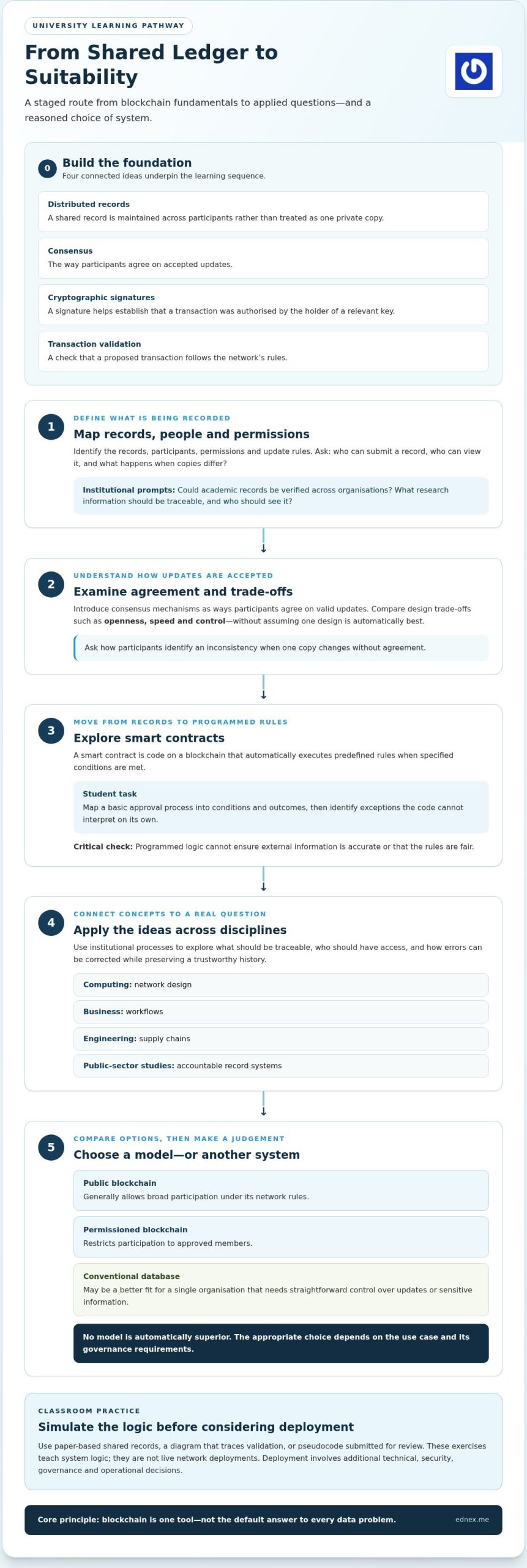
Start with four connected ideas: distributed records, consensus, cryptographic signatures, and transaction validation. A signature helps establish that a transaction was authorised by the holder of a relevant key. Validation checks whether it follows the network’s rules, while consensus describes how participants agree on accepted updates.
Make decentralisation tangible with a shared-record classroom exercise. Give groups matching copies of a simple transaction log, then ask them to agree on a proposed update using a defined rule. If one copy changes without agreement, students can compare versions and discuss how the group identifies the inconsistency. The activity illustrates the idea, not every technical feature of a live blockchain.
Teach judgement alongside mechanics. Blockchain is one tool, not the right answer for every data problem. A single organisation may be better served by a conventional database, particularly when it needs straightforward control over updates or sensitive information.
Why move beyond cryptocurrency examples?
Cryptocurrency can introduce transactions and digital signatures, but a curriculum centred on token trading narrows the subject and risks making blockchain learning sound like investment training. University study should build conceptual understanding and guided application, not promise investment expertise.
Institutional processes offer richer questions. How might an institution verify a record shared between organisations? What information should be traceable, and who should be able to see it? How can participants correct errors while preserving a trustworthy history? These questions connect computing students’ interest in network design with business students’ focus on workflows, engineering students’ attention to supply chains, and public-sector studies’ examination of accountable record systems.
For higher education audiences across the UAE, this cross-disciplinary approach makes blockchain training for universities UAE relevant without tying the curriculum to cryptocurrency headlines or policy claims. It equips students to assess where shared records may add value, then apply that reasoning to more specialised topics.
How blockchain concepts become practical university learning
Once students understand the purpose of a shared ledger, teaching can move from concepts to design choices and applied analysis. Build the pathway in stages: identify records, participants, permissions, and update rules; examine how a network agrees on updates; explore applications; and evaluate whether blockchain suits the problem. Each technical idea should lead to a question, demonstration, or piece of student work.
A staged pathway from ledger basics to smart contracts
Begin with a simple model in which participants propose updates to a shared ledger. Ask students who can submit a record, who can view it, and what happens when copies differ. Introduce consensus mechanisms as ways participants agree on valid updates, then compare trade-offs such as openness, speed, and control.
Next, explore rule-based actions. A smart contract is code on a blockchain that automatically executes predefined rules when specified conditions are met. Students might map a basic approval process into conditions and outcomes, then identify exceptions the code cannot interpret on its own. This highlights an important limitation: a contract can follow its programmed logic, but it cannot ensure that external information is accurate or that the rules are fair.
Activities can remain classroom simulations. Learners can update shared records on paper, use a diagram to trace validation, or submit pseudocode for review. These exercises teach system logic; they are not live network deployments. Deployment involves additional technical, security, governance, and operational decisions beyond a classroom model.
Choosing permissioned or public blockchain examples
Use the participation model to frame a design comparison. A public blockchain generally allows broad participation under its network rules. A permissioned blockchain restricts participation to approved members. Neither model is automatically superior; the appropriate choice depends on the use case and its governance requirements.
- Transparency: Which participants need to inspect records, and what should remain restricted?
- Privacy: Could sensitive information be kept off-chain or access-controlled?
- Governance: Who can join, validate updates, and respond to errors?
- Performance: How might participation rules affect throughput and coordination?
Ethereum and Hyperledger Fabric can illustrate different design approaches; students do not need to deploy either platform to compare them. Ask learners to assess how a proposed use case might fit each model, then defend their reasoning in a short design brief. This makes blockchain training for universities UAE relevant to interdisciplinary learning without reducing the curriculum to tool instruction.
For universities building applied technology learning, Ednex’s blockchain training fits within a broader higher education and Industry 4.0 context, linking foundational ideas to guided projects.
University blockchain training examples across disciplines
Cross-disciplinary examples help students investigate blockchain as a design choice, not a predetermined solution. The same shared-record concept raises different questions in computing, business, engineering, and research. For each activity, have students use fictional or sample data, state their assumptions, and explain what their proposed approach does and does not establish.
| Example | Discipline | Learning question | Student output |
|---|---|---|---|
| Credential verification | Computing, education, and public-sector studies | How could a recipient verify a credential without exposing unnecessary personal data? | A process diagram showing who issues, shares, and verifies a credential, with privacy risks identified. |
| Supply-chain provenance | Engineering, logistics, and business | How might records track a material or product through several hand-offs? | A sample provenance ledger and a short analysis of data quality, access, and error correction. |
| Research record integrity | Science, research methods, and information systems | What can a timestamped record contribute to auditability, and what can it not prove? | A mock research-record timeline with a discussion of authorship, corrections, and limits. |
| Smart-contract logic | Computing, business, and administration | Can a defined institutional process be expressed as conditions and actions? | A simulated contract or flowchart for a simple approval process, including exception cases. |
Credential verification and supply-chain provenance
For a credential exercise, have students map the issuer, graduate, and verifier. Then ask whether proof of authenticity could be shared without placing sensitive personal details on a shared record. For a provenance task, provide fictional records for a material as it moves between suppliers and a manufacturer. Ask learners who entered each update and how an incorrect entry could be challenged or corrected.
Assess the reasoning, not just the diagram. Strong work considers privacy, data quality, governance, and error correction, including the possibility that a technically valid record contains inaccurate information.
Research records and smart-contract exercises
Students can use a simulated research timeline to examine how timestamps may support an audit trail, while recognising that timestamps do not independently prove the truth or quality of a finding. For a smart-contract task, define a modest process, such as recording completion of a review before an approval step, then test the rules against exceptions.
A classroom prototype demonstrates an idea; a blockchain use case must also justify its value, governance, and operation in a real setting. Have students compare their prototype with a conventional database. If one trusted organisation can manage the records effectively, the simpler system may suffice. This gives blockchain training for universities UAE a clear academic purpose without presenting blockchain as the answer to every institutional challenge.
How to design and assess a university blockchain training pathway
A well-designed pathway starts with the learners and the capabilities they need, not with a platform. For blockchain training for universities UAE, this keeps teaching relevant across disciplines and makes progress assessable, from basic literacy to considered system design.
- Define learners and prerequisites. Identify whether students are new to blockchain, have studied related concepts, or are ready for technical implementation. State any assumed knowledge clearly.
- Set observable outcomes. Introductory learners might explain how a shared ledger is updated. Interdisciplinary groups might assess a use case and its trade-offs. Advanced learners might model a system or prototype its logic.
- Select discipline-relevant examples. Use scenarios connected to students’ fields, such as record verification, provenance, or a defined approval workflow. Make clear that each is a learning scenario, not a recommendation to adopt blockchain.
- Choose activities that build capability. Progress from concept checks and shared-record demonstrations to system diagrams, design briefs, or supervised prototypes. Keep simulations distinct from live deployments.
- Assess evidence and reasoning. Ask students to show how their design addresses the stated problem, justify key decisions, and identify limitations and alternatives.
- Review and refine. Use learner work and feedback to identify gaps, clarify prerequisites, and improve examples or assessment criteria for future delivery.
This pathway can connect with other emerging-technology learning. For example, an AI lab setup for UAE universities offers a complementary context for considering how different technologies address distinct learning and institutional challenges.
Match outcomes to student backgrounds
Not every learner needs to write code. Introductory objectives can focus on explaining core terms and identifying suitable or unsuitable problems. Interdisciplinary objectives can ask students to map participants, information flows, and governance choices. Technically advanced objectives can require a system model or prototype, supported by stated prerequisites. Make outcomes visible in a presentation, diagram, brief, or tested model.
Assess projects with evidence and reflection
A strong project brief asks students to define a problem, model a proposed system, and justify their design choice. Assessment should consider technical function alongside privacy, cybersecurity, data governance, and responsible handling of student work. Use sample or fictional data where appropriate, and set clear expectations for access, storage, and sharing.
Reward sound judgement, not blockchain use by default. Ask students to explain what could go wrong, how errors might be handled, and whether a conventional database would meet the need more simply. Ednex’s blockchain training connects these principles with applied higher education learning.
Connecting blockchain training with Ednex’s university learning ecosystem
A university can move from asking whether blockchain might address a particular challenge to helping students examine it through structured learning. The progression is deliberate: introduce the use case, identify the relevant concepts, develop a guided project, then assess the design reasoning and its limitations. This makes blockchain training for universities UAE applied technical education, rather than a discussion confined to cryptocurrency or abstract theory.
From a use-case question to an applied learning environment
Begin with a clearly defined institutional or discipline-based question. Students might explore what a shared record could contribute to verification or traceability, map who would participate, and identify what information should remain protected. A guided project can then ask learners to compare possible approaches and present a reasoned model, without implying that the institution should deploy it.
This pathway can complement wider advanced technology education. Blockchain concepts connect naturally to the broader Industry 4.0 learning context, where students consider how technologies interact with real processes and systems. For a wider view of this educational environment, explore the Industry 4.0 lab solutions guide. Related applied learning also draws on ideas in the advanced manufacturing technology lab guide.
Ednex offers blockchain training within its higher education and advanced technology learning portfolio in the UAE. Learning activities can be shaped around institutional goals and student backgrounds, linking foundational concepts to guided, assessed projects.
What a university can take forward
A strong pathway helps learners explain core concepts, connect them to questions across disciplines, and assess whether a blockchain-based approach is justified. Project work can develop the ability to define a problem, model a possible system, consider privacy and governance, and compare the proposal with simpler alternatives. Assessment should recognise sound analysis, including a well-supported conclusion that blockchain is not the best fit.
These principles give institutional teams a practical foundation for shaping learning around their educational objectives. For a closer look at how Ednex connects blockchain learning with higher education, explore Ednex’s blockchain training.
Turn blockchain concepts into meaningful university learning
Effective university blockchain education moves beyond cryptocurrency examples. Students build foundational understanding, explore cross-disciplinary use cases, and develop projects that test a real question while weighing privacy, governance, and alternative solutions. Assessment should reward clear reasoning, not blockchain adoption by default.
For institutions shaping blockchain training for universities UAE, the next step is to connect learning goals with suitable examples and guided, assessed activities. Ednex offers blockchain training for higher education institutions in the UAE as part of its broader advanced technology portfolio, spanning engineering and technology education. This creates a way to connect blockchain concepts with institutional priorities and Industry 4.0 learning.
Explore Ednex blockchain training for university learning and consider how applied technology education can support your institution’s objectives. A thoughtful progression from core concepts to critical project work helps universities engage learners with emerging technologies responsibly.
Frequently Asked Questions
What is blockchain training for universities?
Blockchain training for universities introduces students to distributed records, consensus, cryptographic signatures, transaction validation, and potential applications. In the UAE, blockchain training for universities UAE can connect these foundations to institutional and discipline-specific challenges. Learners might analyse a record-verification scenario, map participants and permissions, or assess whether blockchain suits a given problem. The goal is informed understanding and applied reasoning, not investment expertise or cryptocurrency trading.
How can universities teach blockchain beyond cryptocurrency?
Universities can teach blockchain through institutional and professional scenarios rather than focusing on token markets. Students might examine how credentials could be verified, how materials could be traced through a supply chain, or how research records could support an audit trail. They can map participants, access needs, and potential risks, then compare a blockchain model with other approaches. Cryptocurrency may provide one context, but it need not define the curriculum.
What are practical blockchain project examples for university students?
Project examples include mapping a credential verification process with privacy safeguards, creating a sample ledger to trace material provenance, and assessing what timestamped research records can and cannot demonstrate. Computing students might model consensus or draft smart-contract logic for a defined approval workflow. Business and engineering students could examine governance, information quality, and error correction. Projects can use simulated or fictional data and should not be presented as live deployments.
Can blockchain training benefit students outside computer science?
Yes. Blockchain raises questions about trust, record sharing, process design, and governance that extend beyond computing. Business students can examine workflows and accountability; engineering students can explore traceability; public-sector learners can consider verification and record management; research students can discuss auditability. Activities should suit each group’s background. Students do not need to build software to assess a use case, identify its limitations, and explain whether another solution may work better.
Is blockchain useful for verifying university credentials?
It can be explored as one possible way to support credential verification, especially when an issuer and a verifier need to assess whether a record is authentic. A learning exercise can map how a graduate shares proof while limiting unnecessary personal-data exposure. A blockchain record alone does not establish that the original information was accurate or that a credential was properly awarded. Institutions must consider privacy, governance, and correction processes as part of any design.
How should universities assess blockchain training projects?
Assess students on evidence and reasoning, not on whether they use blockchain. A project brief can require a clear problem statement, system model, justified design choice, and discussion of limitations. Evaluation can consider privacy, cybersecurity, data governance, and how errors might be addressed. Ask learners to compare their proposal with alternatives, including a conventional database. A thoughtful explanation of why blockchain is unsuitable can demonstrate strong understanding and sound technical judgement.
What is the difference between blockchain and a traditional database?
A database stores and organises information, often under the control of an administrator who manages access and updates. A blockchain is a type of shared digital ledger in which records are linked and updates are accepted according to network rules. The distinction is not simply that one is secure and the other is not. Blockchain may suit some shared-governance needs, while a conventional database can be simpler when one organisation manages the records.
Related Posts ...




Comments are disabled