



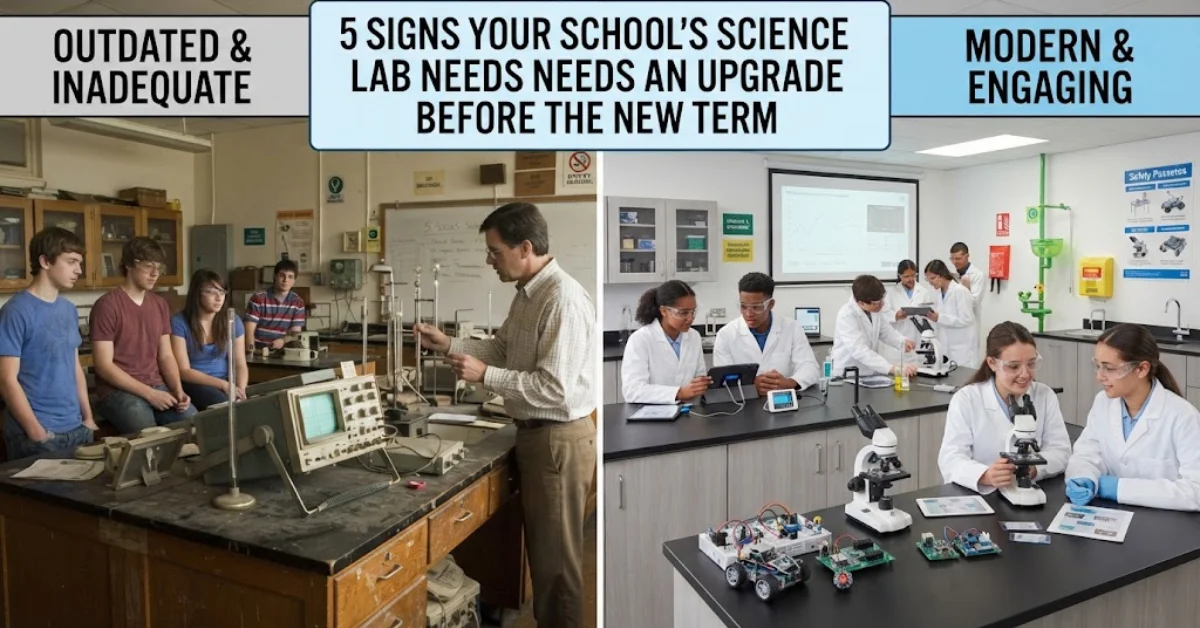
5 Signs Your School’s Science Lab Needs an Upgrade Before the New Term
A well-equipped science laboratory can transform how students learn. Instead of simply reading about scientific principles, students can conduct experiments, observe results, collect data, test hypotheses, and develop practical problem-solving skills.
But science laboratory equipment does not remain suitable forever. Some equipment becomes outdated, damaged, difficult to maintain, or no longer aligned with the curriculum. As schools prepare for a new academic term, it is important to evaluate whether the existing laboratory can support the learning experiences students are expected to receive.
For school administrators, science coordinators, and educators, the question is not simply whether the laboratory contains equipment. The more important question is whether the equipment is safe, functional, relevant, and capable of supporting effective hands-on learning.
Here are five important signs that your school’s science lab may need an upgrade before the new term.
1. Your Equipment Is Outdated or No Longer Supports the Curriculum
One of the clearest signs of a laboratory that needs an upgrade is outdated equipment.
Science education continues to evolve. Modern curricula increasingly encourage students to conduct practical investigations, use digital measurement tools, work with technology, analyze data, and apply scientific concepts to real-world problems.
Older equipment may still function, but that does not necessarily mean it provides the learning experience students need.
For example, a laboratory may still depend heavily on traditional measuring instruments when digital sensors and data acquisition systems could provide students with opportunities to collect and analyze data more efficiently.
Schools should review whether existing equipment supports current lessons in areas such as:
- Physics
- Chemistry
- Biology
- Environmental science
- Electronics
- Engineering
- Robotics
- Data analysis
Ask These Questions
School administrators can begin the assessment by asking:
- Can students complete the required practical experiments?
- Does the equipment support the current curriculum?
- Are students learning with technologies used in modern laboratories?
- Can teachers easily demonstrate scientific concepts?
- Are obsolete instruments limiting practical activities?
If the answer to several of these questions is no, it may be time to plan an upgrade.
2. Equipment Is Frequently Damaged, Unreliable, or Difficult to Maintain
Laboratory equipment experiences regular use, and even high-quality instruments eventually require maintenance or replacement.
Frequent breakdowns can have a direct impact on teaching.
If teachers regularly have to cancel experiments because equipment is unavailable, students lose valuable hands-on learning opportunities.
Common warning signs include:
- Equipment frequently stops working
- Replacement parts are difficult to find
- Instruments provide inconsistent results
- Calibration is overdue
- Repairs are becoming increasingly expensive
- Teachers avoid using certain equipment
- Consumables are difficult to source
A laboratory should not become dependent on temporary repairs simply to remain operational.
Consider Total Cost of Ownership
Schools should evaluate the long-term cost of maintaining older equipment.
Sometimes continuing to repair outdated equipment can be more expensive than investing in modern, reliable alternatives.
When reviewing replacement options, schools should consider:
- Purchase price
- Maintenance requirements
- Warranty
- Calibration
- Spare parts
- Technical support
- Consumables
- Expected service life
The cheapest equipment is not always the most cost-effective option.
3. Students Are Not Getting Enough Hands-On Experience
Another important warning sign is low student engagement with laboratory equipment.
A science lab may contain a large number of instruments but still provide limited practical learning if students rarely get to use them.
If students spend most laboratory sessions watching demonstrations instead of conducting experiments themselves, the laboratory may not be making full use of its potential.
Hands-on science education gives students opportunities to:
- Make observations
- Form hypotheses
- Conduct experiments
- Collect measurements
- Analyze data
- Identify errors
- Draw conclusions
- Communicate findings
From Demonstration to Investigation
A modern science laboratory should encourage students to become active participants.
For example, rather than simply watching a teacher demonstrate a physics experiment, students can work in small groups to measure variables, record data, compare results, and determine why their findings may differ.
Similarly, biology students can use appropriate laboratory equipment to investigate biological processes, while chemistry students can perform controlled experiments and analyze results.
The goal is to create a laboratory where students learn science by doing science.
4. Safety Equipment and Laboratory Infrastructure Need Attention
Safety should always be one of the first considerations when evaluating a school science laboratory.
A laboratory upgrade may be necessary if safety infrastructure is outdated, damaged, insufficient, or no longer appropriate for current activities.
Schools should inspect:
- Personal protective equipment
- Safety signage
- Emergency procedures
- First-aid supplies
- Fire safety equipment
- Electrical systems
- Ventilation
- Chemical storage
- Laboratory workstations
- Waste disposal systems
- Equipment operating procedures
The laboratory should also have clearly defined procedures for students and teachers.
Safety Should Be Part of Procurement
Schools should not treat safety as something to address after purchasing equipment.
Safety requirements should be considered during laboratory planning and equipment selection.
New equipment should be appropriate for the age group using it and should come with suitable operating instructions and training requirements.
Teachers and laboratory staff should also receive appropriate training before introducing new equipment into classroom activities.
5. Your Teachers Need Better Tools to Deliver Modern STEM Learning
A science laboratory upgrade is not only about students. Teachers also need appropriate tools and resources to deliver effective practical lessons.
If teachers regularly report that:
- Equipment is difficult to use
- Experiments take too long to prepare
- There are insufficient instruments for student groups
- Equipment does not match lesson requirements
- Data collection is difficult
- Existing resources limit project-based learning
then the laboratory may need modernization.
Teacher Feedback Is a Valuable Indicator
Teachers use laboratory equipment every day and can often identify problems that may not be visible during a general facility inspection.
Before planning an upgrade, schools should gather feedback from science teachers, laboratory technicians, department heads, and curriculum coordinators.
They can identify:
- Frequently used equipment
- Underused equipment
- Missing equipment
- Difficult-to-maintain instruments
- Equipment required for new experiments
- Training requirements
This information can help schools prioritize their investment.
What Should a Science Lab Upgrade Include?
A laboratory upgrade does not necessarily mean replacing everything.
Schools should first conduct an equipment audit and categorize existing resources into:
Keep: Equipment that is functional, safe, and curriculum-relevant.
Repair: Equipment that can be economically restored.
Replace: Equipment that is obsolete, unreliable, or unsafe.
Add: New equipment required for curriculum expansion or modern practical activities.
Depending on the school’s requirements, an upgrade may include:
- Science experiment equipment
- Digital measurement systems
- Microscopes
- Physics laboratory equipment
- Chemistry laboratory systems
- Biology equipment
- Electronics training systems
- Environmental science equipment
- Robotics and STEM kits
- Data acquisition systems
- Laboratory furniture
- Storage solutions
- Safety equipment
How to Plan a Cost-Effective Science Lab Upgrade
Schools should avoid making equipment purchases without a clear plan.
A practical upgrade process can follow these steps:
Step 1: Audit the Existing Laboratory
Record equipment condition, age, usage, maintenance history, and curriculum relevance.
Step 2: Review Curriculum Requirements
Identify the experiments and practical activities students need to complete during the new academic term.
Step 3: Identify Skills Gaps
Determine which scientific and technical skills students should develop and whether existing equipment supports them.
Step 4: Prioritize Equipment
Separate essential equipment from enhancement and future-expansion requirements.
Step 5: Establish a Budget
Consider purchase costs as well as installation, training, maintenance, consumables, and future support.
Step 6: Evaluate Suppliers
Look beyond product price and consider quality, warranty, technical support, training, and long-term scalability.
Step 7: Install and Test Before the New Term
Equipment should ideally be installed, tested, and commissioned before students begin using the laboratory.
Why a Modern Science Lab Matters
A science laboratory can play an important role in developing the next generation of scientists, engineers, healthcare professionals, researchers, and technology specialists.
Modern practical learning can help students develop:
- Critical thinking
- Scientific reasoning
- Problem-solving
- Collaboration
- Data analysis
- Technical skills
- Experimental design
- Communication
A laboratory upgrade should therefore be viewed as an investment in the quality of education rather than simply an infrastructure expense.
Choosing the Right Laboratory Partner
A successful science lab upgrade requires more than purchasing individual instruments. Schools may need support with laboratory planning, equipment selection, installation, teacher training, safety, maintenance, and future expansion.
EdNex provides laboratory solutions for educational institutions and can support schools in developing practical, technology-enabled learning environments.
When selecting a laboratory solutions provider, schools should consider:
- Curriculum alignment
- Equipment quality
- Safety
- Installation
- Teacher training
- Warranty
- Maintenance
- Technical support
- Scalability
- Long-term value
Conclusion
A science laboratory should evolve alongside the curriculum, students, teachers, and technologies used in modern education.
If your school’s equipment is outdated, frequently failing, rarely used by students, creating safety concerns, or limiting teachers’ ability to deliver practical STEM activities, these are strong indications that an upgrade should be considered before the new term.
The best approach is not necessarily to replace every piece of equipment. Instead, schools should conduct a structured audit, identify their most important needs, prioritize investments, and create a laboratory environment that supports meaningful hands-on learning.
With the right combination of modern equipment, safe infrastructure, teacher training, curriculum alignment, and technical support, schools can turn their science laboratories into engaging environments where students learn through experimentation and discovery.
For schools preparing for a new academic term, now is the right time to assess whether the current laboratory is ready for the next generation of learners.
Frequently Asked Questions
1. How do I know if my school’s science lab needs an upgrade?
Common signs include outdated equipment, frequent breakdowns, insufficient safety infrastructure, limited student access to practical experiments, and equipment that no longer supports the current curriculum.
2. Should schools replace all their science lab equipment during an upgrade?
Not necessarily. Schools should first conduct an equipment audit and identify which items can be retained, repaired, replaced, or added. A phased upgrade can be a cost-effective approach.
3. What equipment should schools consider when upgrading a science lab?
Depending on the curriculum, schools may consider modern physics, chemistry, biology, environmental science, digital measurement, microscopy, electronics, robotics, STEM, and data acquisition equipment.
4. Why is teacher training important when upgrading a science laboratory?
Teacher training helps educators use new equipment safely and effectively. It also enables teachers to incorporate practical experiments, data collection, project-based learning, and modern STEM activities into their lessons.
5. How can EdNex help schools upgrade their science laboratories?
EdNex provides laboratory solutions for educational institutions and can support schools with practical laboratory environments, equipment, and related solutions based on their curriculum and learning requirements.
Related Posts ...
Comments are disabled