



BiomechX for Education: Biomechatronics Lab Solutions Guide
For education, “biomechx” is best explored through biomechatronics: the study of how biological systems interact with mechanics, electronics, robotics, and control. Search results may point to unrelated health technology, apps, or individual products, so institutions should focus on the learning outcomes behind the search. The practical question is how students can connect these engineering disciplines through purposeful lab work.
A biomechatronics lab should do more than demonstrate equipment. It should link course objectives to activities students can perform, evidence instructors can assess, and facilities the institution can support. This guide explains how biomechatronics learning can take shape in higher education and vocational training, compares lab approaches, and outlines a practical planning process. It also explains how Ednex’s laboratory design and equipment implementation can help shape a learning environment around institutional needs. Start by defining the capabilities students should develop, then plan the lab around them.
Key Takeaways
- “BiomechX” can refer to unrelated technology contexts, so an educational search is best understood through the broader field of biomechatronics.
- Trace how sensing, signal interpretation, control, and physical response work together to make engineering concepts observable.
- Compare demonstration, modular project, and integrated lab approaches by learning goals, adaptability, teaching use, and implementation complexity.
- Translate curriculum outcomes into activities and facility requirements, then separate essential lab needs from optional extensions.
- Ednex designs and equips biomechatronics learning environments for higher education and vocational training.
What Does BiomechX Mean in Education? Start with Biomechatronics
Search results for “biomechx” can lead to unrelated apps, health technology, or equipment listings. For educational planning, treat the term as a route into biomechatronics, not as the name of a specific product. Biomechatronics brings biological systems together with engineering principles, including mechanics, electronics, robotics, and control.
In education, biomechatronics is the hands-on study of how engineered systems can sense, interpret, and respond to biological movement or function. It is a learning discipline, not a clinical equipment purchasing category. Students might explore how a sensor captures movement, how electronic signals are processed, or how a control system produces a mechanical response. The goal is engineering understanding through design, testing, and analysis, not diagnosis or treatment.
The Biomechatronics overview describes the field’s applications and research areas. For lab planning, the useful next step is to turn that broad field into course-level requirements: identify the concepts students need to understand, the tasks they will perform, and the evidence that will demonstrate their learning.
How Is Biomechatronics Different from Biomedical Engineering?
The fields overlap, but they do not always have the same emphasis. Biomedical engineering covers a broad range of engineering applications related to medicine and biology. Biomechatronics focuses more specifically on interactions between biological systems and engineered mechanical, electronic, robotic, or control systems. In a classroom, students could investigate movement sensing or model how feedback changes a mechanism’s response. These are engineering exercises, not clinical assessments. Course outcomes are the clearest way to define the scope of a particular module.
Where Does Biomechatronics Fit in Education?
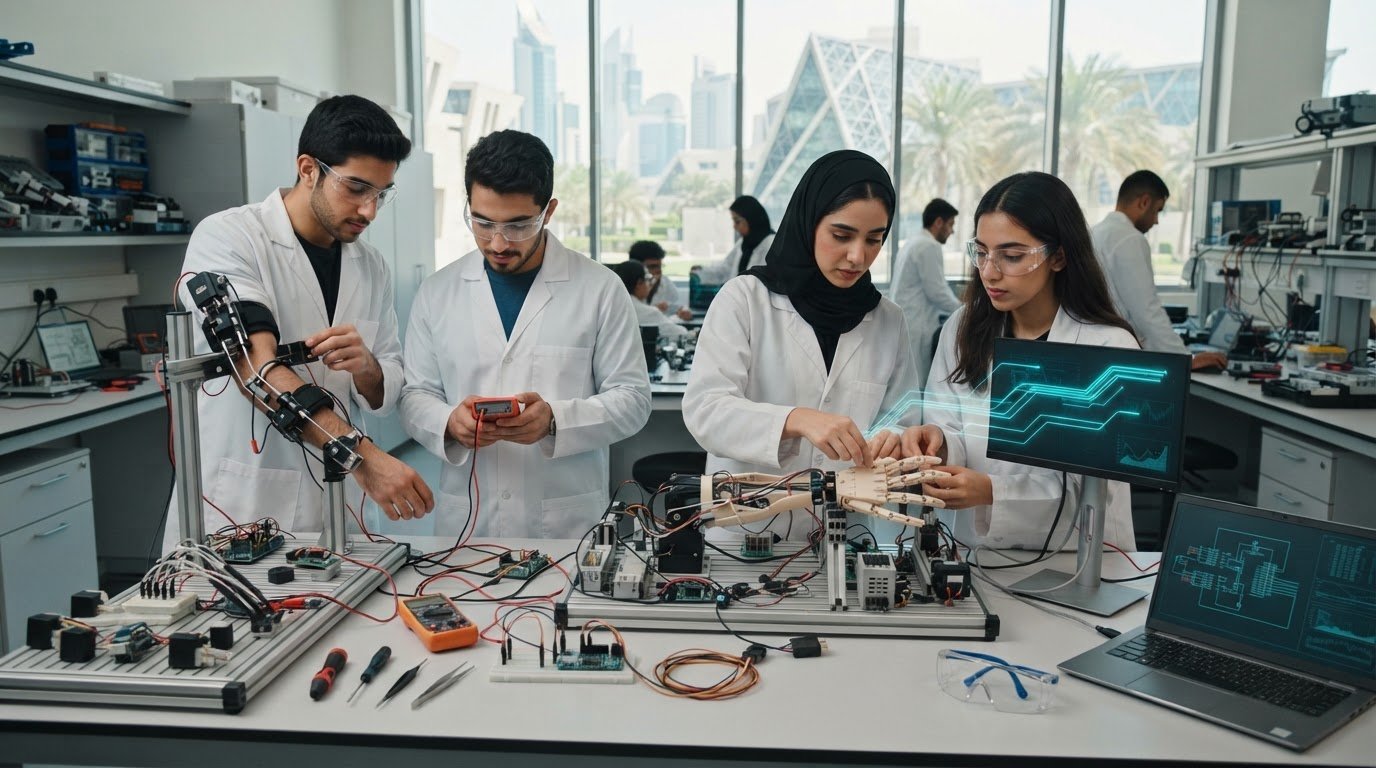
Biomechatronics can connect higher education and vocational technical learning with mechanical engineering, electronics, instrumentation, and control. Students apply concepts across disciplines by collecting a signal, interpreting what it represents, adjusting a system, and evaluating the response. This sequence develops practical problem-solving and makes the links between engineering subjects visible.
For curriculum planners, the field can support a progression from understanding components to completing integrated projects. Learners might first explore how sensors and actuators function, then use that knowledge in a controlled movement-modeling activity. Choose activities to match learner level, course objectives, and available facilities. Within a broader engineering ecosystem, biomechatronics can also complement futuristic engineering lab solutions, connecting emerging technical fields within a coherent learning environment.
How Biomechatronics Systems Connect Sensors, Movement, and Control
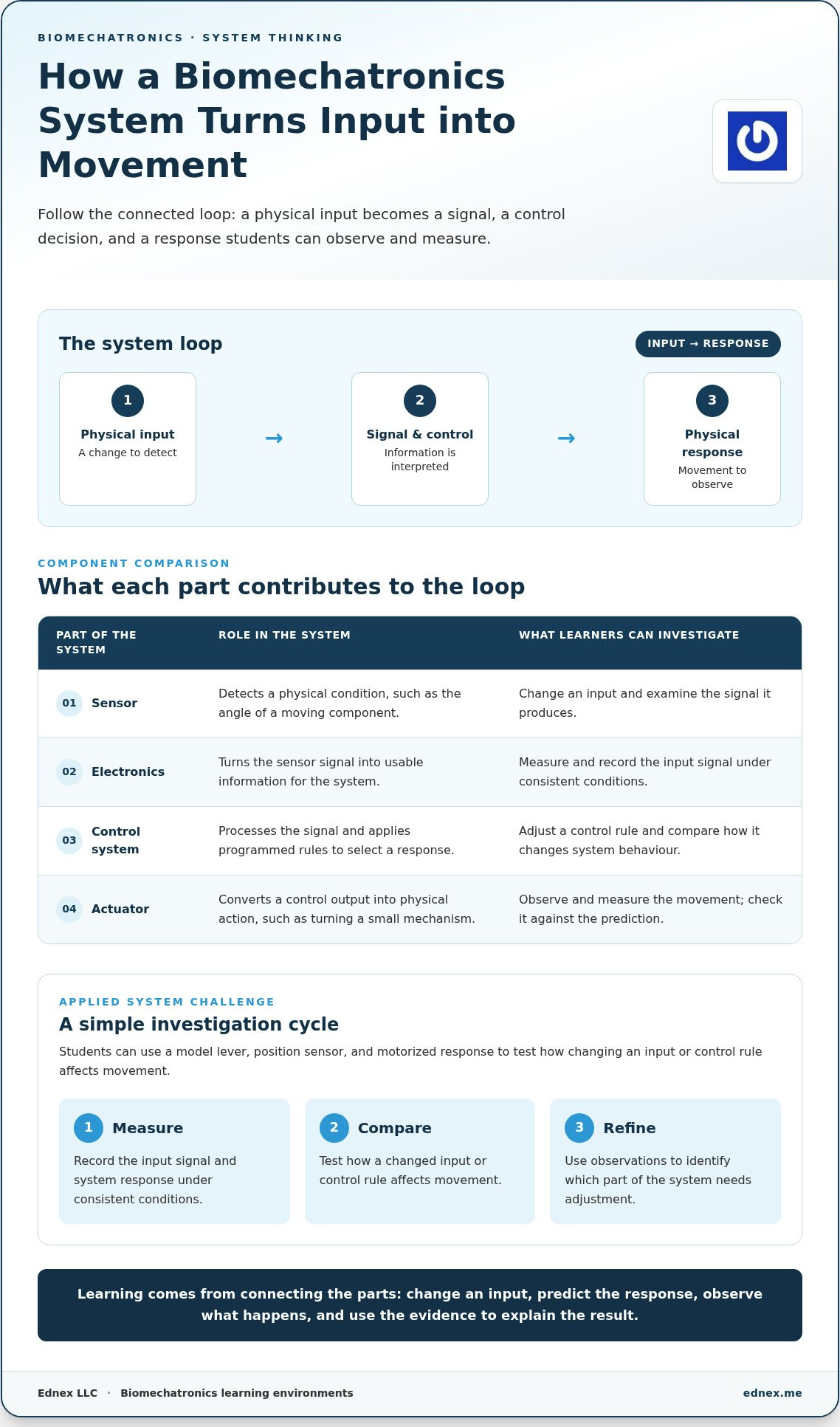
A biomechatronics learning system works as a loop, not a collection of disconnected components. A physical input produces a measurable signal. A controller interprets that signal according to programmed rules, an output device responds, and learners observe the result. This loop makes ideas from instrumentation, electronics, mechanics, and control visible through system behaviour.
A sensor detects a change, electronics turn it into usable information, a controller selects a response, and an actuator creates movement that students can observe and measure. Students can use the sequence to investigate cause and effect: change an input, predict the response, and compare the prediction with what happens.
What Roles Do Sensors, Actuators, and Control Systems Play?
A sensor detects a physical condition, such as the angle of a moving component. A control system processes its signal and applies programmed logic. An actuator converts a control output into physical action, such as turning a small mechanism. Each has a distinct role, but the learning comes from examining how the parts interact and identifying where system behaviour changes.
For a classroom prototype, students could use a model lever with a position sensor and a motorized response. They can adjust the input or control rule, then observe whether the model behaves as expected. The example keeps the investigation focused on a system and avoids human testing.
What Can Students Learn Through Applied System Challenges?
Structured challenges ask learners to measure inputs and outputs, record observations, and revise a design when results differ from predictions. Teams can divide work across sensing, control logic, and mechanical response, then combine their components to test the full loop. Ask students to explain what they changed, what they observed, and how the evidence informed their next step.
- Measure: Record the input signal and system response under consistent conditions.
- Compare: Test how a changed input or control rule affects movement.
- Refine: Use observations to identify which part of the system needs adjustment.
This structure connects a biomechx search to practical engineering study. Instead of relying on an ambiguous term, students investigate observable relationships among input, processing, and output. In broader robotics activities, the same systems thinking can inform work supported by a robotics lab setup, connecting sensing and control to wider robotic platforms.
Institutions can shape these activities around their curriculum and facilities. Ednex designs and equips specialist educational laboratories, including biomechatronics systems for higher education and vocational training. For a broader view of how these environments can fit into an engineering ecosystem, explore Ednex’s educational lab solutions.
Compare Biomechatronics Lab Approaches by Learning Goal
Compare lab approaches by what learners will do, rather than by equipment lists. An institution introducing a concept in a single lesson may need a different environment from one supporting repeated projects or a learning pathway across several engineering subjects. The models below are planning frameworks, not named Ednex packages or fixed configurations. Use them to align lab scope with curriculum, learner access, and available facilities.
The right educational fit depends on the activities students need to practise, the concepts they need to connect, and how those experiences build across a course.
| Approach | Learning objective | Adaptability | Teaching use | Implementation complexity |
|---|---|---|---|---|
| Focused demonstration | Introduce a small set of core concepts | Typically narrower | Instructor-led explanation and observation | Lower relative complexity; scope remains limited |
| Modular project work | Explore components and relationships through tasks | More adaptable across activities | Guided projects, testing, and design iteration | Moderate; requires planning how modules support lessons |
| Integrated lab pathway | Connect concepts across courses or disciplines | Broad, shaped by the curriculum | Progressive projects and cross-disciplinary teaching | Greater coordination across space, systems, and instruction |
When Does a Focused Demonstration Suit an Institution?
A focused demonstration can introduce a concept such as the relationship between a measured input and a mechanism’s response. Its narrow scope can fit into an existing lesson and give learners a clear starting point. The trade-off is less room for open-ended investigation or adapting an activity to different project briefs. Treat any example as illustrative, not as a fixed equipment requirement.
When Is a Modular or Integrated Lab Approach More Suitable?
Modular project work supports varied activities by letting instructors build investigations around connected system categories. It can also support staged learning, moving from guided exploration to more independent design tasks. An integrated pathway takes a broader view, linking biomechatronics with subjects such as instrumentation, control, and robotics across courses. This requires more coordination, but helps institutions plan connected learning experiences rather than isolated demonstrations.
Cross-disciplinary planning also matters in areas such as Industry 4.0, where institutions can connect engineering subjects through shared learning priorities. A biomechx search can be a starting point, but the decision should rest on course aims. Identify the activities, map how learners will progress, and select the lab approach that supports that sequence. Ednex designs and equips specialist educational laboratories, including biomechatronics systems for higher education and vocational training, with the learning environment tailored to institutional needs.
Plan a Biomechatronics Lab Around Learners and Curriculum
A strong lab plan begins with the educational experience, not a shopping list. Define what learners should understand and practise, then work outward to activities, facilities, staff preparation, and equipment integration. This sequence helps institutions distinguish essential teaching requirements from possible enhancements. It also keeps a biomechx search focused on the learning environment the institution needs to create.
How Should Institutions Define Learning Outcomes and Projects?
Start with course objectives, learner experience, and the capabilities students are expected to develop. A higher education course may emphasise system analysis and design decisions, while vocational training may focus on applying technical procedures and interpreting system behaviour. Map each objective to a practical activity and evidence of learning, such as a recorded test, design explanation, or project review.
- Set the learning outcomes. Identify the concepts and capabilities the course intends to develop, taking learners’ prior experience into account.
- Design activities and assessment evidence. For each outcome, define what students will do and how instructors will assess their reasoning or work. Make projects suitable for the relevant learner levels and course formats.
- Separate essential needs from enhancements. List the space, system categories, and teaching resources required for core activities. Add extensions when they support a defined curriculum priority, rather than increasing complexity without a clear purpose.
- Plan the facility and workflow. Consider room layout, learner access, instructor supervision, storage, and equipment integration. Plan safe supervision around the selected activities and systems, following the institution’s applicable procedures.
- Prepare for implementation and future use. Identify faculty preparation, staff responsibilities for routine equipment care, and ways the lab can adapt as courses or projects evolve. Review the plan with relevant teaching and facilities stakeholders before implementation.
What Should Facility and Implementation Planning Cover?
Translate planned activities into a workable room and teaching plan. Consider how learners and instructors will access and use the space, where materials will be stored, and how equipment will support the intended workflow. Faculty readiness matters too: instructors need to understand the activities and systems they will teach. Define responsibilities for preparation and maintenance, and plan for future adaptation without assuming a fixed room size, cost, or delivery schedule.
Once outcomes, activities, and facilities align, the institution can turn its goals into a practical lab brief. Explore Ednex educational lab solutions to see how specialist laboratory design and equipment implementation can be tailored to institutional priorities.
How Ednex Supports Biomechatronics Learning Environments
A specialist educational lab takes shape when curriculum, learners, facilities, and equipment work as one system. Ednex designs and equips educational laboratories, including biomechatronics systems for higher education and vocational training. Planning can start with institutional learning goals and the activities students need to undertake, then connect those priorities to laboratory design and equipment supply.
For decision-makers exploring biomechx, the practical focus is not a single device or fixed configuration. It is an educational environment aligned with the institution’s courses, teaching approach, and facilities. A considered plan clarifies how students will use the space, how activities relate to wider engineering subjects, and which capabilities the institution wants the lab to support over time.
How Can Biomechatronics Fit a Wider Engineering Learning Ecosystem?
Biomechatronics can sit alongside learning in mechanical engineering, electronics, instrumentation, control, and robotics. The connections depend on the institution’s programme. One curriculum may prioritise a focused biomechatronics environment, while another may connect it with broader engineering activities. There is no universal lab configuration for every institution. Plan around the intended learning pathway and the role of related technical subjects.
Institutions considering connections across emerging engineering disciplines can also explore futuristic engineering lab solutions as a broader planning context. Integration works best when related learning environments reinforce the institution’s educational direction, rather than simply combining technologies under one roof.
What Should Decision-Makers Bring to a Project Discussion?
A useful project discussion starts with the information that will shape design and implementation. Decision-makers can prepare a concise brief covering:
- Curriculum priorities: the courses, learning objectives, and practical activities the laboratory should support.
- Learner groups: the intended learner levels and whether the environment will serve higher education, vocational training, or both.
- Available facilities: relevant room details, existing engineering resources, access needs, and operational considerations.
- Project scope: the capabilities required for essential teaching activities and any future extensions to consider.
- Implementation needs: faculty preparation, equipment integration, and ongoing responsibilities that should inform planning.
This brief gives Ednex a clear foundation for tailoring laboratory design and equipment implementation to institutional objectives. It also helps frame how biomechatronics learning can connect with the wider technical education ecosystem, while keeping the plan specific to the institution’s courses and facilities.
Bring your curriculum priorities and project scope into the conversation. Discuss an educational laboratory project with Ednex.
Turn Learning Priorities into a Lab Vision
Turn institutional ambitions into a clear project direction by identifying the capabilities learners should build, how biomechatronics can support those priorities, and where the learning environment could connect with other engineering disciplines. A focused brief gives faculty and decision-makers a shared foundation for shaping a lab around teaching plans and future curriculum needs.
For teams exploring biomechx, the opportunity is bigger than finding equipment. It is creating the conditions for learners to engage with engineering ideas through purposeful practice. Ednex brings specialist laboratory design and biomechatronics systems for higher education and vocational training into the planning process, connecting institutional goals with an educational environment designed around them.
Bring your curriculum priorities, learner needs, and project scope to Ednex. Explore Ednex laboratory solutions and start planning a learning environment around your institution’s direction.
Frequently Asked Questions
What does BiomechX mean in an educational context?
In education, “biomechx” is best treated as a search term for biomechatronics learning, not as the name of a specific product. The topic involves applying engineering ideas to explore interactions between biological systems and technology. For example, students might model how a sensor detects a change in a moving structure. Use course descriptions and learning objectives to define the intended subject and avoid assuming that search listings refer to one standard lab or device.
Is biomechatronics the same as biomedical engineering?
No. The disciplines overlap, but biomedical engineering covers a broad range of engineering applications connected to biology and medicine. Biomechatronics focuses more specifically on combining biological-system concepts with mechanical, electronic, robotic, and control principles. An institution might place a movement-sensing project in a biomechatronics module while exploring other engineering applications in biomedical engineering courses. Programme scope and learning objectives clarify how the terms are used.
Can biomechatronics projects use non-medical examples?
Yes. Projects can use models and mechanical systems without clinical applications or human testing. For instance, students could design a tabletop mechanism that responds to the changing angle of a model joint, or compare how different control rules affect a moving linkage. These activities let learners investigate sensing, motion, and system behaviour while keeping the focus on engineering principles rather than diagnosis, treatment, or patient outcomes.
What skills can students develop through biomechatronics learning?
Biomechatronics activities can give students practice in measurement, signal interpretation, basic control logic, mechanical reasoning, and technical communication. A project team might document why a model mechanism responds differently after an input change, then present its test results and design choices. The specific capabilities depend on the course and activity. Instructors can make expected technical and teamwork skills clear in the project brief.
Can an existing engineering lab support biomechatronics activities?
It can, depending on the lab’s resources and the planned activities. Map existing equipment, work areas, access arrangements, and instructor capabilities against course requirements. A lab used for electronics or instrumentation may already support some learning tasks, while a project involving physical movement may need additional planning for space and supervision. This assessment helps identify what can be used, adapted, or added.
How should institutions assess learning outcomes in a biomechatronics lab?
Assess both process and understanding, not just whether a prototype moves. Students might submit measurement records, annotated diagrams, an explanation of control decisions, and a reflection comparing predicted and observed behaviour. A rubric can clarify criteria such as testing practice, interpretation of results, and quality of reasoning. Match each assessment method to the course objective so students understand what their practical work is intended to demonstrate.
What should an institution consider before planning a biomechatronics lab?
Start with the courses the lab will serve, learners’ prior experience, planned practical activities, and the evidence instructors will assess. Then consider available space, existing equipment, staff preparation, supervision, storage, and responsibilities for upkeep. Separate core teaching needs from optional extensions, and consider how the environment could accommodate curriculum changes. A concise project brief helps align academic, facilities, and implementation discussions around shared priorities.
Related Posts ...
Comments are disabled