








Vocational Training ROI: How UAE Industrial Employers Measure Skills-Gap Program Success
The UAE’s industrial sector is evolving rapidly. Manufacturing, energy, logistics, construction, engineering, utilities, and advanced industrial operations increasingly depend on skilled employees who can work safely and efficiently with modern technologies.
As industrial organizations invest in automation, digital systems, advanced machinery, and new production processes, one challenge continues to receive attention: the skills gap.
Hiring new employees is one way to address skills shortages, but vocational training and workforce development can provide another solution. By improving the capabilities of existing employees, companies can strengthen productivity, reduce operational risks, and prepare their workforce for changing industrial requirements.
However, training is an investment. Industrial employers need to understand whether that investment is producing measurable results.
This is where vocational training ROI becomes important.
For UAE industrial employers, measuring the success of a skills-gap training program should go beyond the number of employees who completed a course. Organizations should evaluate whether training has improved employee performance, reduced operational problems, increased productivity, strengthened safety, and contributed to measurable business outcomes.
Why Skills-Gap Training Matters in the UAE Industrial Sector
Industrial workplaces increasingly require employees to combine technical knowledge with practical skills.
Employees may need to operate automated systems, interpret technical information, use digital tools, troubleshoot equipment, follow advanced safety procedures, and work with increasingly sophisticated machinery.
A skills gap can occur when employees do not have the competencies required for their current responsibilities or when existing skills no longer match changing workplace technologies.
Vocational training can help organizations address these gaps through practical, job-focused learning.
Instead of providing training based only on general topics, employers can identify specific competency gaps and create programs around the skills employees actually need.
For example, an industrial organization may discover that technicians need stronger capabilities in:
- Equipment maintenance
- Industrial automation
- Electrical systems
- PLC programming
- Robotics
- Mechanical systems
- Welding and fabrication
- Health and safety
- Digital manufacturing
- Preventive maintenance
- Quality control
The goal is to turn these identified gaps into measurable learning and performance improvements.
What Does Vocational Training ROI Mean?
Training Return on Investment, or training ROI, measures the financial or operational value generated by a training program compared with its cost.
A simplified ROI calculation can be expressed as:
Training ROI = (Training Benefits − Training Costs) ÷ Training Costs × 100
However, industrial employers should not rely exclusively on financial calculations.
Some training benefits may be difficult to immediately convert into monetary value. Improved safety awareness, stronger employee confidence, better technical decision-making, and greater workforce adaptability can also create significant organizational value.
Therefore, a strong vocational training evaluation should combine financial, operational, technical, and workforce indicators.
1. Measure Skills Before and After Training
The first step in evaluating a skills-gap program is establishing a baseline.
Before training begins, employers can assess employee competencies through:
- Practical skills assessments
- Technical tests
- Equipment operation demonstrations
- Troubleshooting exercises
- Supervisor evaluations
- Competency checklists
- Workplace performance data
After completing the program, the same or equivalent assessments can be conducted.
This creates a measurable comparison between the employee’s capabilities before and after training.
For example, if technicians initially demonstrate limited ability to diagnose industrial equipment faults but can independently identify and troubleshoot faults after training, the organization has evidence of skill improvement.
2. Track Productivity Improvements
One of the most important indicators of vocational training success is productivity.
Employers can evaluate whether trained employees complete tasks more efficiently or with fewer interruptions.
Relevant measurements may include:
- Production output
- Task completion time
- Equipment utilization
- Maintenance response time
- Downtime
- First-time-right performance
- Work order completion
- Production cycle time
For example, if maintenance technicians receive training in preventive maintenance and troubleshooting, the employer can monitor whether equipment downtime decreases after the training program.
The objective is to connect learning with measurable workplace performance.
3. Measure Reduction in Equipment Downtime
For industrial organizations, unplanned downtime can have significant operational consequences.
Technical training can help employees identify equipment problems earlier, perform maintenance correctly, and troubleshoot faults more efficiently.
Employers can compare downtime data before and after training.
Useful indicators include:
- Number of equipment breakdowns
- Mean time to repair
- Mean time between failures
- Maintenance response time
- Repeat equipment faults
- Preventive maintenance compliance
If a training program results in fewer repeat failures or faster repairs, the organization can begin connecting training investment to operational savings.
4. Evaluate Safety Performance
Safety is another important indicator of vocational training effectiveness.
Industrial employees often work around machinery, electrical systems, chemicals, elevated work areas, vehicles, and other workplace hazards. Practical training can improve employees’ ability to identify hazards and follow correct procedures.
Organizations can monitor indicators such as:
- Safety incidents
- Near-miss reports
- Safety violations
- PPE compliance
- Equipment operating errors
- Corrective actions
- Safety audit findings
A successful training program should contribute to safer workplace behavior.
However, employers should avoid measuring safety training only by whether incidents occur. A reduction in unsafe practices and stronger compliance can also provide evidence of improvement.
5. Measure Quality Improvements
Skills gaps can affect product and service quality.
Employees who lack technical knowledge may make avoidable errors, incorrectly operate equipment, or fail to identify problems during production.
After training, organizations can monitor:
- Defect rates
- Rework
- Scrap
- Customer complaints
- Inspection failures
- Process deviations
- Quality audit findings
For example, technical training in machine operation or quality inspection may reduce production defects.
These improvements can contribute directly to cost savings.
6. Track Employee Certification and Competency
Vocational training programs can also be evaluated through competency attainment.
Employers can track the percentage of employees who successfully complete practical assessments or achieve relevant certifications.
However, certification alone should not be considered proof of workplace success.
A stronger approach is to combine certification with workplace competency.
For example:
Training completed → Practical assessment passed → Workplace competency demonstrated → Performance improvement measured
This creates a more complete picture of training effectiveness.
7. Measure Internal Workforce Development
Vocational training can also reduce an organization’s dependence on external recruitment for certain technical roles.
If existing employees can be trained for higher-skilled positions, companies may be able to develop internal talent pipelines.
Employers can measure:
- Internal promotions
- Cross-skilling
- Multiskilling
- Employee retention
- Time to competency
- Internal transfers
- Reduction in external recruitment needs
This is particularly valuable when organizations require specialized technical skills that may be difficult to recruit quickly.
8. Evaluate Employee Retention and Engagement
Training can contribute to employee development and career progression.
Employees who see opportunities to develop technical skills may be more likely to engage with their work and pursue longer-term career growth within an organization.
Employers can monitor:
- Employee retention
- Training participation
- Skills progression
- Internal mobility
- Employee feedback
- Engagement scores
While training should not be assumed to be the sole cause of improved retention, workforce development can be an important component of an overall employee development strategy.
9. Use a Skills Matrix to Identify Training Gaps
A skills matrix is a practical tool for managing vocational training.
It can show which employees possess specific competencies and where additional development is required.
For example:
Skill | Required Level | Current Level | Gap |
PLC Programming | Advanced | Intermediate | High |
Preventive Maintenance | Advanced | Basic | High |
Electrical Safety | Advanced | Intermediate | Medium |
Equipment Diagnostics | Advanced | Intermediate | Medium |
This approach allows employers to prioritize training based on actual operational requirements.
Instead of sending employees to generic courses, organizations can create targeted skills-gap programs.
10. Calculate the Total Cost of Training
To calculate ROI effectively, employers need to consider the complete cost of training.
This may include:
- Training equipment
- Instructor costs
- Learning materials
- Laboratory or workshop facilities
- Employee training hours
- Travel expenses
- Assessment and certification
- Equipment maintenance
- Technology and software
- Administrative costs
Calculating the full cost provides a more realistic picture of the investment.
11. Compare Training Benefits With Business Results
Once training costs and outcomes are available, employers can begin measuring the business impact.
For example, suppose an organization invests in technical training that costs AED 100,000.
After training, the organization identifies AED 160,000 in measurable benefits through reduced downtime, lower rework, improved maintenance efficiency, and reduced external recruitment costs.
Using the basic ROI formula:
ROI = (AED 160,000 − AED 100,000) ÷ AED 100,000 × 100
ROI = 60%
This provides a financial indicator of the program’s value.
However, organizations should also record non-financial outcomes such as improved employee competency, stronger safety practices, and greater workforce flexibility.
Building a Data-Driven Vocational Training Strategy
Successful skills-gap programs should not end when employees complete training.
Employers should establish a continuous improvement cycle:
Identify Skills Gap → Assess Employees → Deliver Training → Evaluate Competency → Measure Workplace Performance → Calculate ROI → Improve Training
This creates a connection between training departments and operational management.
Managers can use performance data to determine whether training content needs to change, whether employees require additional practice, or whether new equipment and technologies should be introduced into the training environment.
The Role of Practical Training Equipment
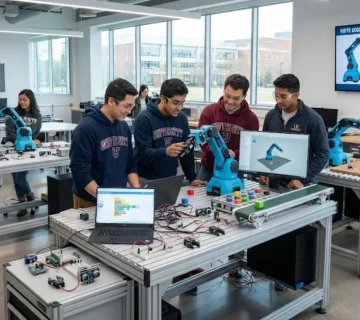
For industrial vocational education, hands-on equipment can make a major difference.
Employees often need to learn by performing real tasks rather than simply watching demonstrations or completing theoretical assessments.
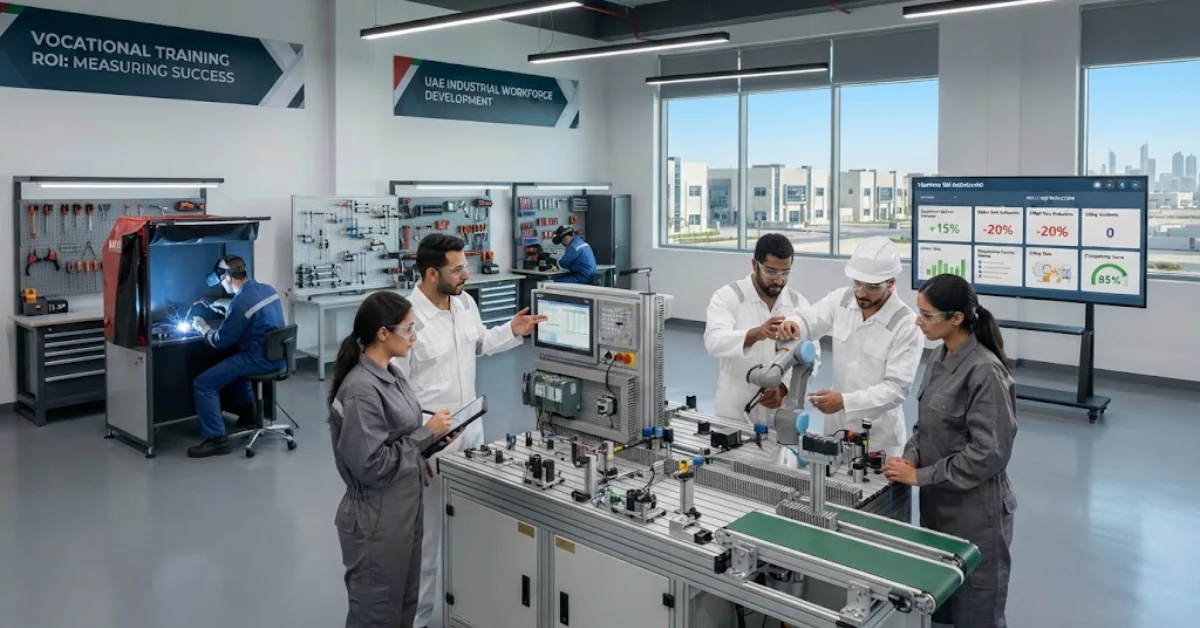
Practical training environments can include equipment for:
- Industrial automation
- PLC systems
- Electrical training
- Mechanical systems
- Pneumatics and hydraulics
- Robotics
- Welding
- Manufacturing
- Mechatronics
- Maintenance and troubleshooting
EdNex provides laboratory and technical training solutions for educational and industrial training environments.
A well-designed practical training facility can help organizations evaluate not only whether employees understand technical concepts, but whether they can apply those concepts safely and effectively.
Conclusion
For UAE industrial employers, vocational training should be viewed as a measurable workforce investment rather than simply an employee development activity.
The success of a skills-gap program can be evaluated through a combination of indicators, including competency improvement, productivity, equipment downtime, safety performance, quality, certification, employee development, retention, and financial ROI.
The most effective approach begins by identifying specific skills gaps and establishing measurable baseline performance. Training can then be designed around practical workplace requirements and evaluated through post-training assessments and operational data.
When employers connect training, practical skills, workplace performance, and business outcomes, they can make better decisions about workforce development and demonstrate the value of vocational education.
For organizations operating in the UAE’s evolving industrial landscape, a data-driven vocational training strategy can help build a workforce that is not only more skilled today but also better prepared for the technologies and industrial requirements of tomorrow.
Frequently Asked Questions
1. What is vocational training ROI?
Vocational training ROI measures the value an organization receives from a training investment compared with the total cost of delivering the program. It can include financial benefits as well as improvements in productivity, quality, safety, employee competency, and operational efficiency.
2. How can UAE industrial companies measure skills-gap training success?
Companies can measure training success through pre- and post-training assessments, productivity data, equipment downtime, safety indicators, quality performance, certification rates, employee competency, and financial outcomes.
3. Why is practical training important for industrial employees?
Practical training allows employees to apply technical knowledge in realistic situations. It can help them develop equipment operation, maintenance, troubleshooting, safety, automation, and other job-specific skills.
4. What is a skills matrix?
A skills matrix is a tool used to compare the competencies employees currently possess with the skills required for their roles. It helps organizations identify skills gaps and prioritize training programs.
5. How can companies calculate training ROI?
A basic calculation is: ROI = (Training Benefits − Training Costs) ÷ Training Costs × 100. Employers should consider measurable benefits such as reduced downtime, improved productivity, lower rework, and reduced recruitment costs.
6. What KPIs should industrial employers track after vocational training?
Important KPIs can include productivity, downtime, maintenance response time, defect rates, safety incidents, competency assessment scores, certification completion, employee retention, and internal promotions.
7. Can vocational training reduce equipment downtime?
Yes. When training is specifically designed around maintenance, troubleshooting, equipment operation, and preventive maintenance requirements, improved employee competency can contribute to reduced downtime and faster fault resolution.
8. How does vocational training support workforce development?
Vocational training helps employees develop practical technical competencies required for current and emerging industrial roles. It can also support cross-skilling, upskilling, internal mobility, and the development of future technical talent.
9. Why should training programs include hands-on equipment?
Hands-on equipment allows employees to practice technical procedures in a controlled environment before applying their skills in the workplace. It also enables employers to evaluate practical competency rather than relying only on theoretical knowledge.
10. How can EdNex support vocational training programs?
EdNex provides laboratory and technical training solutions that can support practical learning environments. Its solutions can be used to develop training facilities focused on industrial technologies, engineering skills, automation, and other technical competencies.
Related Posts ...


Comments are disabled