


Why Niryo Robotic Arms Are Becoming the Standard for University Robotics Labs
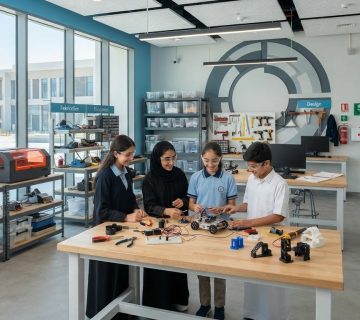
Robotics education is moving beyond basic demonstrations. Universities increasingly want students to work with robotic systems that allow them to program, experiment, integrate sensors, test automation concepts, and develop real engineering solutions.
This shift has increased interest in compact, programmable robotic arms for university laboratories.
Among the educational robotics platforms available today, Niryo robotic arms have attracted attention because they provide students with a practical way to explore industrial robotics concepts in an academic environment.
For universities building or upgrading robotics laboratories, robotic arms can serve as an important bridge between classroom theory and industrial automation.
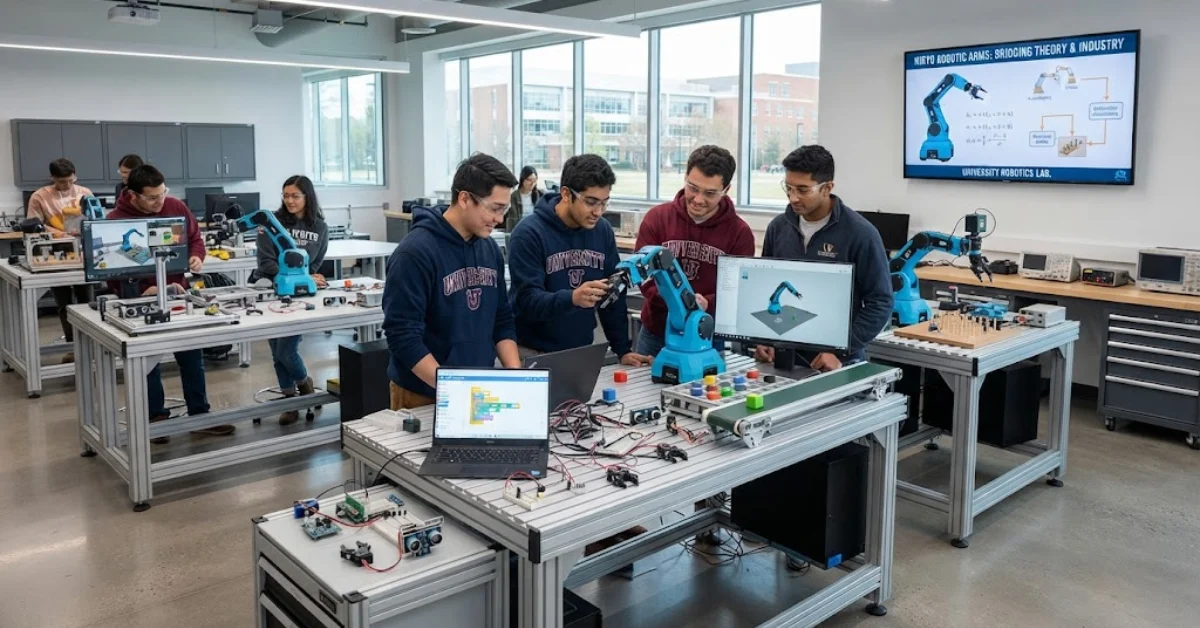
The value of a robotic arm in education is not simply its ability to move objects. Students can use it to explore programming, kinematics, motion planning, automation, computer vision, end-effectors, control systems, and human-robot interaction.
What Are Niryo Robotic Arms?
Niryo develops educational and collaborative robotic solutions designed to make robotics and automation concepts accessible for learning, prototyping, and research.
Their robotic arms can be used in educational environments to introduce students to concepts associated with industrial robotics while providing a platform that is appropriate for laboratory experimentation.
Depending on the configuration, students can work with robotic arms, grippers, sensors, vision systems, programming environments, and automation workflows.
This makes them suitable for universities looking to provide practical exposure to robotics without relying exclusively on large industrial robotic installations.
Why Are Robotic Arms Important in University Education?
Robotic arms combine several engineering disciplines in one platform.
A single laboratory project can involve:
- Mechanical engineering
- Electrical engineering
- Electronics
- Embedded systems
- Programming
- Control systems
- Artificial intelligence
- Computer vision
- Automation
- Industrial engineering
This multidisciplinary nature makes robotic arms valuable teaching tools.
Students can learn how software commands are converted into physical movement and how sensors, controllers, motors, and mechanical structures work together.
1. They Connect Theory With Practical Application
Robotics students often learn concepts such as coordinate systems, kinematics, dynamics, control algorithms, and programming through lectures and simulations.
A physical robotic arm allows them to see these concepts in action.
For example, students studying robotic kinematics can calculate the required joint movements for a particular position and then test their calculations using a real robotic system.
This creates a direct connection between mathematical theory and physical behavior.
2. They Provide Hands-On Programming Experience
Programming is an essential component of modern robotics.
A university robotic arm can give students opportunities to develop programs that control movement, interact with sensors, perform sequences, and respond to external inputs.
Students can progress from simple tasks to more advanced applications.
Beginner Projects
Students can learn to:
- Move the robotic arm between positions
- Control individual joints
- Operate a gripper
- Create basic movement sequences
Intermediate Projects
Students can develop:
- Pick-and-place operations
- Object sorting
- Automated workflows
- Sensor-triggered movements
- Repetitive assembly tasks
Advanced Projects
Students can explore:
- Computer vision
- AI-assisted object recognition
- Automated inspection
- Human-robot interaction
- Multi-robot coordination
- Smart manufacturing concepts
This progression makes robotic arms useful across multiple levels of university education.
3. They Introduce Students to Industrial Automation
Robotic arms are widely associated with manufacturing and automation.
Although educational robotic platforms are not necessarily direct replacements for full-scale industrial systems, they can introduce students to the principles behind automated production.
Students can explore applications such as:
- Pick and place
- Sorting
- Assembly
- Machine tending
- Inspection
- Packaging
- Material handling
These activities help students understand how robots can improve consistency, productivity, and repeatability in industrial processes.
4. Compact Robotic Platforms Fit University Laboratories
Space can be a significant limitation for universities.
Large industrial robots may require substantial floor space, safety fencing, specialized infrastructure, and dedicated operating areas.
Compact educational robotic arms can provide an alternative for teaching and prototyping where laboratory space is limited.
Their smaller footprint can make it easier to create student workstations where multiple teams work simultaneously.
This can be particularly useful in undergraduate teaching laboratories.
5. They Support Project-Based Learning
Robotics is best learned through experimentation.
A robotic arm provides students with a platform for developing projects rather than simply completing isolated exercises.
For example, students can be challenged to create an automated sorting system.
The project may require them to:
- Detect an object.
- Identify its characteristics.
- Calculate its position.
- Plan robotic movement.
- Move the arm.
- Pick up the object.
- Place it in the correct location.
- Evaluate system performance.
This single project can involve sensors, programming, mechanics, computer vision, control, and system integration.
6. Robotic Arms Can Support Computer Vision
Modern robotics increasingly depends on vision systems.
When a camera is integrated with a robotic arm, students can explore how robots identify objects and determine where they are located.
University projects can involve:
- Object recognition
- Color sorting
- Shape identification
- Position detection
- Visual inspection
- Automated sorting
This introduces students to the connection between robotics and artificial intelligence.
7. They Can Support Research and Prototyping
Robotic arms are useful not only for undergraduate teaching but also for research projects.
Students and researchers can investigate:
- Robotic control
- Automation
- Computer vision
- Human-robot collaboration
- AI applications
- Manipulation
- Motion planning
- Industrial processes
Because educational robotic arms are programmable, researchers can modify applications and test different approaches without requiring a large industrial production cell.
8. They Help Students Understand Robot Kinematics
Kinematics is a fundamental robotics topic.
Students can study how joint movements affect the position and orientation of the robotic arm.
A physical robotic platform can be used to demonstrate:
- Forward kinematics
- Inverse kinematics
- Coordinate transformations
- Joint-space motion
- Cartesian movement
- End-effector positioning
Instead of viewing these concepts only through mathematical equations, students can observe the resulting movements.
This can make complex robotics concepts easier to understand.
9. They Encourage Multidisciplinary Collaboration
A university robotics laboratory can bring students from different departments together.
For example:
Mechanical Engineering: Robot mechanics and end-effectors
Electrical Engineering: Motors, sensors, and control
Computer Science: Programming and AI
Mechatronics: System integration
Industrial Engineering: Automation and production processes
Artificial Intelligence: Computer vision and intelligent decision-making
Collaborative projects can reflect the multidisciplinary nature of professional robotics development.
10. What Should Universities Consider Before Buying?
Although robotic arms can provide significant educational value, universities should evaluate their requirements before making a purchase.
Important considerations include:
Number of Students
How many students will use each robotic arm?
Curriculum
Which robotics concepts should the equipment support?
Programming
What programming interfaces and software environments will students use?
Accessories
Does the system support grippers, sensors, cameras, and other peripherals?
Safety
What safety procedures and operating requirements are necessary?
Training
Will faculty members receive sufficient training?
Technical Support
Is maintenance and troubleshooting support available?
Scalability
Can additional robotic arms or accessories be added later?
These factors can determine the long-term value of the laboratory investment.
Designing a University Robotics Lab Around Robotic Arms
A robotic arm should not be treated as an isolated piece of equipment.
The strongest laboratory environments combine robotic platforms with complementary technologies.
A university robotics laboratory may include:
- Robotic arms
- Mobile robots
- Cameras
- Sensors
- PLC systems
- Industrial automation equipment
- Embedded controllers
- Programming workstations
- Simulation software
- End-effectors
- Safety equipment
Students can then move between different platforms and understand how robotic systems fit into larger automated environments.
Creating a Progressive Robotics Curriculum
Universities can structure robotics education around increasing levels of complexity.
Level 1: Robotics Fundamentals
Students learn robot components, basic programming, safety, and movement.
Level 2: Kinematics and Control
Students study coordinate systems, joint movement, trajectory planning, and control.
Level 3: Automation
Students develop pick-and-place, sorting, and assembly applications.
Level 4: Vision and AI
Students integrate cameras and intelligent algorithms.
Level 5: Advanced Projects
Students develop multidisciplinary applications involving automation, research, or industrial scenarios.
This structure helps students build skills progressively.
The Role of Laboratory Support
The success of a robotics laboratory depends on more than the robotic arm itself.
Universities should consider equipment installation, faculty training, software support, maintenance, spare parts, safety procedures, and curriculum integration.
EdNex provides laboratory solutions for educational institutions and can support universities developing practical robotics and engineering learning environments.
A complete laboratory approach can help universities ensure that robotic platforms are actively integrated into teaching and research.
Are Niryo Robotic Arms Becoming a Standard?
The growing interest in compact educational and collaborative robotic platforms reflects a broader trend in university robotics education.
Rather than treating robots as expensive demonstration equipment, universities increasingly want platforms that students can directly program, modify, test, and integrate into projects.
Niryo robotic arms can fit this educational model by providing a practical platform for learning robotics, automation, programming, and system integration.
However, the right robotic platform ultimately depends on the university’s curriculum, student requirements, laboratory capacity, budget, and long-term objectives.
The goal should not simply be to purchase a recognized robotic brand. The goal should be to create a learning environment where students can develop meaningful robotics skills.
Conclusion
Robotic arms are becoming increasingly valuable in university laboratories because they bring together programming, mechanics, electronics, control systems, automation, and artificial intelligence.
Niryo robotic arms can provide an accessible platform for students to explore these concepts through practical projects, from basic movement and programming to computer vision, automation, and research.
For universities, the greatest value comes when robotic arms are integrated into a broader curriculum and laboratory environment.
With appropriate training, complementary equipment, safety procedures, and project-based learning, robotic arms can help students move from understanding robotics theoretically to actually designing, programming, testing, and improving robotic systems.
As universities prepare students for increasingly automated industries, practical robotics platforms can play an important role in building the next generation of engineers, researchers, and automation specialists.
Frequently Asked Questions
1. Why are Niryo robotic arms useful for university robotics labs?
Niryo robotic arms provide students with a practical platform for learning robotics, programming, kinematics, automation, control, and system integration. They can support hands-on projects ranging from basic robot movement to advanced automation and computer vision.
2. What can students learn using a Niryo robotic arm?
Students can learn robot programming, kinematics, motion planning, end-effector control, pick-and-place operations, automation, sensor integration, computer vision, and robotics system design.
3. Can Niryo robotic arms be used for research projects?
Yes. Programmable robotic arms can support university research and prototyping in areas such as robotics control, computer vision, AI, automation, human-robot interaction, manipulation, and motion planning.
4. What should universities consider when buying robotic arms?
Universities should consider curriculum requirements, student capacity, programming capabilities, accessories, safety, faculty training, technical support, maintenance, available laboratory space, and future scalability.
5. Can EdNex help universities set up a robotics laboratory with robotic arms?
EdNex provides laboratory solutions for educational institutions and can support universities in developing practical robotics and engineering learning environments based on their curriculum, laboratory requirements, and student training objectives.
Related Posts ...

Comments are disabled