




Material Science Lab Equipment: What ABET-Aligned Mechanical Engineering Programs Need
Material science plays a vital role in modern mechanical engineering. From developing high-strength automotive components to designing lightweight aerospace structures, mechanical engineers need to understand how materials behave under different conditions and how material selection affects product performance.
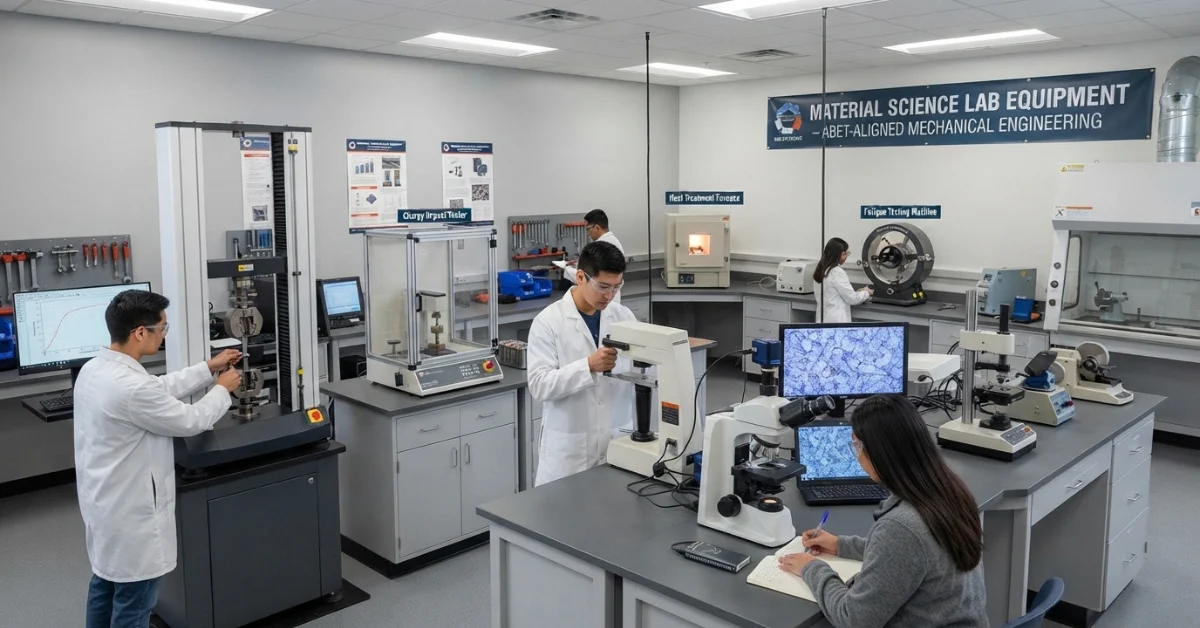
A well-equipped Material Science Lab gives engineering students the opportunity to transform theoretical knowledge into practical skills. Students can examine material structures, test mechanical properties, study the effects of heat treatment, investigate failure mechanisms, and analyze experimental data.
For universities developing or upgrading mechanical engineering laboratories, choosing the right equipment is particularly important. ABET accreditation focuses on whether a program has adequate facilities, laboratories, equipment, and resources to support student learning and the attainment of student outcomes. ABET does not prescribe one fixed list of material science equipment; instead, institutions need to demonstrate that their facilities are appropriate for their educational objectives and engineering program.
For this reason, an ABET-aligned laboratory should be planned around curriculum requirements, student outcomes, practical learning, safety, modern engineering tools, and future needs.
Why Material Science Is Important in Mechanical Engineering
Mechanical engineers work with a wide range of materials, including metals, polymers, ceramics, composites, and advanced engineering materials. Selecting the right material requires an understanding of its strength, hardness, toughness, ductility, fatigue resistance, thermal properties, and manufacturing characteristics.
A material science laboratory helps students understand the relationship between:
- Material structure
- Material properties
- Manufacturing processes
- Heat treatment
- Mechanical performance
- Failure mechanisms
- Material selection
Through laboratory experiments, students can investigate real engineering questions.
For example, they can determine why a particular steel becomes harder after heat treatment, how a material behaves under tensile loading, why components fail under repeated stress, or how microscopic structures influence mechanical properties.
This practical exposure is essential for developing engineering skills that complement classroom-based learning.
What Does ABET Require for Engineering Laboratories?
One important point for universities is that ABET accreditation is not based on purchasing a predetermined equipment checklist.
ABET’s engineering accreditation criteria require institutions to provide adequate classrooms, laboratories, and associated equipment to support the attainment of student outcomes. The criteria also address appropriate modern tools, equipment, computing resources, maintenance, upgrades, and safe student use of laboratory facilities.
Therefore, universities should not approach laboratory development simply by asking:
“Which equipment should we buy?”
A better question is:
“What should our students be able to learn and demonstrate through this laboratory?”
For example, if students are expected to understand tensile behavior, the laboratory should provide the appropriate testing machine, specimens, measurement systems, data acquisition capabilities, and software required to conduct and analyze the experiment.
This outcome-based approach helps institutions make more meaningful laboratory investments.
Essential Material Science Lab Equipment for Mechanical Engineering
A comprehensive Material Science Lab should provide equipment that allows students to progress from material observation and preparation to mechanical testing, analysis, and engineering interpretation.
1. Universal Testing Machine
A Universal Testing Machine (UTM) is one of the most important pieces of equipment in a mechanical engineering material testing laboratory.
Depending on its configuration and accessories, a UTM can be used for tensile, compression, bending, and other mechanical tests.
During tensile testing, students can generate stress-strain curves and investigate properties such as:
- Yield strength
- Ultimate tensile strength
- Young’s modulus
- Percentage elongation
- Elastic behavior
- Plastic deformation
- Fracture characteristics
The experiment directly connects classroom concepts from mechanics of materials and mechanical design with real experimental data.
2. Hardness Testing Machine
Hardness is an important property when selecting materials for engineering applications.
A laboratory may use Rockwell, Brinell, Vickers, or other suitable hardness testing systems. These instruments allow students to compare materials and investigate how processing and heat treatment affect hardness.
Students can test different metals, compare treated and untreated specimens, and relate hardness values to potential engineering applications.
3. Impact Testing Machine
Components can experience sudden or shock loading during real-world operation. Impact testing helps students understand how materials respond to these conditions.
Charpy and Izod impact testing systems can be used to demonstrate concepts such as:
- Impact strength
- Toughness
- Energy absorption
- Ductile-to-brittle behavior
- Failure under sudden loading
Impact testing is particularly useful for connecting laboratory experiments with engineering applications involving vehicles, machinery, structures, and other components.
4. Metallurgical Microscope
Material properties are closely related to internal structure. A metallurgical microscope allows students to observe material microstructures that cannot be seen with the naked eye.
Students can examine prepared specimens and investigate features such as grain structures, phases, inclusions, and other microstructural characteristics.
This helps students understand the fundamental structure-property relationship in materials science.
5. Specimen Preparation Equipment
Accurate microscopic examination depends on proper specimen preparation.
A Material Science Lab may require equipment for:
- Sample cutting
- Mounting
- Grinding
- Polishing
- Etching
- Cleaning
These processes teach students the importance of experimental procedures and sample preparation in obtaining reliable results.
Specimen preparation equipment should therefore be considered an essential part of a complete material science laboratory rather than an optional addition.
6. Heat Treatment Furnace
Heat treatment can significantly change the properties and microstructure of metals.
Laboratory furnaces allow students to study processes such as annealing, normalizing, hardening, and tempering, depending on the curriculum and equipment configuration.
Students can test material properties before and after heat treatment using hardness testing, microscopy, or mechanical testing.
This creates an integrated learning process:
Heat Treatment → Microstructure → Material Properties → Engineering Performance
Such experiments help students understand why manufacturing processes must be carefully controlled to achieve the desired material properties.
7. Fatigue Testing Machine
Many mechanical components are exposed to repeated or cyclic loading rather than one-time static loads.
A fatigue testing machine allows students to investigate how materials behave under repeated stress and how failure can occur even when the applied stress is below the material’s static strength.
Students can study:
- Fatigue life
- Cyclic loading
- Crack initiation
- Crack propagation
- S-N curves
- Fatigue failure prevention
Fatigue testing is highly relevant to automotive, aerospace, manufacturing, machinery, and structural engineering applications.
8. Creep Testing Equipment
Creep becomes an important consideration when materials are subjected to sustained loads, particularly at elevated temperatures.
Creep testing equipment can help students understand time-dependent deformation and investigate how stress and temperature influence long-term material behavior.
For programs with advanced materials, manufacturing, or high-temperature engineering components in their curriculum, creep testing can provide valuable practical learning opportunities.
9. Digital Data Acquisition Systems
Modern engineering laboratories increasingly depend on digital measurement and data acquisition systems.
Sensors, load cells, displacement sensors, temperature measurement devices, digital displays, and software can be integrated with testing equipment to provide students with real-time experimental data.
Students can develop skills in:
- Data collection
- Data visualization
- Engineering calculations
- Statistical analysis
- Error and uncertainty analysis
- Experimental interpretation
- Technical reporting
This ensures that laboratory learning goes beyond operating a machine. Students learn how to evaluate whether experimental results are reliable and what those results mean in an engineering context.
How Material Science Equipment Supports ABET Student Outcomes
The value of laboratory equipment should be measured by the learning experiences it enables.
For example, consider a tensile testing experiment.
Laboratory activity: Perform a tensile test on a material specimen.
Required resources: Universal Testing Machine, specimen, measurement system, data acquisition system, and analysis software.
Student learning: Conduct the experiment, obtain stress-strain data, calculate mechanical properties, evaluate experimental uncertainty, and communicate the results.
This approach provides evidence that laboratory facilities are directly supporting student learning.
An effective ABET-aligned laboratory can help students develop abilities associated with engineering problem-solving, experimentation, data analysis, use of modern engineering tools, and technical communication.
Creating an Integrated Material Science Laboratory
The strongest laboratories are not necessarily those with the largest number of machines. They are laboratories where equipment is connected to meaningful experiments and learning objectives.
For example, students could complete an integrated material science project by following these steps:
- Select an engineering material.
- Prepare the specimen.
- Examine its microstructure.
- Apply an appropriate heat treatment.
- Measure hardness before and after treatment.
- Perform tensile testing.
- Compare stress-strain behavior.
- Analyze experimental data.
- Identify changes in material properties.
- Recommend suitable engineering applications.
This type of experiment demonstrates the relationship between processing, structure, properties, and performance.
It also gives students experience with the complete engineering process rather than isolated laboratory exercises.
Safety and Maintenance of Material Science Laboratory Equipment
Laboratory equipment must be selected with safety and long-term operation in mind.
Students should receive appropriate training before operating testing machines, furnaces, cutting equipment, polishing systems, and other laboratory tools.
Universities should also establish:
- Laboratory safety procedures
- Personal protective equipment requirements
- Equipment operating instructions
- Calibration schedules
- Preventive maintenance plans
- Equipment inspection procedures
- Technician support
- Safe specimen handling procedures
- Appropriate ventilation and environmental controls
Maintenance should be considered during equipment procurement. A laboratory with reliable equipment, regular calibration, technical support, and proper maintenance can provide more consistent learning experiences.
Choosing the Right Material Science Lab Equipment Supplier
Developing a modern Material Science Lab involves more than purchasing individual machines. Universities may require assistance with laboratory planning, equipment selection, installation, commissioning, faculty training, student training, maintenance, and future upgrades.
A laboratory solutions provider should therefore understand both engineering education and laboratory requirements.
EdNex provides engineering laboratory solutions for higher education, including Material Science and Mechanical Engineering laboratory environments.
When evaluating laboratory equipment suppliers, universities should consider:
- Equipment quality and reliability
- Curriculum compatibility
- Student capacity
- Laboratory space
- Safety requirements
- Calibration and maintenance
- Technical support
- Faculty training
- Software and data acquisition capabilities
- Future scalability
- Industry relevance
Building a Future-Ready Material Science Lab
Engineering education continues to evolve as industries adopt advanced materials, digital manufacturing, automation, simulation, and data-driven engineering.
A modern Material Science Lab should therefore be designed with future requirements in mind.
Universities can consider creating flexible laboratory spaces where equipment can be upgraded as technology develops. Digital data acquisition, computer-based analysis, advanced testing capabilities, and interdisciplinary experiments can help students develop skills that remain relevant beyond graduation.
The goal is not simply to create a laboratory filled with equipment. The goal is to create an environment where students can experiment, analyze, design, troubleshoot, and solve real engineering problems.
Conclusion
A well-designed Material Science Lab is an important part of practical mechanical engineering education. Equipment such as Universal Testing Machines, hardness testers, impact testing systems, metallurgical microscopes, heat treatment furnaces, fatigue testing machines, specimen preparation systems, and digital data acquisition tools can help students understand how materials behave and why material selection matters.
For ABET-aligned programs, the focus should not be on purchasing equipment simply to satisfy a checklist. Instead, universities should select laboratory resources based on curriculum requirements, student outcomes, professional engineering practice, safety, accessibility, maintenance, and future development.
When equipment is properly integrated with laboratory experiments, students gain more than hands-on experience. They learn how to design experiments, collect and analyze data, evaluate material performance, solve engineering problems, and communicate technical findings.
For universities planning a new laboratory or upgrading an existing facility, the right combination of equipment, curriculum integration, training, and technical support can create a practical and future-ready learning environment.
EdNex can support higher education institutions in developing modern engineering laboratory environments designed to meet the practical learning needs of today’s mechanical engineering students.
Frequently Asked Questions
What equipment is required for a Material Science Lab?
A typical Material Science Lab may include a Universal Testing Machine, hardness testing machine, impact testing machine, metallurgical microscope, specimen preparation equipment, heat treatment furnace, fatigue testing equipment, and digital data acquisition systems. The exact equipment requirement depends on the curriculum, student capacity, specialization, and laboratory objectives.
Does ABET specify a particular list of Material Science Lab equipment?
No. ABET does not prescribe one universal list of material science laboratory equipment. Instead, programs are expected to provide adequate laboratories and associated equipment to support student outcomes and the educational objectives of the program. Equipment should be appropriate, maintained, and suitable for the intended learning activities.
Why is a Universal Testing Machine important in mechanical engineering education?
A Universal Testing Machine allows students to perform mechanical tests and understand material behavior under controlled loading. Tensile testing, for example, helps students investigate stress-strain behavior, strength, deformation, and failure.
What is the purpose of a metallurgical microscope?
A metallurgical microscope allows students to observe the microstructure of engineering materials. It helps demonstrate how grain structure, phases, and other microscopic characteristics can influence material properties and performance.
Why is heat treatment equipment important in a Material Science Lab?
Heat treatment equipment enables students to study how controlled heating and cooling can change the microstructure and properties of materials. Students can compare specimens before and after treatment using hardness testing, microscopy, or mechanical testing.
How can a Material Science Lab support ABET accreditation?
A properly designed laboratory can support ABET requirements by providing facilities and equipment that contribute directly to student learning and the attainment of student outcomes. Programs should also maintain equipment, provide appropriate student guidance, and demonstrate how laboratory activities support educational objectives.
What should universities consider when purchasing laboratory equipment?
Universities should consider curriculum requirements, student outcomes, equipment quality, student capacity, laboratory space, safety, calibration, maintenance, technical support, faculty training, software integration, and future expansion.
Can EdNex help universities establish a Material Science Lab?
Yes. EdNex provides engineering laboratory solutions for higher education institutions, including Material Science and Mechanical Engineering laboratory environments. Universities can explore EdNex’s laboratory solutions for planning and developing modern engineering teaching facilities.
Related Posts ...
Comments are disabled