



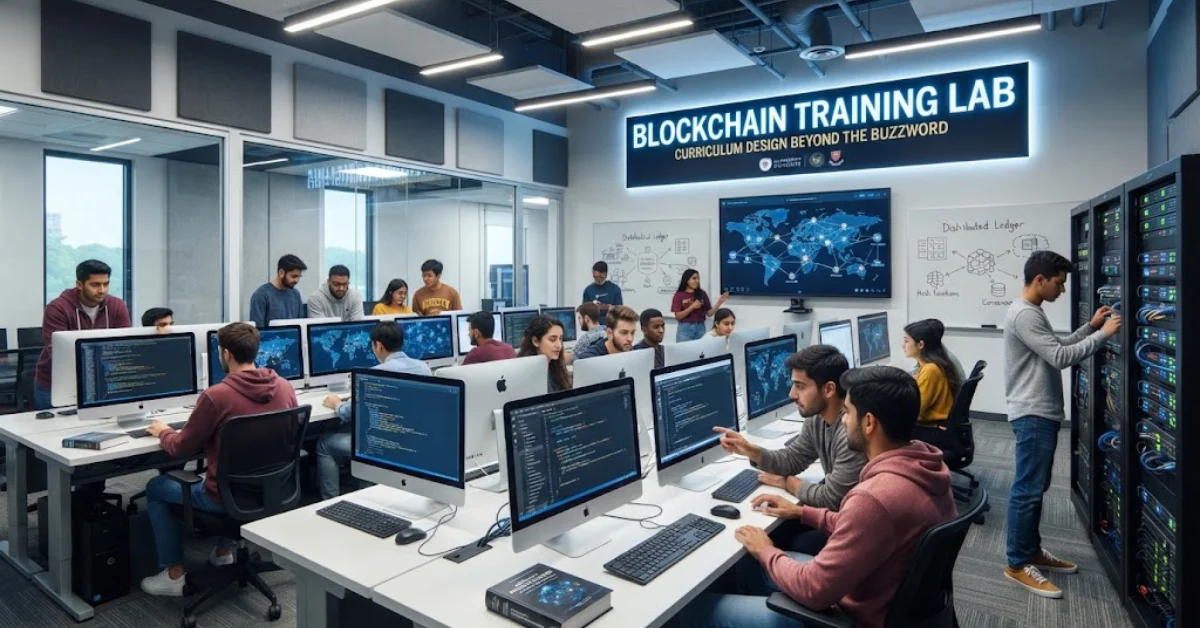
Blockchain Training Labs for Universities: Curriculum Design Beyond the Buzzword
Blockchain has moved beyond its early association with cryptocurrencies. Today, blockchain technologies are being explored across finance, supply chains, healthcare, digital identity, cybersecurity, logistics, smart contracts, and decentralized applications.
For universities, this creates an opportunity to prepare students for emerging technology roles through practical, application-oriented education. However, teaching blockchain effectively requires more than lectures about cryptocurrency or distributed ledgers.
A modern Blockchain Training Lab should provide students with the hardware, software, development environments, networking infrastructure, and practical tools needed to build, test, deploy, and analyze blockchain applications.
The objective should be simple: move students from understanding blockchain concepts to developing hands-on blockchain development skills.
For universities planning a new technology laboratory, curriculum design and equipment selection should therefore work together. The laboratory should support structured learning, experimentation, collaborative projects, and exposure to real-world blockchain development workflows.
Why Universities Need Blockchain Training Labs
Blockchain is a practical technology. Students can understand concepts such as blocks, hashes, consensus mechanisms, wallets, smart contracts, and decentralized applications through textbooks, but meaningful technical skills develop when students actually implement these concepts.
A dedicated blockchain laboratory gives students an environment where they can:
- Develop blockchain applications
- Create and test smart contracts
- Work with blockchain networks
- Explore consensus mechanisms
- Build decentralized applications
- Analyze transactions
- Understand cryptographic principles
- Experiment with distributed systems
- Test blockchain-based solutions
- Collaborate on real-world projects
This practical approach helps universities bridge the gap between theoretical computer science education and the skills expected in emerging technology roles.
What Should a Blockchain Training Lab Teach?
A blockchain laboratory should be designed around progressive learning rather than simply providing access to blockchain software.
A well-structured curriculum can move through several stages.
Blockchain Fundamentals
Students should first understand the basic architecture of blockchain systems.
Topics may include:
- Distributed ledgers
- Blocks and transactions
- Hash functions
- Cryptographic keys
- Digital signatures
- Wallets
- Nodes
- Peer-to-peer networks
- Consensus mechanisms
- Blockchain security
Laboratory activities can reinforce these concepts through simple implementations and demonstrations.
Instead of simply explaining how a block contains transaction information and a cryptographic hash, students can create a basic blockchain and observe how changing one block affects subsequent blocks.
This creates a much stronger connection between theory and practical understanding.
Smart Contract Development
Smart contracts are one of the most important practical areas of blockchain education.
Students can learn how programmable blockchain applications work by designing, coding, testing, and deploying smart contracts in controlled laboratory environments.
Depending on the curriculum, students may work with platforms and development frameworks appropriate to the institution’s learning objectives.
Practical exercises can include:
- Writing basic smart contracts
- Defining contract functions
- Managing transactions
- Testing contract behavior
- Identifying vulnerabilities
- Deploying contracts to development networks
- Interacting with contracts through applications
Smart contract development also creates opportunities to teach students about secure coding and responsible software development.
Decentralized Application Development
A blockchain laboratory should ideally go beyond smart contracts and introduce students to decentralized applications, or dApps.
Students can learn how blockchain back-end functionality can interact with user-facing applications.
A project may involve creating:
- A blockchain-based data structure
- A smart contract
- A web or application interface
- A wallet connection
- Transaction functionality
- Testing and debugging
- Deployment to a development environment
This approach exposes students to the complete development workflow rather than isolated blockchain concepts.
Blockchain Lab Equipment and Infrastructure
The quality of practical learning depends partly on the laboratory infrastructure available to students.
A university blockchain lab can include high-performance computers or workstations capable of running development environments, virtual machines, containers, blockchain nodes, databases, and development tools.
High-Performance Workstations
Workstations should provide sufficient processing power, memory, storage, and graphics capabilities for the intended applications.
Students may need to run multiple development tools simultaneously, execute local blockchain networks, run virtualized environments, and perform software testing.
A suitable workstation environment can therefore improve laboratory productivity and allow students to experiment without excessive resource limitations.
Networking Infrastructure
Blockchain is fundamentally distributed, making networking an important component of practical training.
A laboratory can provide an isolated or controlled network environment where students can configure multiple nodes and observe communication between them.
Students can experiment with concepts such as:
- Peer-to-peer communication
- Node discovery
- Transaction propagation
- Network latency
- Distributed consensus
- Network security
This helps students understand blockchain as a distributed computing technology rather than simply a database or cryptocurrency platform.
Blockchain Development Servers
Centralized laboratory servers can support development environments, virtual machines, containerized applications, blockchain nodes, databases, and collaborative projects.
Servers can also provide controlled environments for instructors to demonstrate blockchain networks while students perform experiments on separate systems.
Storage and Backup Systems
Blockchain projects can generate source code, transaction data, test networks, logs, datasets, and other digital resources.
Reliable storage and backup infrastructure can help universities manage student projects and laboratory resources.
Version control systems can also be integrated into the curriculum to introduce students to professional software development practices.
Creating a Hands-On Blockchain Curriculum
Equipment alone does not create an effective blockchain laboratory. The curriculum should determine how the equipment is used.
A progressive curriculum might be organized into the following stages.
Module 1: Blockchain Architecture
Students learn the fundamental concepts behind distributed ledgers, blocks, transactions, hashes, and nodes.
Practical activity: Build a simplified blockchain and implement basic hashing and block validation.
Module 2: Cryptography and Security
Students explore public-key cryptography, digital signatures, hashing, wallets, and transaction authentication.
Practical activity: Generate keys, sign transactions, verify signatures, and investigate basic security scenarios.
Module 3: Distributed Networks
Students learn how blockchain nodes communicate and how distributed networks maintain consistency.
Practical activity: Configure multiple local nodes and observe transaction propagation.
Module 4: Smart Contracts
Students learn smart contract development, testing, deployment, and interaction.
Practical activity: Develop and test a simple smart contract for a real-world use case.
Module 5: Decentralized Applications
Students integrate blockchain functionality with application interfaces.
Practical activity: Develop a basic dApp that interacts with a smart contract.
Module 6: Blockchain Security and Testing
Students investigate common vulnerabilities, transaction risks, access-control issues, and secure development practices.
Practical activity: Test a sample application, identify vulnerabilities, and implement improvements.
Module 7: Capstone Project
Students apply their skills to a complete blockchain solution.
Potential projects include:
- Supply chain tracking
- Digital certificates
- Secure document verification
- Asset management
- Identity management
- Academic credential verification
- Decentralized record systems
The capstone project allows students to demonstrate their ability to move from problem identification to blockchain-based solution development.
Software and Development Tools
A blockchain training lab should provide students with access to appropriate development environments.
Depending on the curriculum, this may include:
- Blockchain development frameworks
- Smart contract development environments
- Local blockchain networks
- Code editors and IDEs
- Version control systems
- Containerization tools
- Virtual machines
- Database systems
- Testing frameworks
- Cryptographic libraries
- API development tools
- Network monitoring tools
The exact technology stack should be selected according to faculty expertise, course objectives, student level, and the blockchain platforms being taught.
A modular approach is often preferable because blockchain technologies continue to evolve rapidly.
Moving Beyond the Blockchain Buzzword
One of the biggest challenges in blockchain education is avoiding a curriculum that focuses too heavily on terminology.
Students should not finish a blockchain course simply knowing what a block, token, wallet, or smart contract is.
They should be able to answer practical engineering questions:
When should blockchain be used?
What problem does decentralization solve?
What are the trade-offs compared with conventional databases?
How can a blockchain application be secured?
How should a distributed application be tested?
These questions encourage students to evaluate blockchain as an engineering technology rather than treating it as a buzzword.
Assessment Through Practical Projects
Practical assessment is particularly important in a blockchain training laboratory.
Instead of relying exclusively on written examinations, universities can assess students through:
- Laboratory exercises
- Coding assignments
- Smart contract projects
- Network configuration tasks
- Security testing
- Technical documentation
- Group projects
- Capstone applications
- Demonstrations and presentations
Students can be evaluated on both technical implementation and engineering decision-making.
This approach provides evidence that students can apply their knowledge to practical blockchain development challenges.
Designing a Future-Ready Blockchain Training Lab
Blockchain technology is continuing to evolve. Universities should therefore avoid designing laboratories around only one platform or application.
A flexible laboratory infrastructure can allow institutions to introduce new development frameworks, blockchain networks, programming environments, security tools, and emerging distributed technologies as they become relevant.
Scalable workstations, configurable networks, virtualization, containerization, centralized management, and modular software environments can make future upgrades easier.
The goal is to create a laboratory that can support both foundational teaching and advanced student projects.
Choosing the Right Blockchain Lab Equipment Partner
Universities developing blockchain laboratories need to consider more than individual computers or software packages. Successful implementation requires alignment between laboratory infrastructure, curriculum, student capacity, faculty requirements, networking, software, and future expansion.
A technology laboratory provider should therefore understand the requirements of higher education and practical engineering education.
EdNex provides laboratory solutions for educational institutions and can support universities looking to develop modern, practical technology learning environments.
When planning a Blockchain Training Lab, universities should evaluate:
- Computing performance
- Networking capabilities
- Laboratory capacity
- Software compatibility
- Virtualization requirements
- Data storage
- Security
- Faculty training
- Student project requirements
- Technical support
- Scalability
- Future technology integration
Conclusion
A university Blockchain Training Lab should be more than a room equipped with computers and blockchain software. It should be a structured environment where students can experiment, develop applications, test distributed systems, analyze security issues, and solve real-world problems.
The right combination of blockchain lab equipment, development infrastructure, curriculum design, practical exercises, and project-based assessment can help students develop meaningful hands-on blockchain development skills.
By moving beyond blockchain terminology and focusing on implementation, testing, security, and problem-solving, universities can prepare students to understand where blockchain technology is genuinely useful—and how to build solutions with it.
For institutions planning a new blockchain laboratory or upgrading an existing technology lab, EdNex can help create a practical and scalable learning environment designed around the needs of modern higher education.
Related Posts ...


Comments are disabled