










Vocational Training in UAE: In-Demand Courses and Career Paths
Vocational Training UAE refers to the structured instruction of practical, job-specific skills designed to prepare learners for direct entry into the technical and applied workforce. As the UAE diversifies its economy beyond hydrocarbons, the demand for skilled technicians, healthcare support staff, and certified trade professionals has accelerated across every emirate. This article examines the economic role of vocational education, identifies the highest-demand sectors, details specific courses and certifications, maps career outcomes, and outlines the procurement considerations that govern institutional and individual enrollment. Readers will gain a structured reference covering the following:
- The economic role and value of vocational training in the UAE
- In-demand vocational sectors and associated courses
- Career paths, certifications, and employment outcomes
- Alignment with UAE Vision 2031 workforce objectives
The Role and Value of Vocational Training in the UAE Economy
Vocational training is the category of education that delivers occupation-specific competencies through applied instruction, workshop practice, and industry-recognized certification rather than theoretical study alone. Within the UAE, this model addresses a defined gap between academic graduate output and the technical labor that commercial, industrial, and service sectors require.
Vocational training delivers the following economic functions:
- Supplies the technical workforce that infrastructure, manufacturing, and service sectors require.
- Reduces dependence on imported skilled labor through domestic capability development.
- Accelerates workforce entry by compressing the time between training and employment.
- Aligns skill supply with the labor demand generated by national diversification strategy.
- Supports Emiratisation objectives by qualifying nationals for technical and supervisory roles.
The value of Vocational Courses in UAE derives from their direct correspondence to employer requirements. A learner who completes a certified electrical or nursing-support program enters the labor market with demonstrable, assessed competence rather than untested academic familiarity. Furthermore, the compressed duration of vocational programs, frequently ranging from several months to two years, produces a faster return on educational investment than conventional degree pathways.
Additionally, vocational education functions as an instrument of economic resilience. As the UAE expands its non-oil sectors, the availability of a qualified technical workforce determines the operational capacity of construction, healthcare, logistics, and energy enterprises.
In-Demand Vocational Sectors in the UAE
The UAE labor market concentrates vocational demand within sectors that support national infrastructure, public services, and economic diversification. The sectors below represent the areas where Career Training Programs produce the most direct employment outcomes.
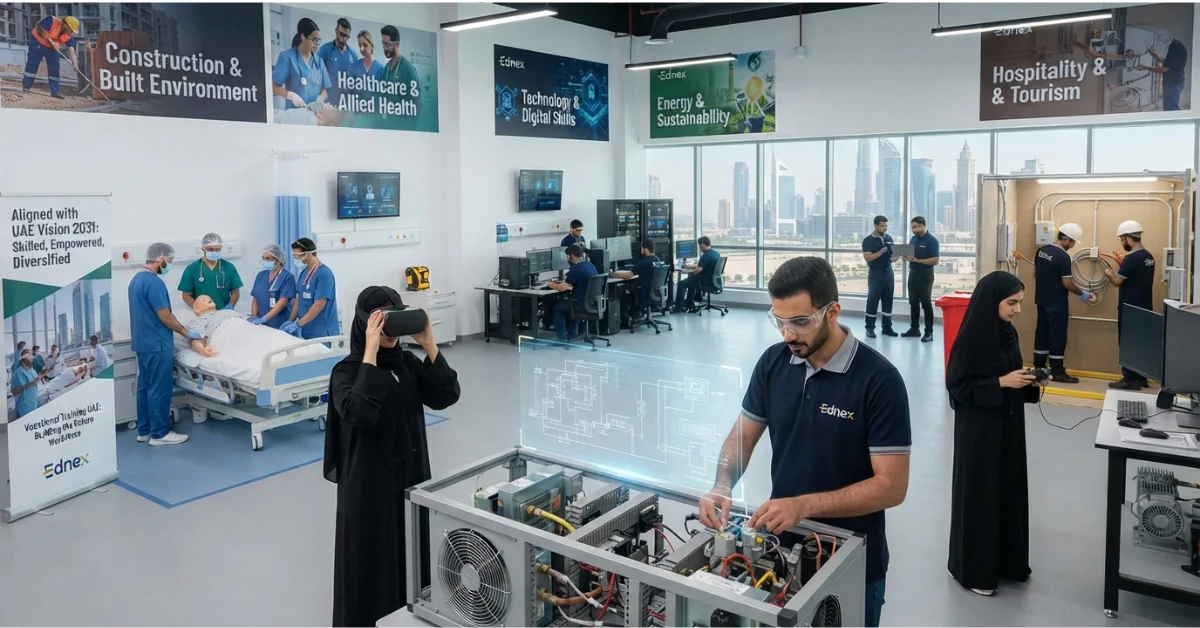
Construction and Built Environment
Construction remains a foundational sector of the UAE economy, sustained by continuous urban development, infrastructure expansion, and large-scale commercial projects.
- Electrical installation: Qualifies technicians for wiring, distribution, and building systems work.
- Plumbing and HVAC: Prepares specialists for water, drainage, and climate-control systems.
- Welding and fabrication: Certifies workers for structural and pipeline applications.
- Building management systems: Trains technicians to configure and maintain integrated control systems across commercial facilities.
The instructional value in construction derives from the sector’s demand for certified, code-compliant competence. Moreover, the integration of smart building technology has expanded vocational requirements to include control systems, sensor networks, and energy-management infrastructure.
Healthcare and Allied Health
Healthcare represents a high-growth vocational sector, driven by population expansion, medical tourism, and the regulatory requirements of UAE health authorities.
- Nursing assistance: Prepares support staff for clinical and patient-care environments.
- Medical laboratory technology: Certifies technicians for diagnostic and analytical procedures.
- Pharmacy support: Qualifies assistants for dispensing and inventory functions.
- Emergency medical services: Trains responders for pre-hospital and ambulance care.
The pedagogical strength in allied health rests on regulated competency standards. Health authorities in Dubai, Abu Dhabi, and the northern emirates require documented certification, which positions vocational training as the controlled entry point into clinical support roles.
Technology and Digital Skills
Technology constitutes the fastest-expanding vocational sector, aligned with the UAE’s positioning as a regional digital economy hub.
- Network administration: Certifies technicians for infrastructure configuration and maintenance.
- Cybersecurity fundamentals: Prepares specialists for threat monitoring and data protection.
- Cloud and data center operations: Qualifies technicians for hosted infrastructure management.
- IoT and smart systems: Trains practitioners to deploy connected sensor and control systems across commercial facilities.
The instructional significance of Technical Training in this sector lies in its alignment with open standards and interoperable platforms. Furthermore, employers prioritize vendor-recognized certifications, which establishes a direct connection between training output and hiring criteria.
Hospitality and Tourism
Hospitality remains a core employment sector, sustained by the UAE’s tourism volume, conference economy, and international event hosting.
- Culinary arts: Certifies kitchen staff across preparation and service disciplines.
- Hotel operations: Prepares personnel for front-office, housekeeping, and guest-service functions.
- Food and beverage service: Qualifies staff for restaurant and banquet operations.
- Event management: Trains coordinators for exhibition and conference delivery.
The value in hospitality derives from the sector’s scale and consistent turnover, which generates sustained demand for certified entry-level and supervisory staff.
Energy and Sustainability
Energy training has expanded in alignment with the UAE’s renewable energy targets and industrial decarbonization objectives.
- Solar installation and maintenance: Certifies technicians for photovoltaic system deployment.
- Energy management: Prepares specialists to optimize consumption across commercial facilities.
- Industrial maintenance: Qualifies technicians for plant and process operations.
- Sustainability auditing: Trains practitioners to assess efficiency and emissions performance.
The instructional importance of energy training rests on its correspondence to regulatory and efficiency mandates. Moreover, the sector’s growth produces measurable outcomes, including documented energy savings and reduced operational cost across building portfolios.
Specific Courses, Certifications, and Career Paths
Vocational programs in the UAE conclude with industry-recognized qualifications that establish defined career trajectories. The certifications below represent the credentials that employers and licensing authorities accept.
Common certification categories include the following:
- National vocational qualifications: Government-recognized credentials aligned with the National Qualifications Framework.
- International trade certifications: Globally accepted credentials in welding, electrical, and HVAC disciplines.
- Vendor certifications: Technology credentials issued by established platform providers.
- Health authority licenses: Mandatory credentials for clinical and allied health practice.
These qualifications map to structured career paths that progress from entry-level to supervisory roles. Skills Development Courses establish the following representative trajectories:
- Construction technician advancing to site supervisor and project foreman.
- Healthcare assistant progressing to senior support staff and department coordinator.
- Network technician advancing to systems administrator and infrastructure specialist.
- Energy technician progressing to facility energy manager and sustainability consultant.
The employment value of these pathways derives from their documented progression. A learner who enters as a certified technician acquires the experience and supplementary credentials required for supervisory advancement, which establishes a continuous career ladder rather than a fixed terminal role.
Alignment with UAE Vision 2031 Workforce Goals
UAE national strategy positions workforce capability as a foundation of economic diversification, and vocational training functions as a primary instrument of this objective. The alignment manifests across several defined priorities.
Vocational training supports national workforce goals through the following mechanisms:
- Develops domestic technical capability to reduce reliance on imported labor.
- Advances Emiratisation by qualifying nationals for technical and supervisory positions.
- Supplies the skilled workforce required by priority growth sectors.
- Supports sustainability targets through energy and efficiency training.
The strategic significance of vocational education rests on its measurable contribution to economic indicators. Furthermore, the alignment between training output and sector demand ensures that educational investment produces employable graduates rather than surplus credentials disconnected from labor requirements.
Procurement and Enrollment Considerations
Institutions establishing vocational programs and learners selecting courses should evaluate defined criteria before commitment. Effective selection aligns training provision with employment outcomes and regulatory requirements.
Institutions and learners should assess the following criteria:
- Accreditation: Programs must hold recognition from relevant UAE authorities and qualification frameworks.
- Industry alignment: Curriculum and equipment must correspond to current employer requirements.
- Certification value: Credentials must hold recognition among employers and licensing bodies.
- Equipment and facilities: Training infrastructure must reflect the technology used in active workplaces.
- Employment outcomes: Programs should document placement rates and career progression data.
- Total cost and duration: Evaluation must balance program cost against expected return and time to employment.
These criteria ensure that vocational investment produces measurable employment return rather than credentials disconnected from market demand. Furthermore, institutions that align training infrastructure with active industry technology produce graduates with directly transferable competence.
Conclusion
Vocational Training UAE establishes a structured pathway that converts applied instruction into measurable employment outcomes across the nation’s priority sectors. Construction, healthcare, technology, hospitality, and energy generate sustained demand for certified technicians and supervisory staff. Industry-recognized certifications map to defined career trajectories that progress from entry-level to leadership roles. The alignment between vocational output and UAE Vision 2031 workforce objectives positions this education model as a foundation of economic diversification. Effective program selection depends on accreditation, industry alignment, certification value, and documented employment outcomes.
Ednex supplies vocational training equipment, laboratory infrastructure, and complete program solutions configured for technical and vocational institutions across the UAE. Ednex aligns equipment specifications, certification frameworks, and curriculum support with industry requirements, accreditation standards, and national workforce objectives to deliver scalable, employment-aligned training provision. Contact Ednex today to design a vocational training program matched to UAE labor market demand.
Frequently Asked Questions
What is vocational training in the UAE?
Vocational training in the UAE is occupation-specific education that delivers practical, job-ready skills through applied instruction and industry-recognized certification. It prepares learners for direct entry into technical and applied roles across sectors such as construction, healthcare, technology, hospitality, and energy.
Which vocational sectors are most in demand in the UAE?
The highest-demand sectors are construction and built environment, healthcare and allied health, technology and digital skills, hospitality and tourism, and energy and sustainability. These sectors generate sustained employment opportunities aligned with national economic diversification.
What vocational courses offer the best career prospects?
Courses in electrical installation, HVAC, nursing assistance, network administration, cybersecurity, solar installation, and energy management offer strong prospects. These programs correspond directly to documented labor market demand and lead to structured career progression.
What certifications are recognized for vocational careers in the UAE?
Recognized credentials include national vocational qualifications aligned with the National Qualifications Framework, international trade certifications, vendor technology certifications, and health authority licenses required for clinical practice.
How long do vocational training programs take to complete?
Vocational programs typically range from several months to two years, depending on the discipline and certification level. This compressed duration produces a faster route to employment than conventional degree pathways.
How does vocational training support UAE Vision 2031?
Vocational training develops domestic technical capability, advances Emiratisation, supplies the workforce required by priority growth sectors, and supports sustainability targets. It functions as a primary instrument of national economic diversification strategy.
What career paths follow vocational training in the UAE?
Career paths progress from certified entry-level technician to supervisory and management roles. Examples include construction technician to site supervisor, healthcare assistant to department coordinator, and energy technician to facility energy manager.
What should institutions consider before establishing a vocational program?
Institutions should assess accreditation, industry alignment, certification value, training equipment and facilities, documented employment outcomes, and total program cost and duration before committing to program development.
Author Bio
Ednex is a provider of educational and vocational training solutions specializing in technical and applied skills instruction. Ednex supplies training equipment, laboratory infrastructure, and complete program configurations for vocational and technical institutions across the UAE, aligning equipment specifications, certification frameworks, and curriculum support with industry requirements and national workforce objectives. Through structured provisioning and technical support, Ednex enables institutions to deliver scalable, employment-aligned vocational training.
Related Posts ...




Comments are disabled