

What’s the Difference Between a STEM Lab, a Science Lab, and a Makerspace?
Educational institutions increasingly invest in dedicated learning spaces, yet the terminology surrounding them generates confusion during planning and procurement. The terms STEM Lab, Science Laboratory, and Makerspace describe distinct facilities with separate purposes, equipment inventories, and instructional models. This article defines each space, compares them across five operational criteria, identifies the overlaps that complicate selection, and provides guidance on matching each facility to specific institutional objectives. Readers will gain a structured reference for selecting the space that aligns with curriculum goals, budget parameters, and intended learning outcomes.
The distinction matters because misaligned investment produces underutilized infrastructure. A school that installs a Makerspace when its curriculum requires controlled experimentation, or a Science Laboratory when its goals center on interdisciplinary design, absorbs capital cost without achieving the intended instructional return.
Defining the STEM Lab
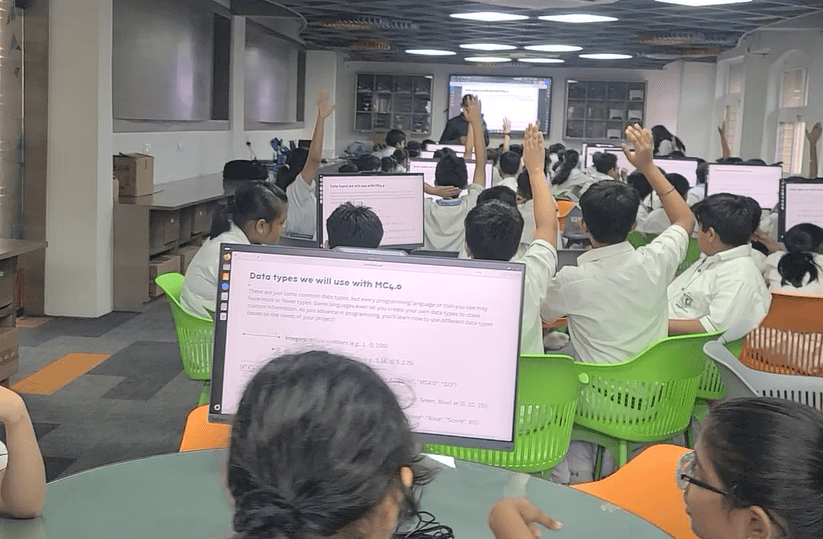
A STEM Lab is an integrated instructional environment designed to teach science, technology, engineering, and mathematics as connected disciplines rather than isolated subjects. The facility emphasizes applied, project-based learning that requires students to combine knowledge across multiple fields to solve defined problems.
The STEM Lab supports the following instructional functions:
- Integrate scientific, technological, engineering, and mathematical concepts within single projects.
- Develop computational thinking through coding, robotics, and data analysis.
- Apply the engineering design process to structured challenges.
- Connect abstract theory to measurable, real-world applications.
- Cultivate collaboration through team-based problem solving.
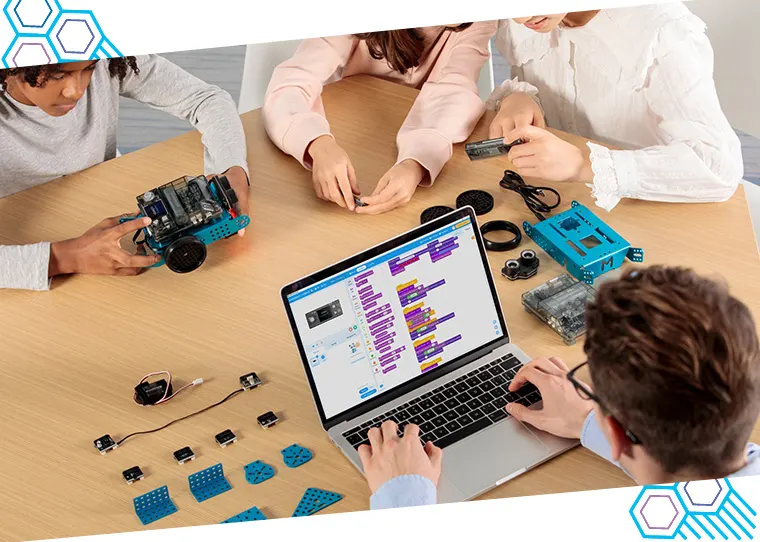
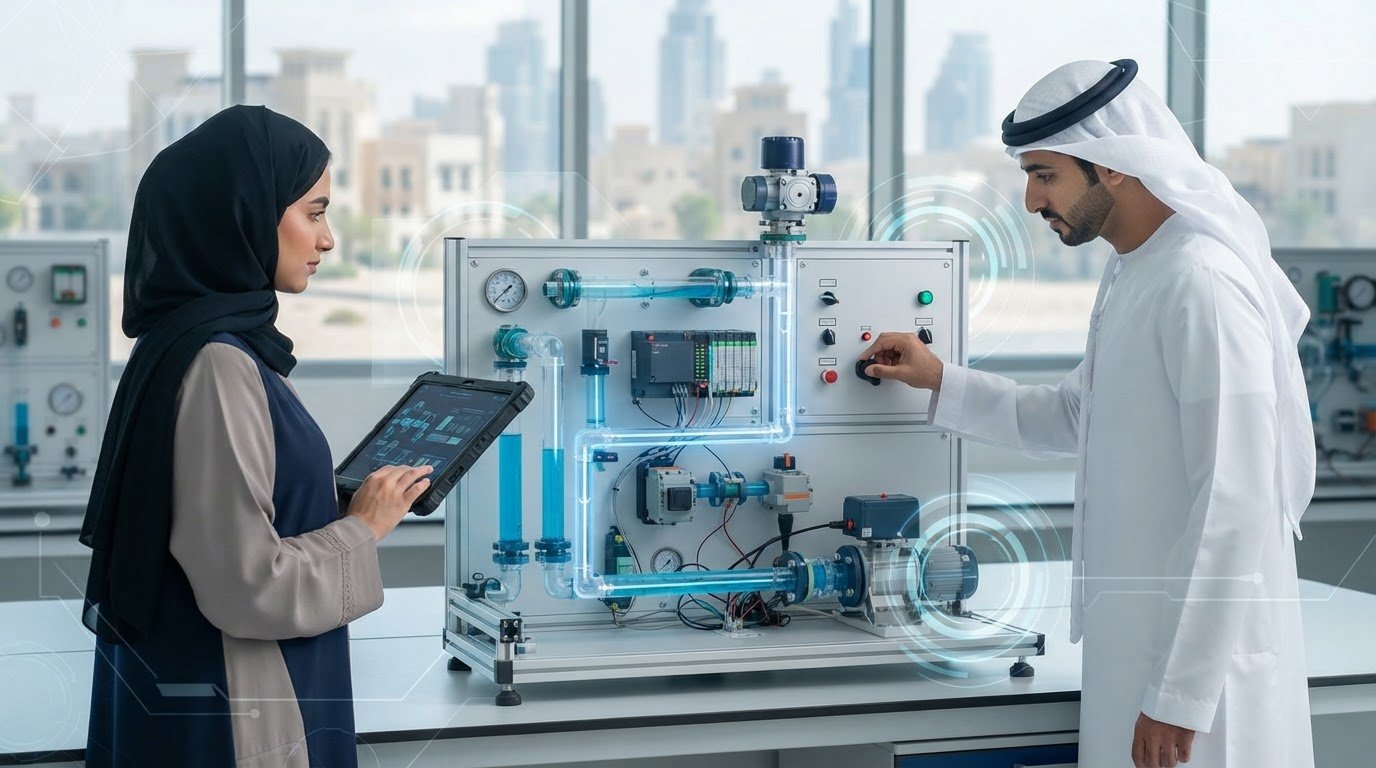
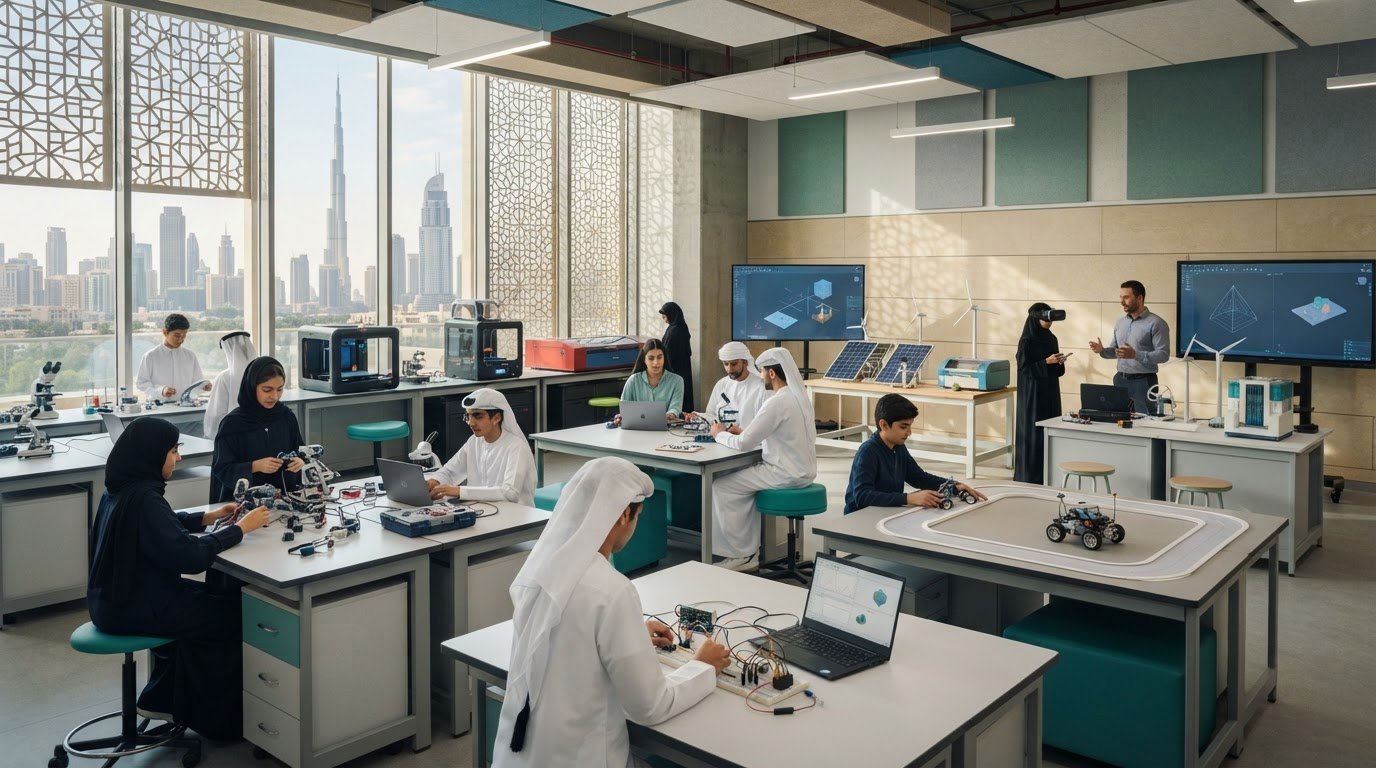
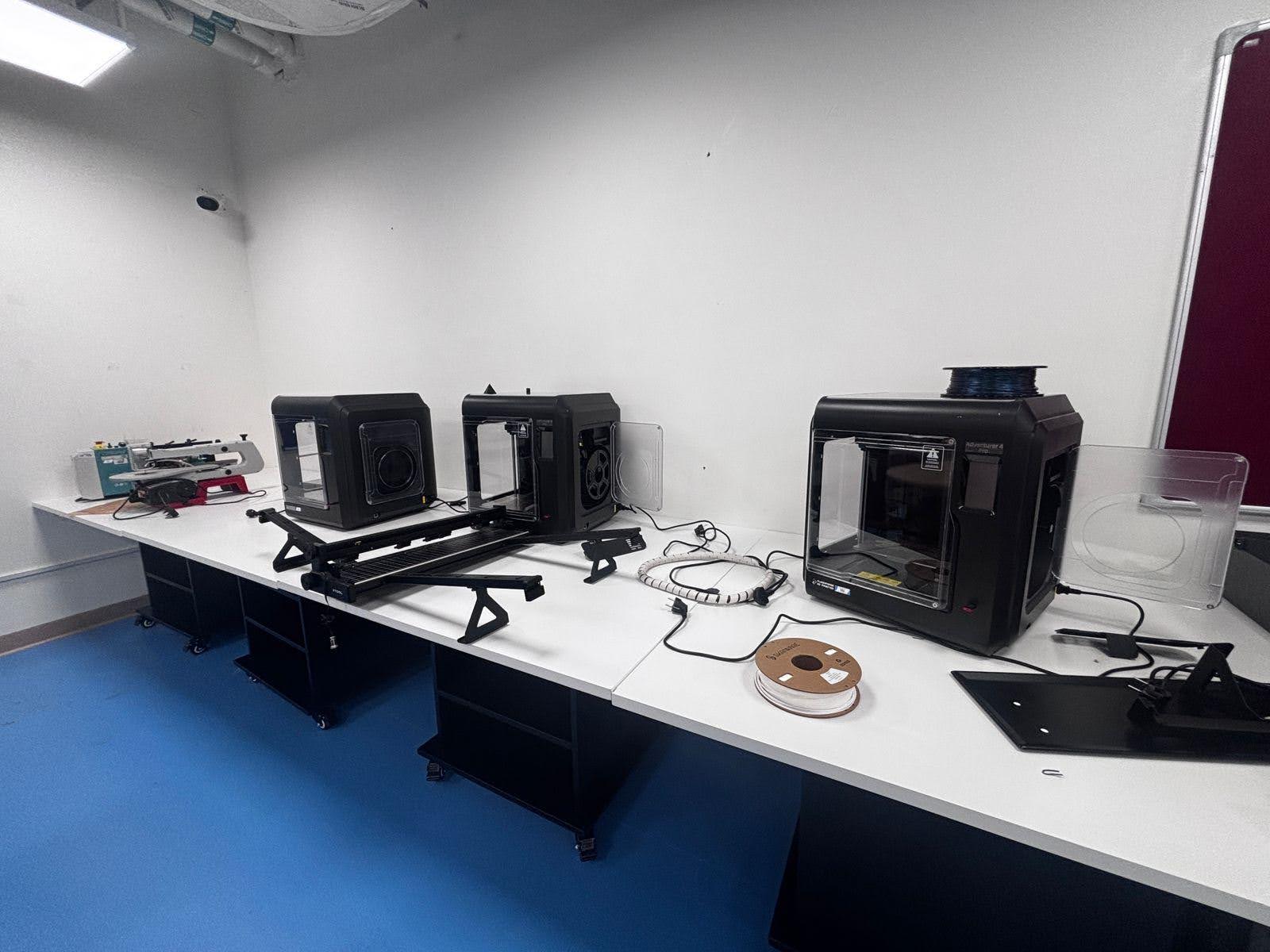
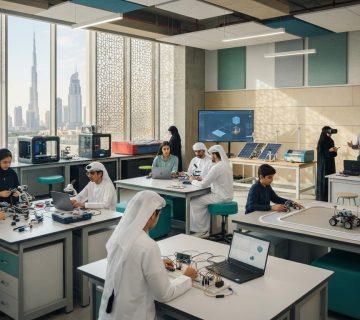
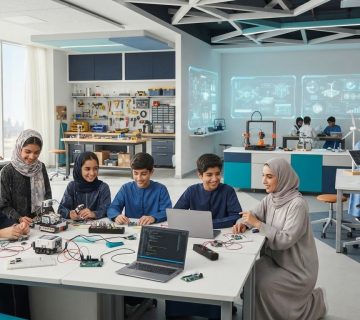
The instructional character of a STEM Lab derives from its cross-disciplinary structure. A single project may require students to program a sensor, analyze the resulting data, and apply mathematical models to interpret outcomes. Consequently, the STEM Lab functions as a convergence point where separate subjects combine into coordinated practice. Equipment typically includes robotics kits, microcontrollers, 3D printers, and computing hardware aligned to defined curriculum standards.
Defining the Science Laboratory
A Science Laboratory is a controlled instructional environment designed for the systematic conduct of experiments across biology, chemistry, and physics. The facility prioritizes the scientific method, measurement precision, and adherence to established experimental protocols.
The Science Laboratory supports the following instructional functions:
- Conduct controlled experiments under supervised, repeatable conditions.
- Measure physical, chemical, and biological phenomena with calibrated instruments.
- Observe reactions, processes, and behaviors within structured procedures.
- Document results for analysis, verification, and assessment.
- Reinforce theoretical instruction through empirical validation.
The defining feature of a Science Laboratory is its alignment with discipline-specific curriculum and assessment standards. Equipment includes microscopes, fume hoods, Bunsen burners, glassware, balances, and specimen storage, supported by safety infrastructure such as eyewash stations, ventilation, and chemical containment. The space operates under strict protocols because controlled experimentation depends on consistent conditions and documented procedures. Unlike the open-ended STEM Lab, the Science Laboratory directs students through defined experimental sequences with predetermined learning outcomes.
Defining the Makerspace
A Makerspace is a flexible, open-access fabrication environment designed to support self-directed creation, prototyping, and hands-on experimentation. The facility prioritizes student agency, iterative design, and the production of tangible artifacts across disciplines.
The Makerspace supports the following instructional functions:
- Prototype physical objects through fabrication and assembly.
- Iterate designs through repeated testing and refinement.
- Combine digital and manual tools within unstructured projects.
- Encourage independent exploration and creative problem solving.
- Produce functional artifacts that demonstrate applied skill.
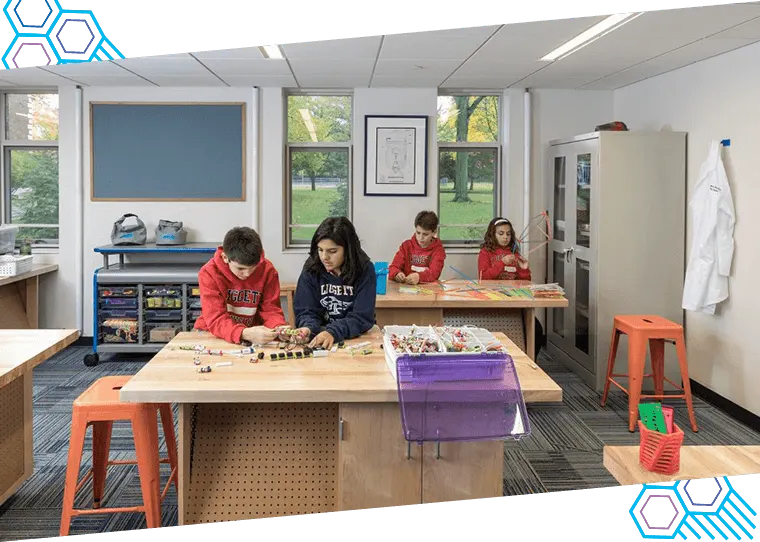
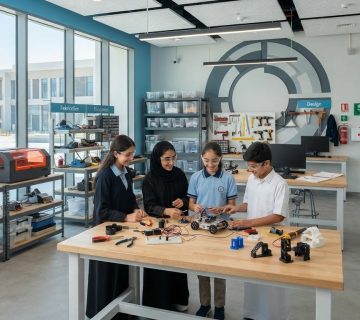
The instructional value of Makerspace Education rests on its emphasis on process over predetermined outcome. Equipment ranges from 3D printers, laser cutters, and CNC machines to hand tools, sewing machines, electronics components, and craft materials. The space accommodates projects that span engineering, art, design, and entrepreneurship without rigid curriculum constraints. The Makerspace functions less as a subject-specific classroom and more as a shared resource that supports creation across the institution.
STEM Lab vs Science Lab vs Makerspace: A Direct Comparison
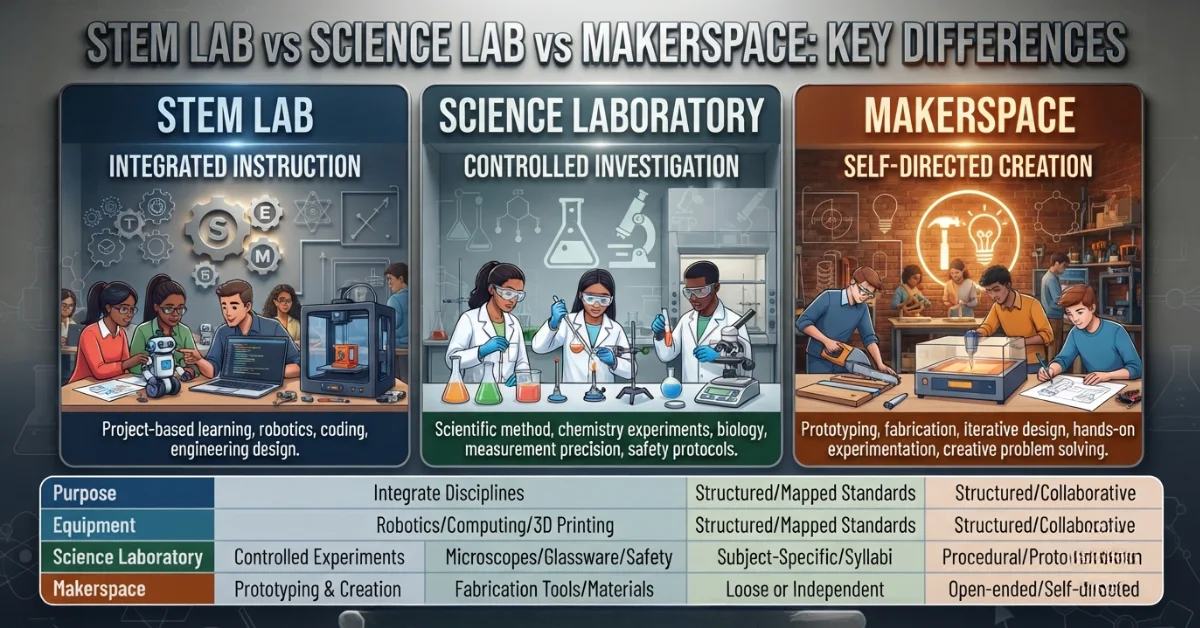
The distinctions among these facilities become clearest when compared across five operational criteria. The following comparison clarifies the trade-offs that govern selection within the broader category of School Innovation Labs.
Purpose
- STEM Lab: Integrate multiple disciplines through applied, problem-based projects.
- Science Laboratory: Conduct controlled experiments aligned with discipline-specific curriculum.
- Makerspace: Support self-directed creation and iterative prototyping.
Equipment
- STEM Lab: Robotics kits, microcontrollers, computing hardware, and design software.
- Science Laboratory: Microscopes, glassware, calibrated instruments, and chemical safety infrastructure.
- Makerspace: Fabrication tools, 3D printers, laser cutters, electronics, and assorted materials.
Curriculum Alignment
- STEM Lab: Mapped directly to integrated STEM curriculum standards and learning objectives.
- Science Laboratory: Mapped to subject-specific science syllabi and assessment requirements.
- Makerspace: Loosely aligned or curriculum-independent, supporting cross-disciplinary application.
Learning Style
- STEM Lab: Structured, collaborative, project-based instruction with defined challenges.
- Science Laboratory: Procedural, supervised, protocol-driven experimentation.
- Makerspace: Open-ended, self-directed, exploratory creation.
Audience
- STEM Lab: Students across grade levels engaged in formal STEM coursework.
- Science Laboratory: Students enrolled in specific science subjects requiring practical assessment.
- Makerspace: A broad institutional community spanning disciplines and interest areas.
Takeaway: The STEM Lab teaches integration, the Science Laboratory teaches controlled investigation, and the Makerspace teaches creation. Each criterion reinforces the same underlying distinction in instructional intent.
Overlaps and Distinctions
These three facilities share equipment and pedagogical features, which explains the frequent confusion during planning. Identifying the overlaps clarifies where the boundaries actually lie.
Common areas of overlap include the following:
- Shared equipment: 3D printers and electronics appear in both STEM Labs and Makerspaces.
- Hands-on emphasis: All three facilities prioritize practical engagement over passive instruction.
- Skill development: Each space cultivates problem-solving and technical competence.
- Cross-disciplinary potential: Projects in any facility may draw on multiple subjects.
The distinctions, however, remain definitive. The Science Laboratory operates under controlled protocols that the Makerspace deliberately avoids. The STEM Lab follows structured curriculum objectives that the Makerspace treats as optional. The Makerspace permits open-ended exploration that the Science Laboratory’s safety and measurement requirements cannot accommodate. Consequently, the facilities complement rather than replace one another. An institution may operate all three, directing students to the space matched to each instructional requirement.
Which Space Suits Which Institutional Goal
Selection depends on the institution’s primary objective, available budget, and intended learning outcomes. The following guidance maps each facility to defined institutional goals.
- Choose a STEM Lab when the objective centers on integrated STEM instruction, robotics, coding, and curriculum-aligned project work. This space suits institutions formalizing STEM programs across multiple grade levels.
- Choose a Science Laboratory when the curriculum requires controlled experimentation, practical assessment, and subject-specific instruction in biology, chemistry, or physics. This space remains essential for institutions delivering examined science syllabi.
- Choose a Makerspace when the goal emphasizes creativity, prototyping, entrepreneurship, and cross-disciplinary making. This space suits institutions seeking a shared resource that serves the entire student community.
Institutions with sufficient budget and space frequently implement a combination. A Science Laboratory satisfies formal curriculum requirements, a STEM Lab delivers integrated project instruction, and a Makerspace provides open access for independent creation. Procurement should align each facility with documented learning outcomes, anticipated student throughput, and long-term maintenance capacity.
Next step: Audit current curriculum requirements and intended outcomes before committing to any single facility. The audit prevents the misaligned investment that produces underutilized infrastructure.
Conclusion
The STEM Lab, the Science Laboratory, and the Makerspace serve distinct educational purposes despite their shared emphasis on hands-on learning. The STEM Lab integrates disciplines through structured projects. The Science Laboratory delivers controlled, curriculum-aligned experimentation. The Makerspace supports open-ended creation and prototyping. Selection depends on matching each facility to specific institutional goals, curriculum standards, and budget parameters. Institutions that understand these distinctions invest with precision and avoid the cost of underutilized space.
Ednex designs and equips STEM Labs, Science Laboratories, and Makerspaces for educational institutions, aligning equipment specifications, safety infrastructure, and curriculum support with defined learning outcomes and budget parameters. Contact Ednex today to plan a learning space matched to your institution’s objectives.
Frequently Asked Questions
What is the main difference between a STEM Lab, a Science Lab, and a Makerspace?
A STEM Lab integrates science, technology, engineering, and mathematics through project-based instruction. A Science Laboratory conducts controlled, curriculum-aligned experiments under defined protocols. A Makerspace supports self-directed creation and prototyping. The core difference lies in instructional intent: integration, investigation, and creation, respectively.
Can a STEM Lab and a Science Laboratory exist in the same institution?
Yes. The two facilities serve complementary purposes. A Science Laboratory satisfies subject-specific curriculum and assessment requirements, while a STEM Lab delivers integrated, cross-disciplinary project instruction. Many institutions operate both to cover the full range of instructional needs.
Is a Makerspace the same as a STEM Lab?
No. Although both share equipment such as 3D printers and electronics, a STEM Lab follows structured curriculum objectives, while a Makerspace prioritizes open-ended, self-directed creation. The STEM Lab teaches defined outcomes; the Makerspace emphasizes process and exploration.
What equipment does a Science Laboratory require?
A Science Laboratory requires microscopes, glassware, calibrated measurement instruments, Bunsen burners, balances, and specimen storage, supported by safety infrastructure including eyewash stations, ventilation, fume hoods, and chemical containment.
Which space is best for teaching coding and robotics?
A STEM Lab is best suited for coding and robotics instruction. It provides microcontrollers, robotics kits, computing hardware, and design software aligned to integrated STEM curriculum standards and defined learning objectives.
Are School Innovation Labs a separate category?
School Innovation Labs is a broad term that encompasses STEM Labs, Science Laboratories, and Makerspaces. It describes the general category of dedicated, hands-on learning environments rather than a distinct facility type.
How should an institution decide which space to build?
Institutions should audit curriculum requirements, intended learning outcomes, budget, and student throughput before committing. Controlled experimentation requires a Science Laboratory, integrated projects require a STEM Lab, and open creation requires a Makerspace.
Can one space serve all three functions?
A single hybrid space can partially serve multiple functions, but it involves trade-offs. Controlled experimentation demands safety protocols that conflict with open Makerspace access, so institutions with sufficient resources typically maintain separate, purpose-built facilities.
Author Bio
Ednex is a provider of educational laboratory and learning-space solutions specializing in STEM, science, and fabrication environments. Ednex designs and equips STEM Labs, Science Laboratories, and Makerspaces for educational institutions, aligning equipment specifications, safety infrastructure, and curriculum support with learning outcomes, accreditation standards, and budget parameters. Through structured provisioning and technical support, Ednex enables institutions to deliver purpose-built, outcome-aligned learning environments.
Related Posts ...
Comments are disabled