





Industry 4.0 Lab Solutions: Education & Training Guide
What if the strongest Industry 4.0 lab solutions aren’t the ones with the most equipment, but the ones that connect each technology to a clear learning goal? For schools, universities, and vocational training institutions across the UAE, choosing what belongs in a lab can be challenging when robotics, AI, IoT, and advanced manufacturing all compete for attention.
That uncertainty is understandable. A collection of advanced equipment won’t automatically prepare learners for connected industrial environments. The technologies need to work together as a coherent learning environment, with practical activities that build relevant technical skills and support your institution’s curriculum.
This guide will help you define a fit-for-purpose lab scope, compare solution approaches, and assess the integration and long-term usability requirements behind an Industry 4.0 lab. You’ll explore the role of robotics, AI, IoT, and advanced manufacturing, then consider how to align equipment decisions with learning goals. You’ll also learn what to look for in a design and implementation partner, including Ednex, which designs, equips, and implements specialized labs for education and training institutions.
Key Takeaways
- Define the lab around curriculum and workforce skills, so each technology supports a clear learning purpose.
- Assess how IoT, automation, robotics, AI, and manufacturing activities can connect into practical learning experiences.
- Compare Industry 4.0 lab solutions by learning outcomes, integration, usability, and ongoing support, separating essentials from optional extensions.
- Involve academic, teaching, facilities, and procurement stakeholders early to shape a workable implementation plan.
- Explore how Ednex’s lab design, installation, and equipment supply can support an institutional environment spanning Industry 4.0, advanced manufacturing, AI, IoT, and mechatronics.
What Industry 4.0 Lab Solutions Enable for Education and Training
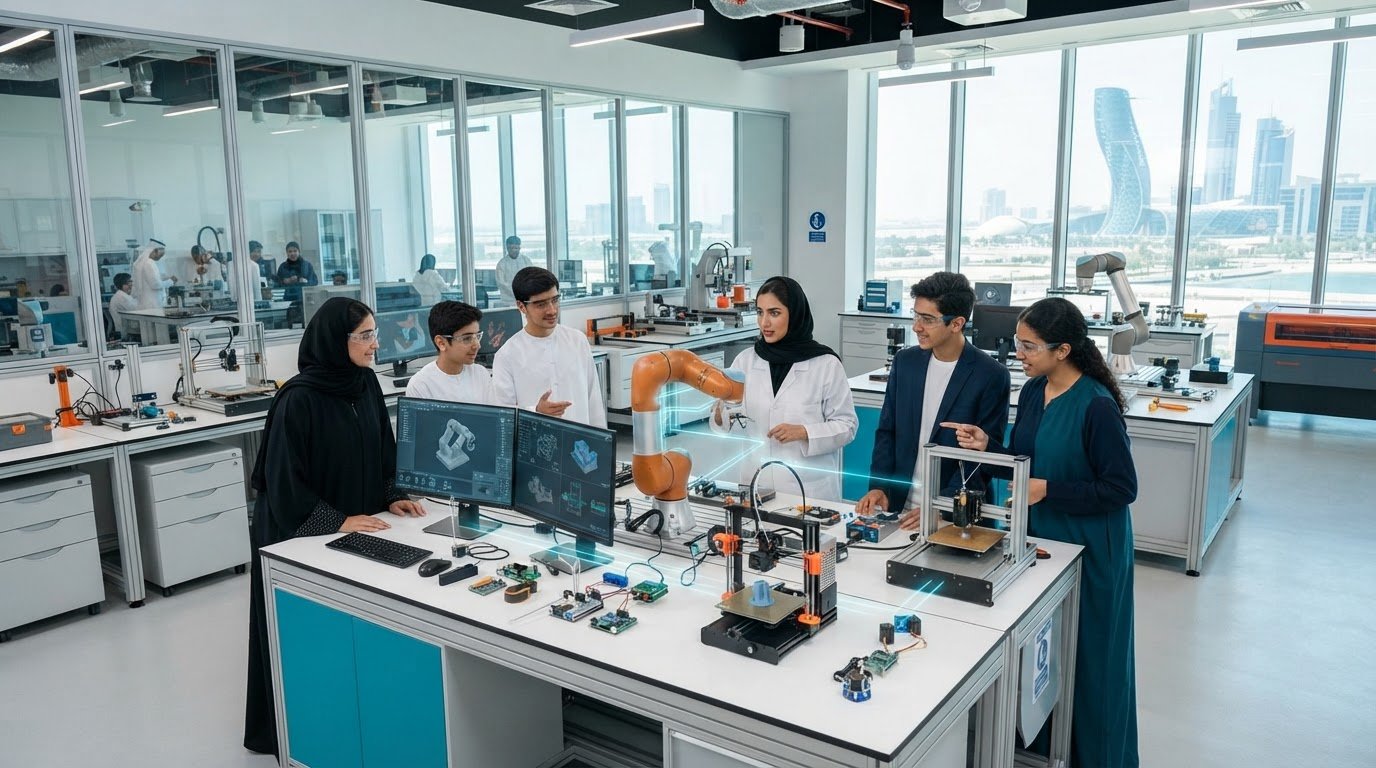
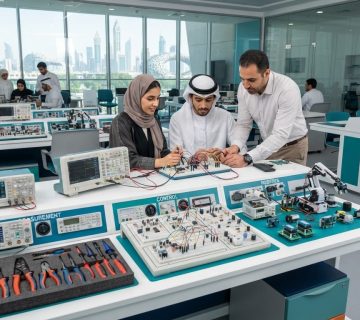
An Industry 4.0 lab is a learning environment where digital technologies connect with manufacturing concepts. Learners can explore how equipment, sensors, automation, and data relate across a process, rather than encountering each technology as an isolated demonstration. The idea builds on the Fourth Industrial Revolution, where digital and physical systems increasingly interact. For education and vocational training, that connection turns abstract concepts into activities learners can observe, operate, and evaluate.
What makes an Industry 4.0 lab different from a conventional engineering lab?
A conventional engineering lab may focus on individual experiments, such as testing a component or practising a specific control task. An Industry 4.0 learning environment can extend that work by showing how connected devices collect information, how automated equipment responds, and how actions affect a wider production workflow. For example, learners might trace a sensor reading through a system and discuss how it informs an operational decision. The emphasis is on relationships between systems, not simply on equipment operation.
Integration doesn’t require every technology or a fully automated production line. A fit-for-purpose lab could connect a focused set of activities around the institution’s curriculum and available facilities. The objective is a coherent learning experience: learners understand what each component does and how it contributes to a broader process.
Who benefits from Industry 4.0 lab solutions?
Higher education institutions can use Industry 4.0 lab solutions to support engineering and mechatronics learning that brings together concepts such as automation, robotics, instrumentation, and data. Activities may help learners investigate system behaviour, interpret information, and connect theoretical principles with practical applications. The appropriate depth depends on the programme and the learners’ existing knowledge.
Vocational training has a different emphasis: structured practice with equipment and workflows relevant to technical instruction. Learners might practise operating or monitoring connected systems, explore basic troubleshooting scenarios, or examine how manufacturing stages relate. These experiences can support practical skills development without promising a particular job outcome.
Start with the learning purpose, not an equipment catalogue. Identify the outcomes instructors need to teach, the level learners are entering at, and how the lab will be used across courses or training activities. Then select equipment that supports those priorities and can be meaningfully integrated. For institutions in the UAE, this approach helps align investment with educational and workforce preparation goals while keeping the lab relevant, usable, and appropriately scoped.
Which Technologies Should an Industry 4.0 Lab Bring Together?
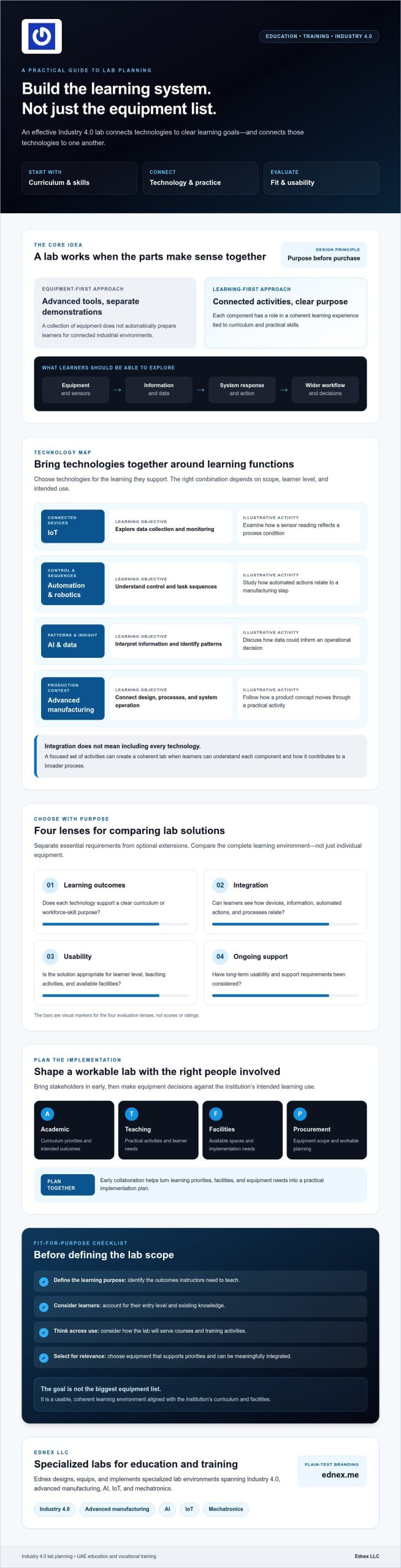
Choose technologies by the learning function they support, then consider how they can form a connected activity. An IoT device can generate information; automation and robotics can act on instructions; AI concepts can help learners interpret patterns; and manufacturing activities can put those ideas into context. The right combination depends on the institution’s scope, learner level, and intended use. The examples below are illustrative, not a fixed equipment specification.
| Technology area | Learning objective | Illustrative activity |
|---|---|---|
| IoT and connected devices | Explore data collection and monitoring | Examine how a sensor reading reflects a process condition |
| Automation and robotics | Understand control and task sequences | Study how automated actions relate to a manufacturing step |
| AI and data analysis | Interpret information and identify patterns | Discuss how data could inform an operational decision |
| Advanced manufacturing | Connect design, processes, and system operation | Follow how a product concept moves through a practical activity |
Core building blocks: connected devices, automation, and data
IoT connects devices so learners can examine information generated during practical activities. Pairing that data with automation or robotics can help students consider how a system responds to inputs and how one stage relates to another. Depending on the course, instructors might introduce programmable logic controllers (PLCs) or digital twins as concepts. Their inclusion as lab equipment or software depends on the institution’s requirements and supplier-verified availability and capabilities.
For an example of a university learning environment bringing digital technologies into manufacturing education, see the Purdue Smart Learning Factory. It offers a reference point for considering how connected devices, AI, and digital-twin concepts may support learning activities. It should inform planning, not be treated as a specification that every institution must replicate.
How AI and advanced manufacturing extend lab activities
AI concepts can give learners a structured way to interpret data, notice patterns, and discuss how information might support process decisions. Advanced manufacturing activities can extend that learning into design choices, process understanding, and equipment operation. The depth should match the curriculum; a focused exercise may be more valuable than adding technology without a clear teaching purpose.
Institutions developing this area can also review the advanced manufacturing technology lab guide. Ednex’s portfolio includes Industry 4.0, advanced manufacturing, AI, IoT, and mechatronics lab solutions. To explore how these areas could fit an institutional scope, see Ednex’s technical lab solutions. Confirm integration and equipment capabilities with the supplier during planning.
How to Evaluate Industry 4.0 Lab Solutions Before You Choose
A strong proposal connects equipment to teaching practice. Before comparing Industry 4.0 lab solutions, document the learning outcomes, intended activities, learner levels, and operational requirements your institution needs to support. Then ask each supplier to show how proposed components enable actual lessons, projects, or training tasks. This keeps the decision focused on educational value rather than the length of an equipment list.
Use a comparison matrix to assess proposals consistently:
- Learning outcomes: Which course outcomes or practical skills does each component support?
- Scope: Does the proposal address essential teaching needs, with optional extensions identified separately?
- Integration: How do the proposed systems connect, and which compatibility assumptions need confirmation?
- Usability: Can instructors and learners use the setup effectively for the intended activities?
- Implementation and support: What design, installation, orientation, maintenance responsibilities, and ongoing support are included?
Mark requirements as essential or optional. An essential component directly supports a planned learning activity; an optional extension may add capability later but isn’t needed to deliver the initial curriculum. Request institution-specific proposals with inclusions clearly defined, rather than relying on unsupported cost benchmarks. Ask suppliers to identify any excluded items, software or equipment dependencies, and assumptions that could affect delivery.
Match lab scope to curriculum, learners, and available space
Record the learner levels, course outcomes, teaching formats, and expected use of the lab, including whether activities are instructor-led, project-based, or shared across programmes. Review the room layout, utilities, supervision needs, storage, and safe movement before approving a configuration. Include instructor preparation and access to relevant teaching resources in the plan. These factors help determine whether a proposed setup is practical for day-to-day education and training.
Assess integration, training, and future adaptability
Ask suppliers to explain how proposed technologies communicate, what information or interfaces are required, and which interoperability claims need verification. Clarify who is responsible for commissioning, educator orientation, maintenance, and ongoing support, and what each responsibility covers. Compare the implementation process and defined deliverables, not just equipment descriptions. A proposal should make clear how the institution moves from requirements and lab design through installation to use by instructors and learners.
Finally, consider how the lab could adapt as courses develop. Ask which components can be extended, what changes that may require, and whether the proposed design supports the institution’s intended future direction. Confirm specifications and integration capabilities directly with the supplier before making a final decision.
How to Plan and Implement an Industry 4.0 Training Lab
A successful lab takes more than selecting equipment. It requires an implementation path that connects institutional priorities to a usable learning environment, with academic, technical, and procurement stakeholders involved from the outset. The sequence below helps turn Industry 4.0 lab solutions into a clear, reviewable project.
- Assess needs. Bring academic leaders, instructors, facilities teams, and procurement stakeholders together to identify programme goals, learner groups, teaching activities, and operational needs. Early collaboration helps surface curriculum, room, and purchasing considerations before they become late-stage constraints.
- Develop a lab brief. Translate those priorities into requirements suppliers can answer consistently. Record room constraints, expected lab use, required learning activities, and assumptions or technical questions that need review before procurement.
- Design and confirm. Review proposed layouts, equipment, utilities, and integration requirements with the relevant institutional teams. Confirm which items are included, who is responsible for each project activity, and which technical or facilities details remain subject to verification.
- Install and orient educators. Agree on responsibilities for installation, testing, handover, and educator familiarization. Plan how instructors will incorporate practical activities into existing or developing curricula, and identify any preparation or teaching resources they’ll need.
- Review and refine. Once the lab is in use, gather evidence such as equipment usage, participation in practical activities, curriculum integration, and instructor feedback. Use these indicators to identify what is working and what may need adjustment, without assuming a particular target value.
From institutional requirements to a lab brief
Keep the brief specific enough to guide design while allowing suppliers to propose suitable approaches. Describe programme objectives, learner levels, teaching formats, planned activities, room conditions, and operational expectations. Separate confirmed requirements from open questions, such as facilities readiness or equipment compatibility, so stakeholders can resolve them before purchase decisions are final.
Installation, educator readiness, and continuous improvement
Clarify the handover process and how educators will become familiar with the lab’s intended use. Orientation should connect equipment operation to planned teaching activities, not stand apart from the curriculum. After launch, instructors and project stakeholders can review usage and feedback together, then decide whether to adjust activities, provide further preparation, or consider future development.
A phased approach may suit an institution that wants to build capability over time, but it should reflect available capacity, curriculum priorities, and a clear expansion rationale. A defined project plan keeps each decision connected to learning and implementation needs. Discuss lab design and implementation with Ednex to explore how an institutional brief can inform a technical lab environment.
Explore Ednex Industry 4.0 Lab Solutions for Your Institution
Once your institution has defined its learning priorities and implementation requirements, the next step is finding a partner able to bring the lab together as a functional whole. Ednex designs and equips technical and scientific labs for education and training institutions across the UAE, providing lab design, installation, and equipment supply. Its portfolio includes Industry 4.0, advanced manufacturing, AI, IoT, robotics, and mechatronics. These areas can be considered in relation to your curriculum and intended lab activities, rather than as a disconnected equipment list.
What to discuss with a lab design partner
A focused first discussion can help translate institutional goals into a practical design brief. Prepare information that enables a partner to understand both the learning environment and its operating context:
- Course objectives and learner groups: Identify the programmes, learner levels, and practical skills the lab should support.
- Planned activities: Describe the exercises, projects, or training tasks instructors want learners to undertake.
- Existing resources: Note current equipment, teaching resources, and relevant facilities information.
- Room constraints and priorities: Share layout considerations, operational needs, and implementation priorities.
Ask how the proposed design connects equipment with learning activities and educator needs. Request clear explanations of scope, installation and implementation responsibilities, educator familiarization, and ongoing support. Confirm technical assumptions and equipment capabilities with the supplier, particularly where integration depends on specific requirements. This helps stakeholders understand what the proposal includes and what needs further review.
Connect Industry 4.0 with related engineering capabilities
An Industry 4.0 environment may sit alongside other technical disciplines, depending on institutional goals. Explore futuristic engineering lab solutions for a wider view of related engineering capabilities. If robotics is central to your programme, the robotics lab setup guidance offers another planning reference.
To begin, share your learner groups, programme goals, room constraints, existing equipment, and desired lab activities. These details give the conversation a clear educational and practical foundation. Discuss an Industry 4.0 lab solution with Ednex tailored to your institution’s requirements.
Build a Lab That Moves Learning Forward
The strongest Industry 4.0 lab solutions connect technology to purposeful learning. Start with curriculum and workforce priorities, then choose technologies that support practical activities and suit your learners, facilities, and institutional capacity. A clear implementation plan, shared responsibilities, and ongoing review help keep the lab relevant and usable.
Ednex supports educational institutions with end-to-end lab design, installation, and equipment supply. Its portfolio includes Industry 4.0, advanced manufacturing, AI, and IoT lab solutions, bringing related capabilities into consideration as part of a coherent learning environment. Share your programme goals, learner groups, room requirements, and intended activities to begin shaping a solution around your institution’s needs.
Discuss an Industry 4.0 lab solution for your institution and take a purposeful next step toward practical, future-focused learning. With clear priorities and the right design partner, your institution can build a lab that supports learning today and creates a foundation for what comes next.
Frequently Asked Questions
What is an Industry 4.0 lab?
An Industry 4.0 lab is an educational environment where digital technologies connect with manufacturing concepts through practical learning activities. Rather than treating each device as a separate demonstration, learners can explore how connected sensors, data, automation, and equipment relate within a process. The lab’s scope can vary by institution and programme. Its purpose is to help learners understand and practise connections between digital systems and industrial workflows.
What equipment does an Industry 4.0 lab need?
There’s no single equipment list that suits every Industry 4.0 lab. Depending on course goals, a lab may bring together connected devices for data collection, automation or robotics for control activities, and manufacturing equipment for applied learning. AI tools or data analysis resources may extend those activities. Define the intended lessons first, then confirm equipment, software, integration capabilities, and facilities requirements with suppliers before finalizing a specification.
How do you choose an Industry 4.0 lab solution?
Choose Industry 4.0 lab solutions by matching the proposal to learning outcomes, learner levels, planned activities, available space, and implementation needs. Compare suppliers using consistent criteria: educational scope, integration assumptions, usability, installation responsibilities, educator orientation, and ongoing support. Ask each supplier to explain how proposed components will be used in actual lessons or projects. Separate essential requirements from optional extensions to keep the lab aligned with institutional priorities.
Can an Industry 4.0 lab support vocational training?
Yes. An Industry 4.0 lab can support vocational training by giving learners structured opportunities to engage with connected equipment and manufacturing concepts. Activities might include examining sensor data, following an automated process, or practising how equipment relates to a workflow. The level of complexity should reflect the programme and learners’ existing skills. Institutions can use these practical activities to support technical learning without assuming or promising specific employment outcomes.
How can a school or university plan an Industry 4.0 lab?
Start by defining programme goals, learner groups, course outcomes, intended activities, and how the lab will be used. Involve academic leaders, instructors, facilities teams, and procurement stakeholders early. Document room conditions and technical questions, then ask suppliers to respond to a clear lab brief. Before installation, agree on responsibilities for testing, handover, and educator familiarization. After launch, review equipment use and curriculum integration to inform future decisions.
Is an Industry 4.0 lab only for engineering universities?
No. Higher education institutions, vocational training centres, and schools can consider an Industry 4.0 lab when its activities fit their learners and curriculum. A university programme might use the environment to connect engineering concepts across disciplines, while vocational instruction may emphasize practical engagement with manufacturing processes. The right scope depends on learner readiness, teaching objectives, available facilities, and institutional priorities, not simply on whether the institution is an engineering university.
What should institutions ask an Industry 4.0 lab provider?
Ask how the proposed design supports specific lessons, projects, and learner needs, and which equipment, installation, and orientation activities are included. Clarify integration requirements, assumptions requiring technical review, facilities responsibilities, handover, maintenance, and ongoing support. Request a clear description of scope and deliverables. Ednex provides lab design, installation, and equipment supply, with portfolio areas including Industry 4.0, advanced manufacturing, AI, and IoT labs for education and training institutions.
Related Posts ...


Comments are disabled