







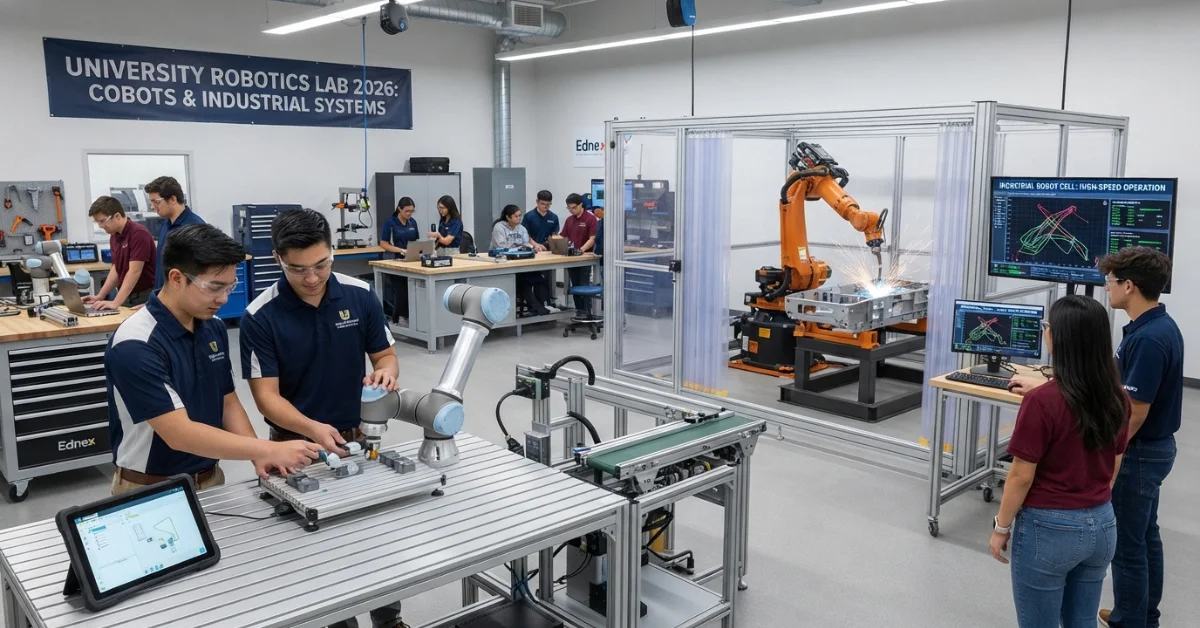
Cobots vs Industrial Robots in University Labs: What Engineering Programs Should Choose in 2026
The selection between collaborative and industrial robotics defines the practical scope, safety profile, and instructional reach of any university robotics program. Engineering departments equipping laboratories in 2026 face a procurement decision that influences curriculum design, student throughput, and graduate employability. This article defines both robot categories within the educational context, compares them across five operational criteria, examines the pedagogical role of collaborative systems, details the industrial use cases that justify heavier equipment, and presents a structured procurement framework. Readers will gain a reference resource covering the following:
- The defining characteristics of cobots and industrial robots in education
- A structured comparison across safety, cost, space, programming, and instructional value
- The pedagogical advantages of collaborative robots in education
- The use cases and considerations for industrial robots in university laboratories
Defining Cobots and Industrial Robots in the Educational Context
Cobots, or collaborative robots, are lightweight robotic arms engineered to operate alongside human operators within a shared workspace without physical barriers. Industrial robots are high-payload, high-speed robotic systems designed for repetitive, precision-intensive tasks within isolated, guarded cells.
The two categories perform distinct instructional functions:
- Demonstrate human-robot interaction through force-limited collaborative operation.
- Replicate production-grade automation through high-speed industrial cycles.
- Teach intuitive programming through hand-guidance and graphical interfaces.
- Develop advanced control competence through trajectory planning and offline programming.
- Prepare graduates for both flexible manufacturing and high-volume production environments.
The distinction between these categories rests on their underlying design philosophy. Collaborative systems prioritize safety, accessibility, and rapid reconfiguration, while industrial systems prioritize speed, payload capacity, and repeatability. Consequently, the Cobots vs Industrial Robots decision determines not only which equipment a laboratory installs, but which competencies its graduates acquire before entering the workforce.
Structured Comparison Across Five Criteria
A direct comparison clarifies the operational trade-offs that govern equipment selection. The following criteria represent the factors that engineering departments weigh during procurement.
Safety
Safety refers to the risk profile of robotic operation within a shared instructional environment populated by students of varying experience.
- Cobots: Integrate force and power limiting, collision detection, and speed monitoring that permit barrier-free operation under ISO/TS 15066 collaborative standards.
- Industrial robots: Require physical guarding, light curtains, and interlocked enclosures to isolate high-speed motion from human operators.
The instructional implication is direct. Collaborative systems allow students to approach, guide, and interact with the robot during operation, which compresses the supervision burden and increases hands-on access. Industrial systems demand strict access controls that limit direct interaction and raise instructor oversight requirements.
Cost
Cost encompasses both the capital acquisition expenditure and the recurring operational outlay across the equipment lifecycle.
- Cobots: Carry lower acquisition costs, minimal installation expense, and reduced infrastructure requirements due to the absence of guarding.
- Industrial robots: Incur higher acquisition costs, substantial installation expense, and additional expenditure for safety enclosures and supporting infrastructure.
Furthermore, the total cost of ownership extends beyond the unit price. Collaborative systems reduce facility modification and safety-system expenditure, while industrial systems require sustained investment in guarding maintenance, controller servicing, and dedicated power provisioning.
Space
Space refers to the laboratory floor area and infrastructure that each system requires for safe, functional operation.
- Cobots: Occupy a compact footprint, mount on benches or mobile bases, and relocate between workstations with minimal reconfiguration.
- Industrial robots: Require dedicated cells, reinforced mounting, and clearance zones that consume substantial laboratory area.
Moreover, the compact footprint of collaborative systems supports higher robot-to-student ratios within a fixed laboratory area, which reduces shared-equipment bottlenecks during scheduled practical sessions.
Programming Complexity
Programming complexity refers to the technical threshold a student must cross to operate, configure, and deploy the robotic system.
- Cobots: Support hand-guidance teaching, graphical block-based interfaces, and simplified scripting that lower the entry threshold for early-stage learners.
- Industrial robots: Require vendor-specific programming languages, offline simulation, and trajectory optimization that demand advanced technical preparation.
The pedagogical consequence is a clear progression pathway. Collaborative systems serve introductory robotics instruction, while industrial systems support advanced coursework in motion planning, kinematics, and production engineering.
Instructional Value
Instructional value refers to the breadth and depth of competencies each system develops across the engineering curriculum.
- Cobots: Teach human-robot collaboration, rapid prototyping, sensor integration, and flexible automation concepts.
- Industrial robots: Teach high-precision motion control, production-cell design, cycle-time optimization, and industrial protocol integration.
Additionally, the two categories prove complementary rather than mutually exclusive. A laboratory equipped with both delivers a complete instructional spectrum spanning accessible introductory work and production-grade advanced practice.
Collaborative Robots in Education: Pedagogical Advantages
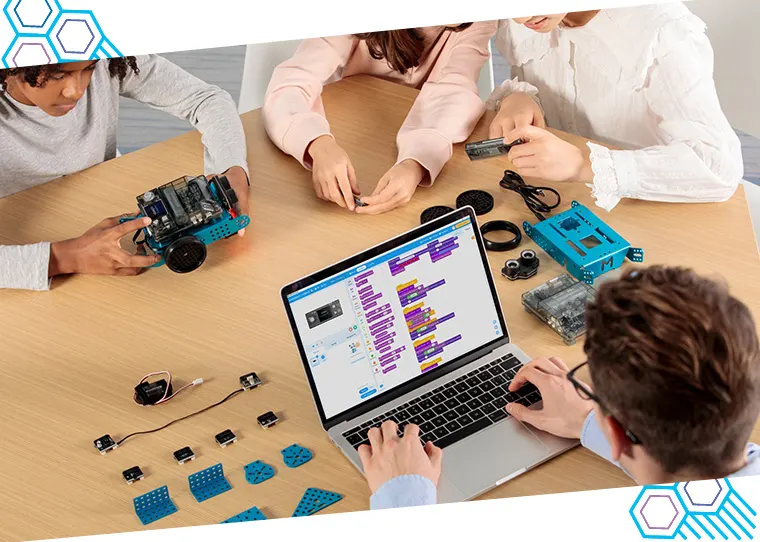
Collaborative Robots in Education are force-limited robotic systems integrated into instructional environments to teach automation concepts through direct, barrier-free human-robot interaction. Their design characteristics align closely with the requirements of undergraduate and early postgraduate instruction.
The pedagogical advantages include the following:
- Lower the technical entry barrier through intuitive hand-guidance and graphical programming.
- Increase hands-on access by permitting safe operation without physical guarding.
- Accelerate experiment turnover through rapid reconfiguration between tasks.
- Support interdisciplinary projects spanning mechatronics, sensor fusion, and machine vision.
- Reflect the flexible automation trend that defines contemporary manufacturing adoption.
The instructional strength of collaborative systems derives from their accessibility. A student programs a pick-and-place sequence through physical guidance within a single session, establishing the connection between instruction and robotic behavior without the preparatory burden that industrial programming requires. Furthermore, the safety profile permits open laboratory access, which extends practical engagement beyond rigidly supervised sessions.
Moreover, collaborative systems correspond to documented industry adoption patterns. Manufacturers increasingly deploy cobots for flexible, low-volume, high-mix production, which establishes a direct connection between laboratory competence and employer requirements. Graduates trained on collaborative platforms enter the workforce with experience relevant to the fastest-expanding segment of industrial automation.
Industrial Robots for University Labs: Use Cases and Applications
Industrial Robots for University Labs are high-payload, high-speed robotic systems installed within guarded cells to replicate production-grade automation for advanced engineering instruction. These systems address competencies that collaborative platforms cannot fully develop.
The primary educational use cases include the following:
- Replicate high-volume manufacturing cells for production engineering coursework.
- Develop advanced motion-control competence through six-axis trajectory programming.
- Integrate robotic systems with conveyors, vision systems, and programmable logic controllers.
- Demonstrate precision applications including welding, machining, and assembly.
- Prepare graduates for roles in automotive, aerospace, and high-throughput manufacturing.
The instructional significance of industrial systems rests on their fidelity to commercial production environments. A student who programs a six-axis robot to execute a precision assembly cycle acquires competence directly transferable to industrial automation roles. Furthermore, the integration of industrial robots with supporting automation infrastructure introduces students to the systems-level engineering that production deployment requires.
Additionally, industrial robots support research applications beyond undergraduate instruction. Postgraduate programs apply these systems to research in advanced control, machine learning for robotics, and process optimization, which extends their value across the institutional research mission.
Robotics Lab Equipment Considerations
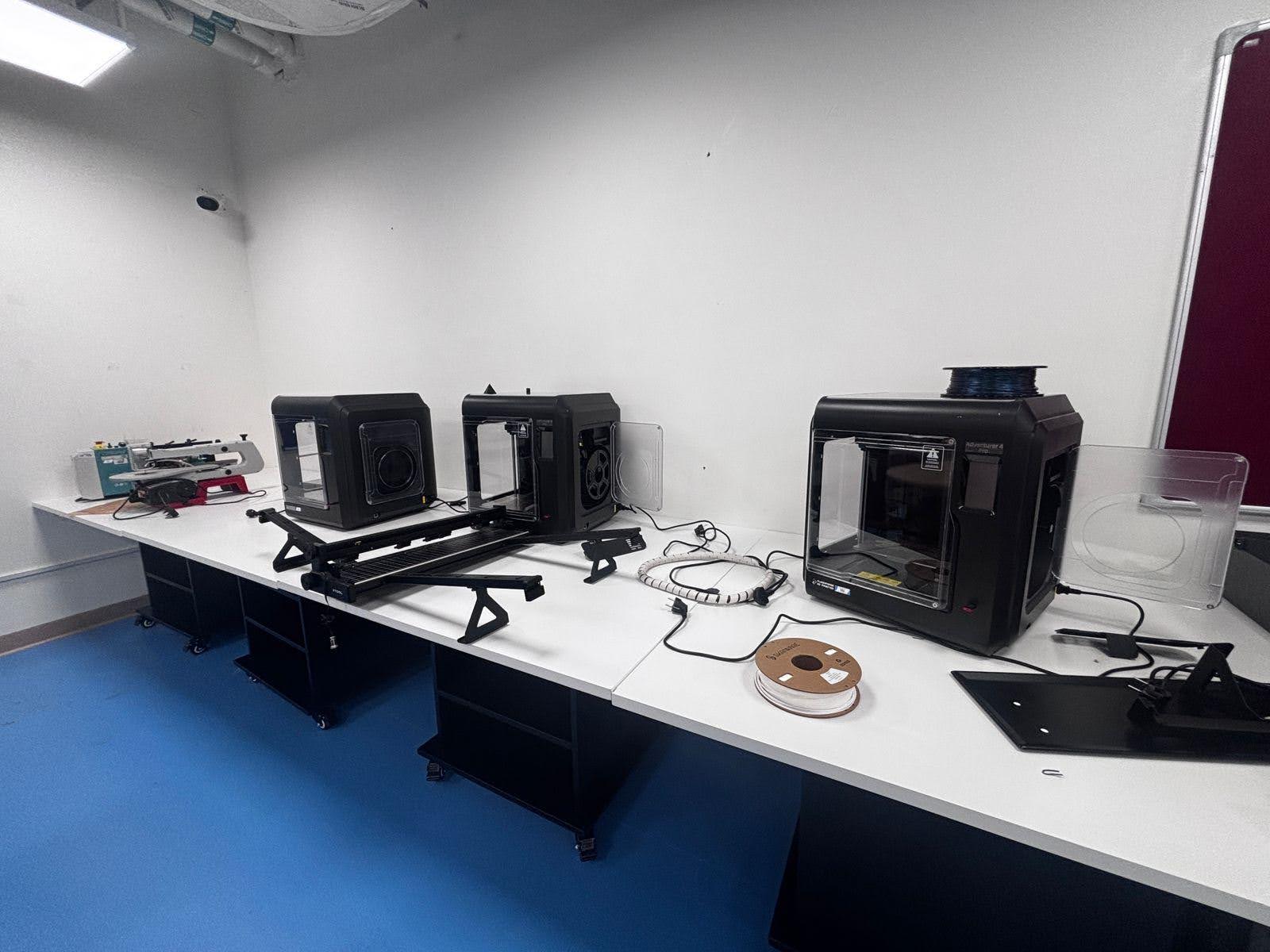
Robotics Lab Equipment comprises the robotic platforms, peripheral systems, software, and safety infrastructure required to construct a functional instructional robotics environment. Effective laboratory design coordinates these components into an integrated system rather than an inventory of isolated units.
Core equipment considerations include the following:
- Robotic platforms: Collaborative and industrial arms selected to match curriculum scope and student level.
- End-effectors: Grippers, vision sensors, and tool changers that extend application range.
- Controllers and software: Programming environments, offline simulation, and digital twin platforms.
- Integration infrastructure: Conveyors, programmable logic controllers, and communication networks supporting open industrial protocols.
- Safety systems: Guarding, light curtains, and emergency stops scaled to the installed equipment.
The selection of peripheral equipment determines the breadth of exercises a laboratory supports. Furthermore, equipment that adheres to open industrial communication standards ensures interoperability across vendors and protects the investment against obsolescence as program scope expands. Departments that standardize software environments across workstations reduce instructor support overhead and enable students to transfer competencies directly between platforms.
Procurement and Decision Framework for 2026
A procurement framework provides a structured method for aligning robotics equipment selection with curriculum objectives, budget parameters, and institutional capacity. Engineering departments should evaluate the following criteria before committing to acquisition.
- Curriculum alignment: Equipment must correspond to defined learning outcomes across introductory and advanced courses.
- Student level and cohort size: Collaborative systems suit introductory cohorts and high throughput; industrial systems suit advanced and research cohorts.
- Safety and supervision capacity: Guarding requirements and instructor availability constrain the feasible equipment mix.
- Space and infrastructure: Available floor area and power provisioning determine the scale of installable systems.
- Total cost of ownership: Evaluation must extend beyond purchase price to include installation, guarding, maintenance, and software licensing.
- Open standards and scalability: Platforms should support interoperable protocols and modular expansion as enrollment increases.
The recommended approach for most 2026 engineering departments is a tiered configuration. Collaborative systems establish the accessible foundation for introductory and high-volume instruction, while a smaller complement of industrial systems delivers advanced and research-grade competence. This dual configuration produces graduates fluent across the complete automation spectrum and protects laboratory investment against shifting industry demand.
Conclusion
The selection between collaborative and industrial robotics shapes the safety profile, cost structure, spatial footprint, programming progression, and instructional reach of every university robotics program. Collaborative robots deliver accessible, barrier-free instruction suited to introductory cohorts and flexible automation competence. Industrial robots deliver production-grade precision suited to advanced coursework and research applications. Robotics laboratory equipment considerations span platforms, end-effectors, controllers, integration infrastructure, and safety systems. A structured procurement framework aligned with curriculum, cohort size, safety capacity, space, cost, and open standards positions departments to select the optimal configuration. Together, a tiered deployment of both categories prepares graduates for the complete spectrum of contemporary robotic automation.
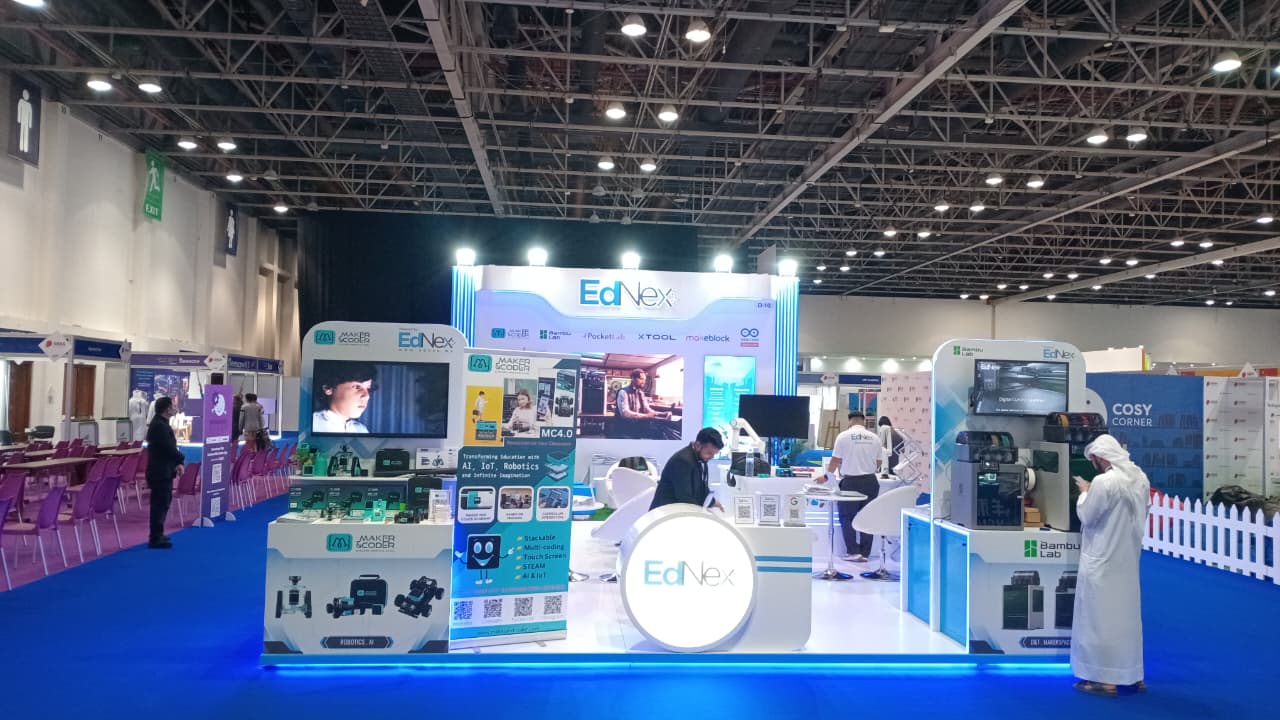
Ednex supplies collaborative and industrial robotics platforms, peripheral systems, and complete robotics laboratory solutions configured for university engineering departments. Ednex aligns equipment specifications, safety infrastructure, and curriculum support with learning outcomes, accreditation standards, and budget parameters to deliver scalable, future-ready laboratory provisioning. Contact Ednex today to design a robotics laboratory matched to your program objectives for 2026.
Frequently Asked Questions
What is the difference between cobots and industrial robots?
Cobots are lightweight, force-limited robotic arms designed to operate safely alongside humans without physical barriers, while industrial robots are high-payload, high-speed systems that require guarded enclosures. The two categories differ across safety, cost, space, programming complexity, and instructional value.
Which is better for a university engineering lab, cobots or industrial robots?
Neither category is universally superior. Collaborative robots suit introductory instruction and high student throughput, while industrial robots suit advanced coursework and research. Most engineering departments benefit from a tiered configuration that includes both.
Why are collaborative robots in education increasingly popular?
Collaborative robots lower the technical entry barrier through hand-guidance and graphical programming, permit barrier-free operation, and reflect the flexible automation trend that defines contemporary manufacturing. These characteristics increase hands-on access and align laboratory competence with industry demand.
What use cases do industrial robots for university labs support?
Industrial robots replicate high-volume manufacturing cells, develop six-axis motion-control competence, integrate with conveyors and programmable logic controllers, and demonstrate precision welding, machining, and assembly. They also support postgraduate research in advanced control and robotics.
What robotics lab equipment is required beyond the robot itself?
A functional robotics laboratory requires end-effectors such as grippers and vision sensors, controllers and programming software, integration infrastructure including conveyors and programmable logic controllers, and safety systems scaled to the installed platforms.
How much laboratory space do industrial robots require compared to cobots?
Industrial robots require dedicated cells, reinforced mounting, and clearance zones that consume substantial floor area. Cobots occupy a compact footprint, mount on benches or mobile bases, and support higher robot-to-student ratios within a fixed laboratory area.
Are cobots safe for students to operate without barriers?
Collaborative robots integrate force and power limiting, collision detection, and speed monitoring under ISO/TS 15066 collaborative standards, which permit barrier-free operation. Industrial robots, by contrast, require physical guarding and interlocked enclosures.
What should engineering departments consider when purchasing robotics equipment in 2026?
Departments should assess curriculum alignment, student level and cohort size, safety and supervision capacity, space and infrastructure, total cost of ownership, and support for open standards and scalability before committing to acquisition.
Author Bio
Ednex is a provider of educational laboratory solutions specializing in robotics and automation instruction. Ednex supplies collaborative robots, industrial robotic systems, peripheral equipment, and complete robotics laboratory configurations for university engineering departments, aligning equipment specifications, safety infrastructure, and curriculum support with learning outcomes, accreditation standards, and institutional budgets. Through structured provisioning and technical support, Ednex enables institutions to deliver scalable, industry-aligned robotics instruction.
Related Posts ...

Comments are disabled