



Arduino vs. Raspberry Pi: Which Is Better for K-12 Education?
When schools begin planning hands-on STEM learning, one question comes up again and again: should you choose Arduino or Raspberry Pi? It is a smart question, and for many school leaders across the UAE and GCC, it can feel like a big one.
Both platforms are popular. Both support coding, electronics, and project-based learning. Both can help students move from theory to real-world problem-solving. But they are not the same, and choosing the right one can make a huge difference in how easy your program is to launch, teach, and scale.
If you are comparing Arduino vs Raspberry Pi for education, the best choice depends on your students’ age, your teachers’ confidence level, your learning goals, and the type of classroom projects you want to run. One platform is usually better for simple electronics and beginner engineering tasks. The other is stronger for full computing, advanced coding, and more complex digital projects.
In this guide, we will break it all down in a clear and practical way for K-12 schools. We will look at the strengths, limits, classroom fit, and long-term value of each platform, with a special focus on schools in the UAE and GCC.
Why this comparison matters for schools in the UAE and GCC
Across the region, schools are investing more in coding, robotics, AI, design thinking, and applied STEM. From innovation labs to maker spaces and future skills programs, there is growing demand for tools that help students build, test, and create.
That is where Arduino and Raspberry Pi stand out. They are two of the most widely used STEM coding platforms for kids and young learners around the world. For schools, they offer a practical way to teach:
- Coding logic
- Electronics fundamentals
- Physical computing
- Problem-solving
- Engineering design
- Computational thinking
- Creativity through building
In the UAE and GCC, schools also need to think about budget control, teacher training, classroom management, and curriculum alignment. A platform may look exciting on paper, but it also needs to work in real school conditions. That is why this comparison matters.
What is Arduino?
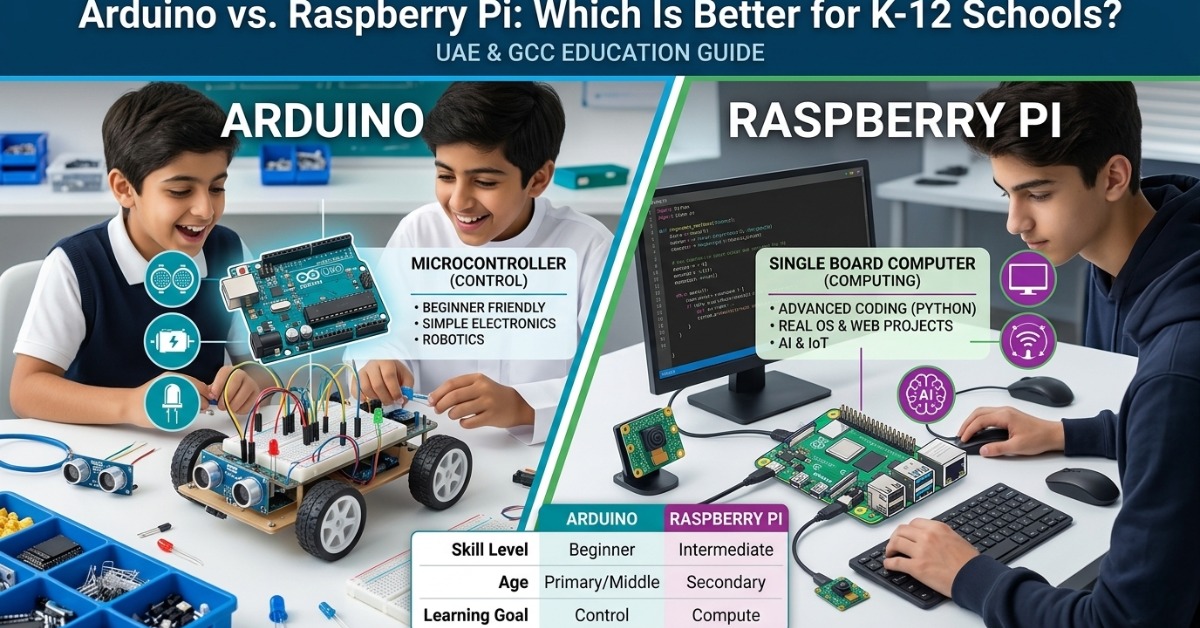
Arduino is a microcontroller-based platform designed to control electronics. In simple terms, it is great for projects that sense, measure, and react. Students can program Arduino boards to turn lights on, run motors, read sensors, or automate simple tasks.
Arduino is often one of the first platforms schools explore because it is focused, practical, and easier to understand for beginners.
Arduino is commonly used for:
- LED projects
- Sensor-based activities
- Simple robotics
- Smart device prototypes
- Automation experiments
- Introductory coding and electronics lessons
For many educators, Arduino for K-12 education works well because it teaches core engineering ideas without overwhelming students with a full computer system.
What is Raspberry Pi?
Raspberry Pi is a small single-board computer. Unlike Arduino, it runs an operating system and can perform many of the tasks of a desktop computer. Students can use it for coding, web development, data projects, multimedia work, AI experiments, and advanced robotics.
This makes Raspberry Pi more powerful in some ways, but also more complex.
Raspberry Pi is commonly used for:
- Python programming
- Desktop computing
- Web and app projects
- Media and display systems
- Camera-based projects
- AI and IoT experiments
- Advanced school maker projects
For schools looking at Raspberry Pi for schools, the big advantage is versatility. It can do a lot more than basic electronics.
Arduino vs Raspberry Pi for education: the core difference
Here is the simplest way to think about it:
- Arduino is best for controlling things
- Raspberry Pi is best for computing things
Arduino is usually better when students are learning how hardware works. Raspberry Pi is often better when students are learning software, operating systems, and more advanced digital projects.
That difference matters a lot in K-12 education.
Arduino for K-12 education: key advantages
Arduino often shines in school settings because it is focused and straightforward. Students write code, upload it to the board, and watch a real device respond. That instant cause-and-effect experience is exciting. It makes learning feel real right away.
Pros of Arduino in schools
- Easy to introduce in beginner STEM classes
- Excellent for electronics and physical computing
- Lower barrier to entry for younger students
- Fast setup for classroom activities
- Good for robotics, sensors, and engineering tasks
- Usually more affordable for basic projects
- Encourages experimentation through simple inputs and outputs
Why schools like Arduino
- It supports hands-on learning without too much technical setup
- Teachers can deliver focused lessons more easily
- Students quickly see results from their code
- It is strong for project-based learning in upper primary and middle school
If your goal is to teach circuits, automation, or device interaction, Arduino may be the best microcontroller for students, especially in beginner and intermediate stages.
Arduino: limitations in a school environment
Arduino is helpful, but it is not the answer for every learning goal.
Cons of Arduino in schools
- Limited computing power
- Not ideal for full desktop-style programming tasks
- Less suitable for projects needing an operating system
- Can require extra components for richer projects
- Advanced debugging may become harder as projects grow
For example, if students want to build websites, run complex Python applications, or explore computer vision, Arduino alone may feel too limited.
Raspberry Pi for schools: key advantages
Raspberry Pi gives students access to a more complete computing environment. That makes it attractive for schools that want to go beyond electronics into broader digital skills.
Pros of Raspberry Pi in schools
- Supports real programming languages such as Python
- Runs a full operating system
- Good for coding, computing, and digital creation
- Suitable for advanced STEM and computer science projects
- Can connect to displays, keyboards, cameras, and networks
- Strong for AI, IoT, and data-based learning
- Useful for older students in secondary education
For schools that want students to build apps, code in Python, create digital systems, or explore connected technologies, Raspberry Pi can be a very powerful choice.
Raspberry Pi: limitations in school use
Raspberry Pi is exciting, but let’s be honest: it can also be more demanding. In some school settings, that complexity becomes a challenge.
Cons of Raspberry Pi in schools
- More setup and maintenance than Arduino
- Requires operating system management
- Can be harder for younger learners to grasp
- Classroom troubleshooting may take longer
- Peripheral needs can increase total cost
- Teachers may need more training and technical support
This is especially important in K-12 settings where time is limited and lesson flow matters. If a teacher has to manage devices, software issues, logins, and hardware connections all at once, the learning experience can slow down.
Arduino vs Raspberry Pi for beginners
This is where many schools find their answer.
If you are looking at Arduino vs Raspberry Pi for beginners, Arduino is usually the better starting point. It is simpler, more direct, and easier for students to understand when they are first learning coding and electronics.
Arduino is better for beginners when:
- Students are in upper primary or middle school
- Teachers are new to physical computing
- The program focuses on simple robotics or sensor projects
- The school wants low-complexity classroom delivery
- The goal is hands-on STEM confidence
Raspberry Pi is better for beginners when:
- Students already have some coding background
- The focus is on computing rather than electronics
- The school has technical support available
- Teachers are comfortable with software setup
- Projects involve Python, media, networks, or AI
In most cases, Arduino vs Raspberry Pi for beginners is not really a battle. It is more about readiness. Arduino often helps students build confidence first. Raspberry Pi can then extend their learning later.
Which is better by age group?
A school-wide decision should take age progression into account.
Best fit by stage
Primary school
- Arduino is often the better fit
- Great for simple outputs, sensors, and guided projects
- Easier for shorter attention spans and introductory STEM lessons
Middle school
- Arduino remains very strong
- Raspberry Pi can be introduced for selected coding groups
- Hybrid pathways begin to make sense
Secondary school
- Raspberry Pi becomes more valuable
- Strong for computer science, Python, AI, and digital systems
- Arduino still works well for electronics and robotics modules
A practical progression for many UAE and GCC schools is simple:
- Start with Arduino in younger grades
- Add Raspberry Pi in later grades
- Use both for advanced STEM pathways
Classroom comparison: side by side
Here is a simple school-focused comparison of Arduino vs Raspberry Pi for education:
Arduino
- Best for: electronics, robotics, sensors, automation
- Skill level: beginner to intermediate
- Setup: simpler
- Cost: often lower for entry-level projects
- Teacher load: lighter
- Age fit: upper primary to secondary
- Learning style: direct and hands-on
Raspberry Pi
- Best for: computing, Python, AI, multimedia, IoT
- Skill level: intermediate to advanced
- Setup: more complex
- Cost: can rise with accessories
- Teacher load: higher
- Age fit: middle school to secondary
- Learning style: broader and more computer-based
Budget and infrastructure considerations for UAE and GCC schools
When schools in the region evaluate tools, cost is never just about the board itself. You also need to look at total implementation cost.
Arduino cost factors
- Boards
- Starter kits
- Sensors and accessories
- Cables and power
- Teacher training
Raspberry Pi cost factors
- Board
- SD card and power supply
- Keyboard, mouse, monitor, or shared display
- Cases and peripherals
- Software setup time
- Teacher training and device management
For many schools, Arduino is easier to pilot at a smaller scale. Raspberry Pi may require more planning, especially if you want full classroom deployment.
This does not mean Raspberry Pi is too expensive. It means it often works best when schools have a clear strategy behind it.
Which platform is best for school goals?
Choose Arduino if your school wants to:
- Teach electronics in a simple way
- Launch robotics or automation lessons
- Build beginner confidence in STEM
- Reduce technical complexity
- Start a maker or innovation program quickly
Choose Raspberry Pi if your school wants to:
- Teach Python and computing in depth
- Support advanced digital projects
- Explore AI, IoT, or media applications
- Give older students broader programming experiences
- Build more advanced secondary pathways
Choose both if your school wants to:
- Create a full K-12 STEM journey
- Start simple and scale upward
- Blend electronics with advanced computing
- Offer differentiated learning opportunities
For many schools, the strongest answer is not one or the other. It is a staged model that uses each platform where it works best.
Final verdict
So, which is better?
If the question is Arduino vs Raspberry Pi for education in K-12 schools, Arduino is often the better starting point for beginners, younger students, and schools that want easier classroom implementation. It is practical, engaging, and very effective for physical computing.
Raspberry Pi is often the better choice for older students, advanced coding, and broader computer science learning. It offers more power and flexibility, but it also demands more support.
The best decision is the one that matches your students, your teachers, and your school’s STEM vision. For many UAE and GCC schools, Arduino is the best first step, while Raspberry Pi becomes a powerful next step.
FAQ
What is the main difference between Arduino and Raspberry Pi for education?
Arduino is a microcontroller used mainly for controlling sensors, motors, and simple electronics. Raspberry Pi is a small computer that can run software, code, and more advanced digital applications.
Which is easier for beginners?
In most cases, Arduino is easier. That is why many educators prefer Arduino vs Raspberry Pi for beginners when launching early STEM and electronics programs.
Is Arduino good for K-12 classrooms?
Yes. Arduino for K-12 education is a strong option for hands-on STEM, robotics, and electronics learning. It is especially useful for upper primary and middle school students.
Is Raspberry Pi suitable for schools?
Yes. Raspberry Pi for schools is excellent for coding, Python, AI, and digital project work, especially in middle and secondary grades.
Which is the best microcontroller for students?
If the focus is simple electronics and physical computing, Arduino is often the best microcontroller for students. If the focus is full computing, Raspberry Pi may be better.
Can schools use both Arduino and Raspberry Pi?
Absolutely. Many schools use Arduino for beginner electronics and Raspberry Pi for advanced coding. This creates a stronger long-term STEM pathway.
Which platform is better for robotics?
Arduino is often better for basic robotics and hardware control. Raspberry Pi can support more advanced robotics projects that need computing power, cameras, or AI tools.
Which is better for STEM coding platforms for kids?
Both are strong STEM coding platforms for kids, but they serve different goals. Arduino is great for simpler physical projects, while Raspberry Pi is better for more advanced coding and computing.
What should schools in the UAE and GCC choose first?
If the school is starting from scratch, Arduino is often the safer first choice. It is easier to implement, easier to teach, and often more manageable in classroom settings.
Author Bio
Ednex helps schools build future-ready learning environments through practical STEM, robotics, coding, and innovation solutions. With a strong understanding of school needs across the UAE and GCC, Ednex supports educators in choosing the right tools, designing effective programs, and creating engaging learning experiences that prepare students for tomorrow.
Related Posts ...


Comments are disabled