

Control Engineering Explained: Principles, Applications, and Learning Pathways
What happens when a sensor detects a change, a controller decides what to do, and an actuator responds? That complete loop is where controlengineering moves from an abstract concept to a system learners can observe, test, and improve.
If the relationship between sensors, controllers, actuators, and automation is hard to grasp from theory alone, a step-by-step example can help. Give each component a clear role, trace how a measurement leads to an action, then observe whether the action moves the process toward its target.
This guide explains what control engineering does, how its core components work, and how open-loop and closed-loop approaches differ. It also outlines a practical learning pathway, with activities that connect foundational concepts to measurable outcomes. For schools, universities, and vocational training institutions in the UAE, a purpose-designed Instrumentation & Control Lab can bring equipment, curriculum, and learner progression together.
Ednex LLC designs and implements specialized engineering learning environments. Its Instrumentation & Control Lab solutions help institutions plan practical activities around control concepts, giving learners a structured route from understanding the feedback loop to investigating system behaviour.
Key Takeaways
- Understand how control engineering regulates processes and connects with instrumentation and automation.
- Trace a feedback loop from its target through measurement and control action to the system response.
- Compare open-loop and closed-loop control by feedback, response, complexity, and suitable use cases.
- Build a practical controlengineering learning pathway by linking activities to observable learner outcomes.
- Plan an Instrumentation & Control Lab around equipment, learning activities, and curriculum goals.
What Is Control Engineering, and What Problems Does It Solve?
Processes change even when a machine is running as intended. Temperature can shift, a motor can encounter a different load, and a fluid level can rise or fall. Control engineering addresses these variations by designing systems that measure a process and adjust it toward a desired result. The work brings together mathematical models, physical components, and decision logic so a system can respond in a planned way.
A room thermostat is a familiar example. A person sets a target temperature, a sensor measures the current temperature, and a controller decides whether heating should switch on or off. The heating system changes the room’s temperature, and the sensor takes another reading. The important point is not just that equipment switches on. The control system is designed to respond as conditions change.
In brief: Control engineering designs how a system measures a process, decides what adjustment is needed, and acts to achieve a defined outcome. Automation uses technology to carry out tasks; control engineering determines how a system should respond to measured conditions. Instrumentation provides the measurement and control devices that support those decisions and actions. For a broader historical and technical overview, see Control Engineering Explained.
What Does a Control Engineer Design?
A control engineer begins by defining the process objective: what needs to be regulated, what can be measured, and what can be changed. The next steps are to understand or model how the process behaves, choose a control method, and select components that can measure and influence it. A useful design accounts for how the process responds to an adjustment, rather than treating the machine as a simple on-off device.
For example, a manufacturing system may need to regulate a motor’s speed as production demands change. An energy system may need to adjust a process variable to support steady operation, while laboratory equipment may need to maintain a selected temperature during an experiment. In each case, operating an automated machine means using its existing sequence. Designing its control means deciding how measurements, logic, and adjustments work together.
Why Control Engineering Matters in Technical Education
Control engineering helps learners connect measurement with decision-making. They can read a sensor value, predict how a controller should respond, and check whether the system’s behaviour matches its objective. An exercise that changes the target or introduces a disturbance makes concepts such as error and stability easier to investigate because learners can see the system respond.
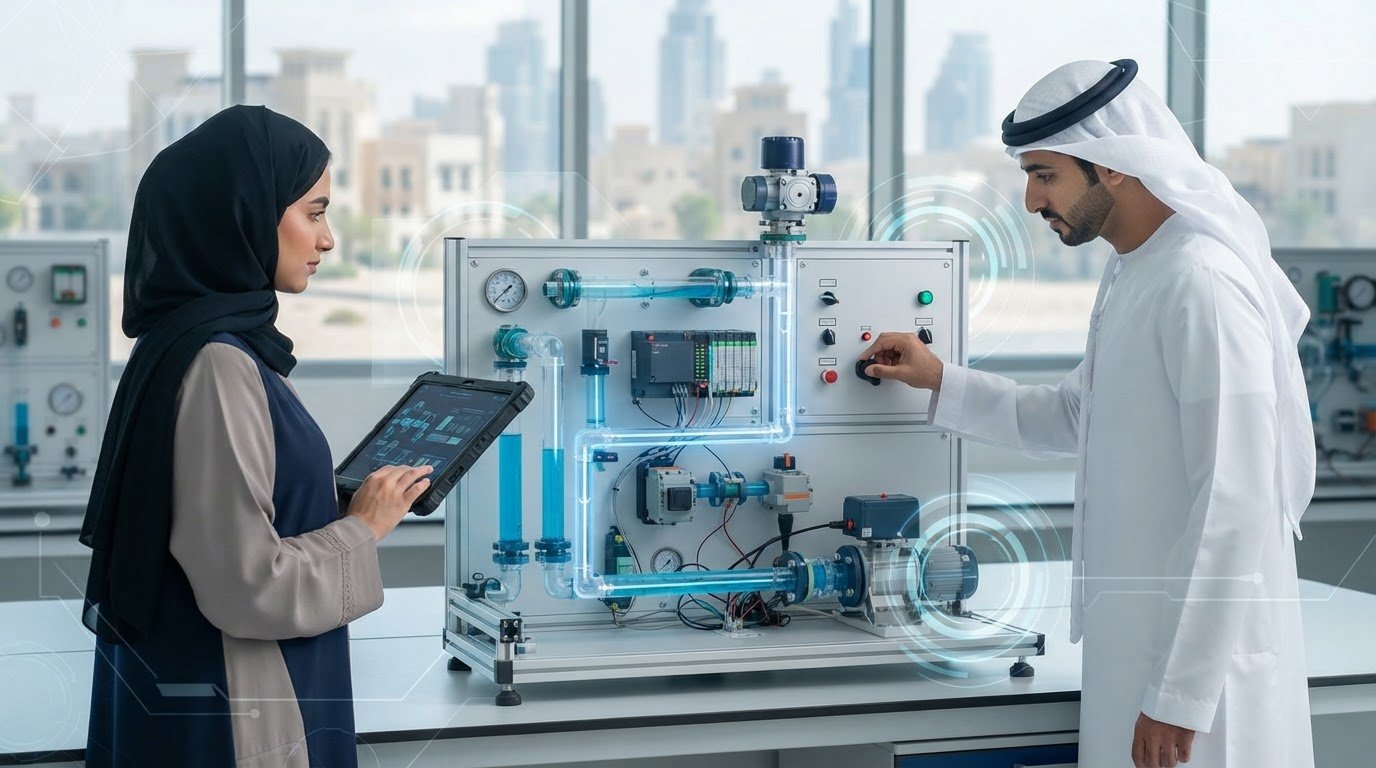
These foundations support study in electrical and electronics engineering, mechanical engineering, energy systems, robotics, and mechatronics. A purpose-designed Instrumentation & Control Lab can connect curriculum goals with equipment and planned activities. Learners can progress from interpreting measurements to testing and evaluating system performance. The central challenge is to design a response that remains appropriate as conditions change.
How Does a Control System Work? Follow the Feedback Loop
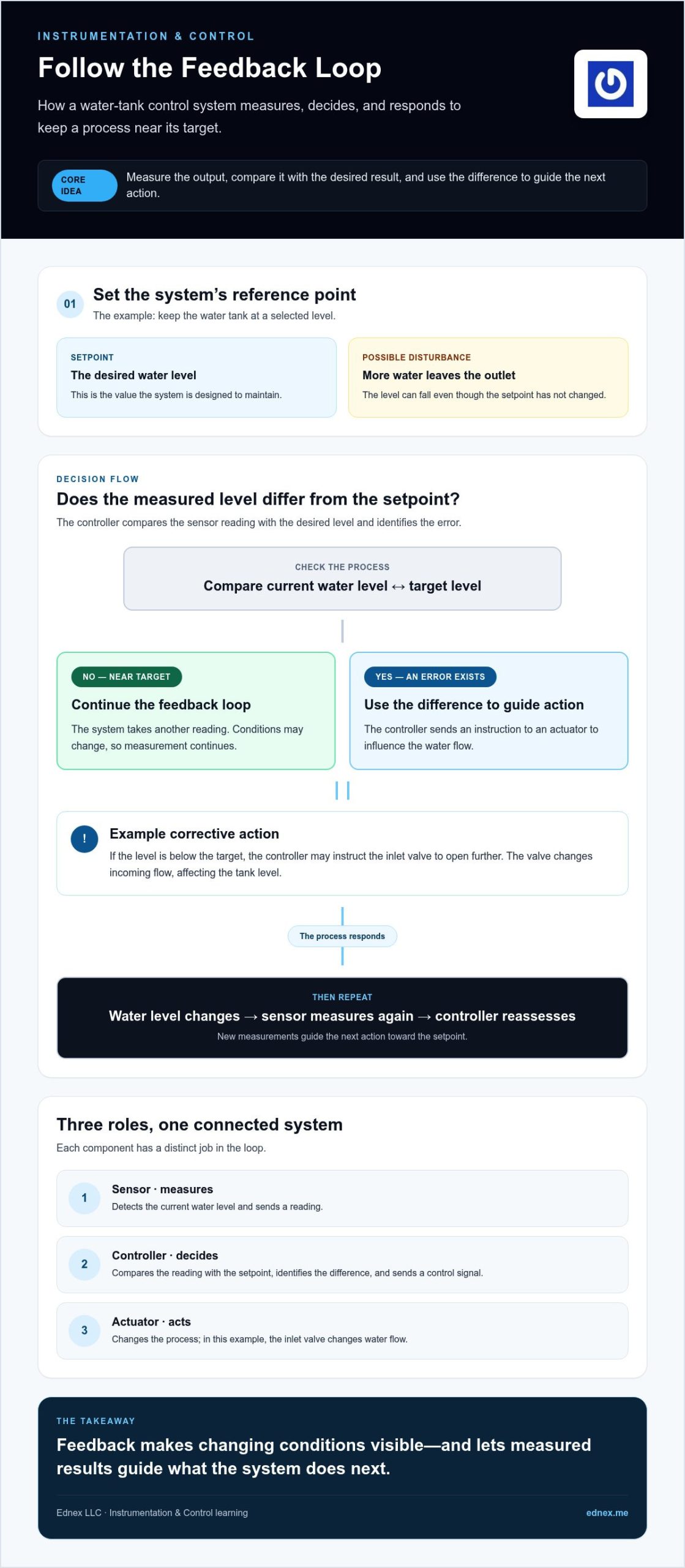
Consider a water tank that needs to stay at a selected level while water flows in and out. A control system measures the level and adjusts the incoming flow as conditions change. This sequence is called a feedback loop: the system measures its output, compares it with the desired result, and uses the difference to guide its next action.
Follow the process step by step:
- Target: Set the desired water level, known as the setpoint.
- Measurement: A level sensor detects the water’s current height and sends a signal.
- Comparison: The controller compares the measured level with the setpoint and identifies the error, or difference.
- Control action: The controller sends an instruction, such as opening an inlet valve further.
- Response: The water level changes. The sensor measures it again, and the loop continues.
Feedback uses new measurements to help reduce the difference between a desired output and the actual output. This is central to controlengineering: the system’s actions respond to what is happening, rather than relying only on a preset instruction.
How Sensors, Controllers, and Actuators Work Together
In the tank example, the sensor measures the process variable, which is the water level, and sends that reading to the controller. The controller compares the reading with the setpoint and determines whether the level is below, above, or near the target. It then sends a control signal to an actuator. Here, the inlet valve changes the water flow. Measurement, decision, and action each have a distinct role, and the loop depends on connecting all three.
Where Setpoints, Disturbances, and Feedback Fit
The setpoint is the value a system is designed to maintain. A disturbance is an external influence that moves the process away from that value. In the tank example, an increase in water leaving through an outlet is a disturbance: the level falls even though the target has not changed.
Feedback makes the change visible. The sensor reports the lower level, the controller identifies the difference from the setpoint, and the actuator adjusts the inlet flow. As the level moves toward its target, further readings guide the next action. The controller’s response depends on its design. Tracing each measurement and adjustment helps learners understand how control decisions affect system behaviour. Michigan Technological University’s overview of Control Systems Engineering Principles and Applications also places control systems in a wider engineering context.
For institutions teaching this sequence through practical work, an Instrumentation & Control Lab can support activities involving measurement, control logic, and system response. Learners can follow a loop in action, observe how the system reacts to a disturbance, and connect each result to an engineering decision.
Open-Loop vs Closed-Loop Control: What Should Learners Compare?
The main difference is whether a system measures its output and adjusts its action. An open-loop system follows instructions without checking the result. A closed-loop system uses feedback to respond when the output differs from its target. Neither approach is automatically better. The choice depends on how predictable the process is, how closely the output needs to match its target, and whether the added measurement and control logic are useful.
A motor makes the contrast easy to see. In an open-loop setup, it might run at a fixed power level for a set time. In a closed-loop setup, a sensor measures its speed, and the controller adjusts the motor if the measured speed moves away from the target. This comparison shows how controlengineering choices affect system behaviour.
| Comparison point | Open-loop control | Closed-loop control |
|---|---|---|
| Feedback | Doesn’t measure the resulting output | Measures output and uses it to guide action |
| Response | Follows a preset instruction | Can adjust when output deviates from target |
| Complexity | Often simpler to implement | Requires measurement and feedback logic |
| Suitable example | Motor runs at a fixed setting for a set duration | Motor speed is regulated against a target |
When Does Open-Loop Control Make Sense?
Open-loop control can suit a predictable process where a preset action is adequate and measuring the output is unnecessary. A motor might run at a fixed setting for a defined interval as part of a repeatable task. The design is straightforward because it does not need an output sensor or logic to correct deviations. The limitation becomes clear if the motor encounters a changing load: the same instruction may not produce the same speed. Learners can test this by changing the load and observing that the control action stays the same even when the output varies.
When Does Closed-Loop Control Add Value?
Closed-loop control is useful when the output needs to stay near a target despite changing conditions. In the motor example, a speed sensor reports the current speed, and a controller compares it with the setpoint. If the motor slows under additional load, the controller can adjust its output to bring the speed closer to the target. This approach adds measurement and decision logic, so the design is more involved.
A programmable logic controller (PLC) is one platform for implementing industrial control logic. Paired with suitable sensors and outputs, it can help learners develop and test a control sequence. Other tools can demonstrate the same principles. A useful exercise has learners compare measured responses, identify what changed, and explain why each method behaved as it did. The IEEE Control Systems Society reflects the breadth of this field across research and professional practice.
To compare the two approaches, keep the operating conditions the same and observe how each system responds to a change. Learners can then justify which method fits the process and explain the trade-off between simplicity and responsiveness.
How to Build a Practical Control Engineering Learning Pathway
Start a control engineering pathway with learning outcomes, not an equipment list. Decide what learners should be able to measure, explain, configure, and evaluate. Then arrange activities so each task builds on a skill they have already practised. This makes controlengineering easier to teach as a connected subject, with clear progress from interpreting readings to assessing system behaviour.
Which Skills Should Learners Develop First?
Begin with process variables, units, and measurement. Learners can record a value, identify what it represents, and describe how it changes. Next, introduce setpoints and simple control logic, then move on to feedback and controlled experiments. At every stage, ask learners to support their explanations with recorded evidence.
- Measure: Identify a process variable, select suitable units, and record readings consistently.
- Interpret: Compare measurements with a target and describe the difference using evidence.
- Control: Apply simple logic, observe the system response, and explain how an adjustment affects it.
- Evaluate: Compare results under changed conditions and identify possible sources of variation.
Practical work should also establish sound engineering habits. Before an experiment, learners review relevant safety procedures and define the test conditions. During it, they document settings, readings, and unexpected behaviour. If the system responds differently from the prediction, troubleshooting should start with evidence: check the measurement, confirm the configured values, and record each change. A closing reflection helps learners separate what the results show from what still needs investigation.
How Can a Lab Connect Concepts to Application?
Define an observable outcome for each activity before planning workstations or equipment. An introductory activity might ask learners to interpret sensor readings. Later tasks can focus on configuring logic or comparing responses. Matching the lab layout and resources to these learning stages helps institutions support different learner levels while keeping activities connected to the curriculum.
Repeatable experiments help learners build knowledge over time. They can hold most conditions steady, change one factor, and compare recorded responses. For example, they might examine what happens after a setpoint changes and record whether the response matches their prediction. The aim is not simply to complete a task. Learners should make a testable prediction, gather evidence, and explain what the result means.
For institutions connecting control studies with production concepts, Industry 4.0 lab solutions offer relevant planning context. A broader view of futuristic engineering lab solutions can also help align learning environments with evolving technical pathways. Ednex designs and implements specialized engineering labs, including Instrumentation & Control Labs, around institutional learning needs. Explore Ednex’s engineering lab solutions to connect learning goals with a practical lab environment.
How Ednex Brings Control Engineering Concepts into the Lab
A control lab is most useful when learners can move from principles to purposeful experimentation. Ednex designs and implements Instrumentation & Control Lab solutions for institutions, aligning the lab environment with planned activities and learning goals. The focus is not simply on equipping a room. It is on supporting structured practical learning that makes controlengineering concepts easier to investigate.
Lab activities can also connect control concepts with related disciplines. Measurement and process regulation complement electrical and electronics engineering, while motion and system response link naturally to mechanical engineering, robotics, and mechatronics. These connections let institutions reinforce shared ideas while retaining the distinct objectives of each technical program.
What Should an Institution Align Before Lab Implementation?
Start with the learners and curriculum. K-12 students, higher education learners, and vocational trainees may have different levels of prior knowledge. Match activities to the intended competencies and build them progressively. Before selecting equipment, define what learners should be able to observe, explain, configure, or evaluate by the end of each exercise.
Next, align the learning sequence with the lab environment. Foundational activities can focus on interpreting measurements; later work can introduce control logic, system response, and performance evaluation. Give each task an observable outcome so instructors can guide learners and review their progress. A planned sequence also helps keep equipment and resources connected to curriculum goals rather than isolated as demonstrations.
Consider connections across programs, too. A control activity might reinforce measurement skills taught in electronics or system behaviour explored in mechanical engineering. These links help institutions build an integrated technical learning experience without losing the specific focus of each lab.
How Can Lab Design Support Long-Term Learning Goals?
A well-planned lab supports repeatable, collaborative practical work. Learners can follow a shared procedure, record observations, compare results, and discuss why responses differ. Planning work areas and equipment around these activities makes it easier to move between explanation, experimentation, and reflection. The goal is a learning space that serves defined activities and supports progression to more advanced applications.
Ednex provides end-to-end design and implementation of specialized engineering labs, aligning learning environments with institutional objectives. This approach connects intended activities with the equipment and layout needed to support them. Institutions planning future-ready technical learning environments can also explore engineering lab solutions as a related resource.
When lab plans reflect competencies, learner progression, and practical application, an Instrumentation & Control Lab can contribute to a connected engineering education strategy. Explore Ednex’s educational lab solutions to develop hands-on engineering learning at your institution.
Shape the Next Stage of Practical Engineering Learning
Turn your institution’s learning priorities into an environment where learners can develop skills through purposeful practice. A considered approach to controlengineering education connects curriculum goals with capabilities students can apply across technical fields.
Ednex designs and implements specialized engineering labs, including Instrumentation & Control Lab solutions, for K-12 schools, higher education, and vocational training. These learning environments support institutions as they plan for different learner needs and long-term objectives.
Begin by defining the outcomes you want learners to achieve, then plan a lab environment around those priorities. Explore Ednex educational laboratory solutions to take the next step toward practical engineering learning.
Frequently Asked Questions
What is the difference between control engineering and automation?
Control engineering designs how a process should behave, while automation uses technology to carry out tasks with less manual intervention. They often work together, but they are not interchangeable. An automated packaging line might follow a programmed sequence, while its control design determines how equipment responds to process conditions. Automation can also include scheduling, material handling, and data collection. In controlengineering study, distinguishing these roles helps learners identify the problem each technology addresses.
Can control engineering be taught without industrial equipment?
Yes. Learners can start with block diagrams, simulations, and simple demonstrations using everyday materials. For example, they can track how quickly a small container fills under different inlet conditions. They can predict what will happen, record observations, and compare results before moving on to specialized systems. The essential step is making the connection between an input, a decision, and an output visible. Practical equipment can then extend the same reasoning to more complex processes.
What mathematics do students need to begin learning control engineering?
Students can start with algebra, units, and graph interpretation, including reading how a measured value changes over time. Plotting temperature readings, for example, can help them identify whether a process is warming, cooling, or holding steady. Instructors can introduce more advanced mathematics as course objectives require, linking each new concept to a system learners can observe. Prior knowledge and program level should guide the pace and depth.
How does a PID controller respond to changes in a process?
A PID controller calculates a response using three actions: proportional, integral, and derivative. Proportional action responds to the current error; integral action accounts for error accumulated over time; derivative action responds to how quickly the error is changing. Consider a system maintaining a target temperature after a door opens. The controller’s combined response depends on the process and how its settings are tuned, so results need to be evaluated in context.
What is the difference between a PLC and a control system?
A control system is the complete arrangement used to achieve a process objective. A programmable logic controller, or PLC, is one type of programmable device that can form part of that arrangement. A packaging station, for instance, may use a PLC to coordinate a sequence of actions, while sensors, actuators, and the process itself complete the wider system. A PLC can also manage sequencing or other logic beyond a single feedback loop.
Why are sensors important in control engineering?
Sensors give a system information about physical conditions, such as an object’s position or a motor’s speed. Their readings help engineers assess whether a process is behaving as intended and whether a control response is appropriate. In a classroom exercise, students might compare two position readings taken with different units or sampling intervals, then consider how measurement quality affects their conclusions. This develops practical judgment about data as well as familiarity with components.
Can control engineering concepts be explored through virtual or remote labs?
Yes. Simulations let learners examine how changing a parameter affects a model, while remote labs can provide access to experiments using physical equipment. Choose based on the learning outcome: simulation is useful for isolating variables and exploring scenarios, while remote access lets learners interpret readings from a real setup. Combining these approaches with in-person practical work can give students different ways to investigate engineering behaviour.
Related Posts ...

Comments are disabled