



School Lab Modernization in the UAE: Trends Shaping 2026 and Beyond
A modern school lab is defined by what students can learn and do there, not just by the equipment in the room. For school lab modernization UAE, that means looking beyond replacing outdated apparatus and asking whether the space, technology, and teaching goals work together. With the UAE introducing a unified Artificial Intelligence and Technology subject for 2026-2027 and increasing project-based assessment, schools have fresh reasons to review how practical learning is supported.
New equipment can be an obvious place to start, but even advanced tools may go unused if they do not connect to the curriculum, suit the students, or support hands-on learning. Modernization is a planning process, not a shopping list.
This article explores the shifts shaping school laboratories across the UAE and practical ways to set priorities. It covers how to align facilities with learning outcomes, assess spaces for science, design and technology, robotics, and AI, and weigh emerging technologies against curriculum needs. From Future Science Labs and Makerspaces to phased upgrades, the focus is on creating a connected learning environment that can adapt as school goals evolve.
Key Takeaways
- School lab modernization UAE is most effective when learning goals, teaching practice, spaces, and equipment are planned together.
- Connected, interdisciplinary, and project-based learning are shaping lab planning, but schools should adopt only approaches that serve their goals.
- Assess potential upgrades against learning purpose, student needs, staff readiness, and how flexibly the space can adapt.
- Use a phased roadmap to define outcomes, audit facilities, prioritize gaps, implement changes, and evaluate their value.
- Integrated lab design, equipment, and school-focused STEAM, robotics, and coding programs can support institutional objectives.
Why School Lab Modernization in the UAE Is About More Than New Equipment
A new instrument can expand what a class can do, but it cannot resolve a mismatch between the room, curriculum, and teaching approach. School lab modernization is the coordinated alignment of learning spaces, teaching practice, equipment, and curriculum to support purposeful practical learning. A newly equipped room may have advanced tools; a modernized lab is planned around what students need to investigate, create, test, and understand.
This distinction matters for school lab modernization UAE. Replacing a device may address a visible gap while leaving other needs unresolved, such as limited room for group work, equipment that does not support current projects, or tools that staff have little opportunity to use in lessons. Start with learning goals, then identify the changes to space, resources, and teaching practice that can support them. Improvements can be phased, with priority needs addressed first rather than requiring a complete transformation at once.
What counts as a modern school laboratory?
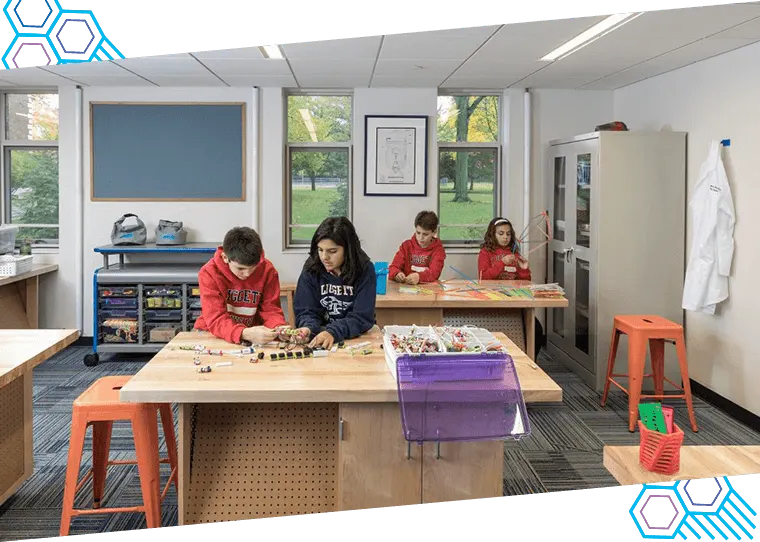
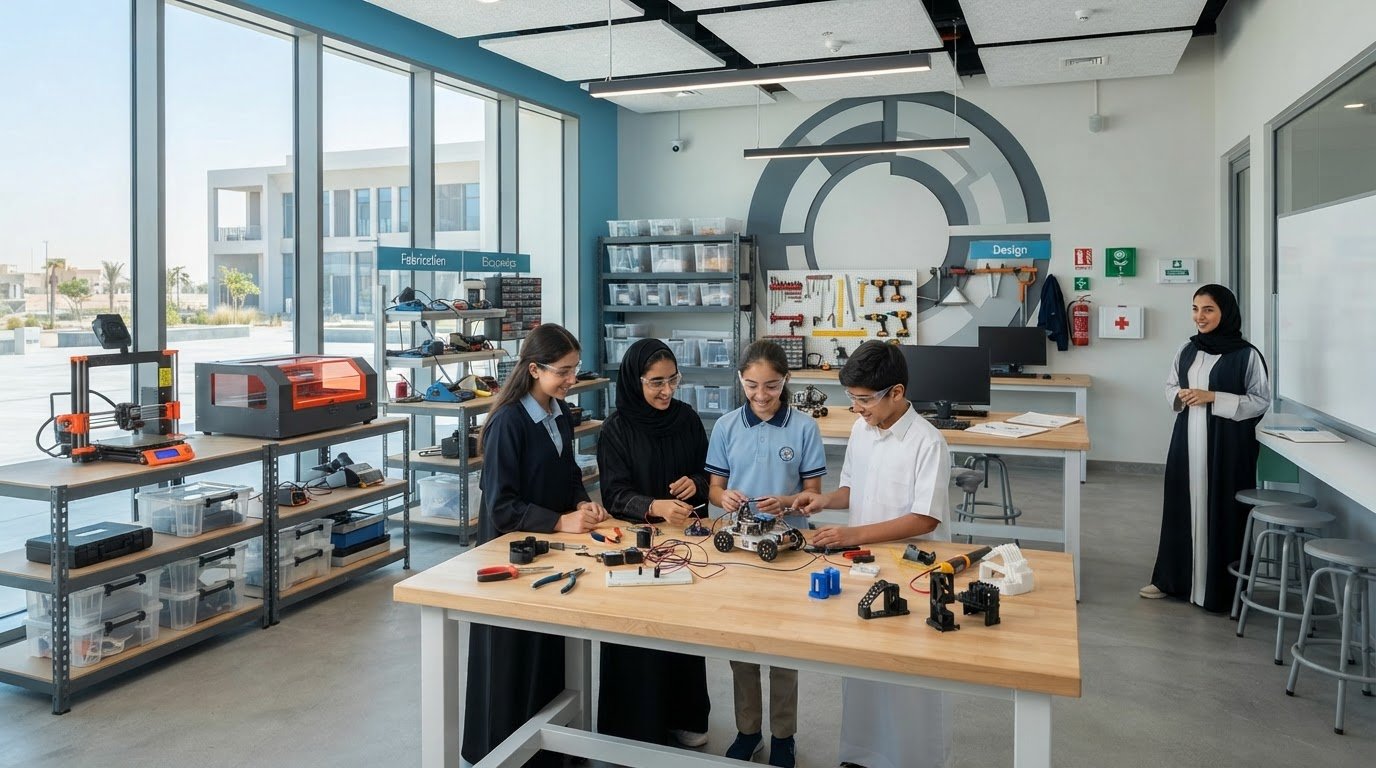
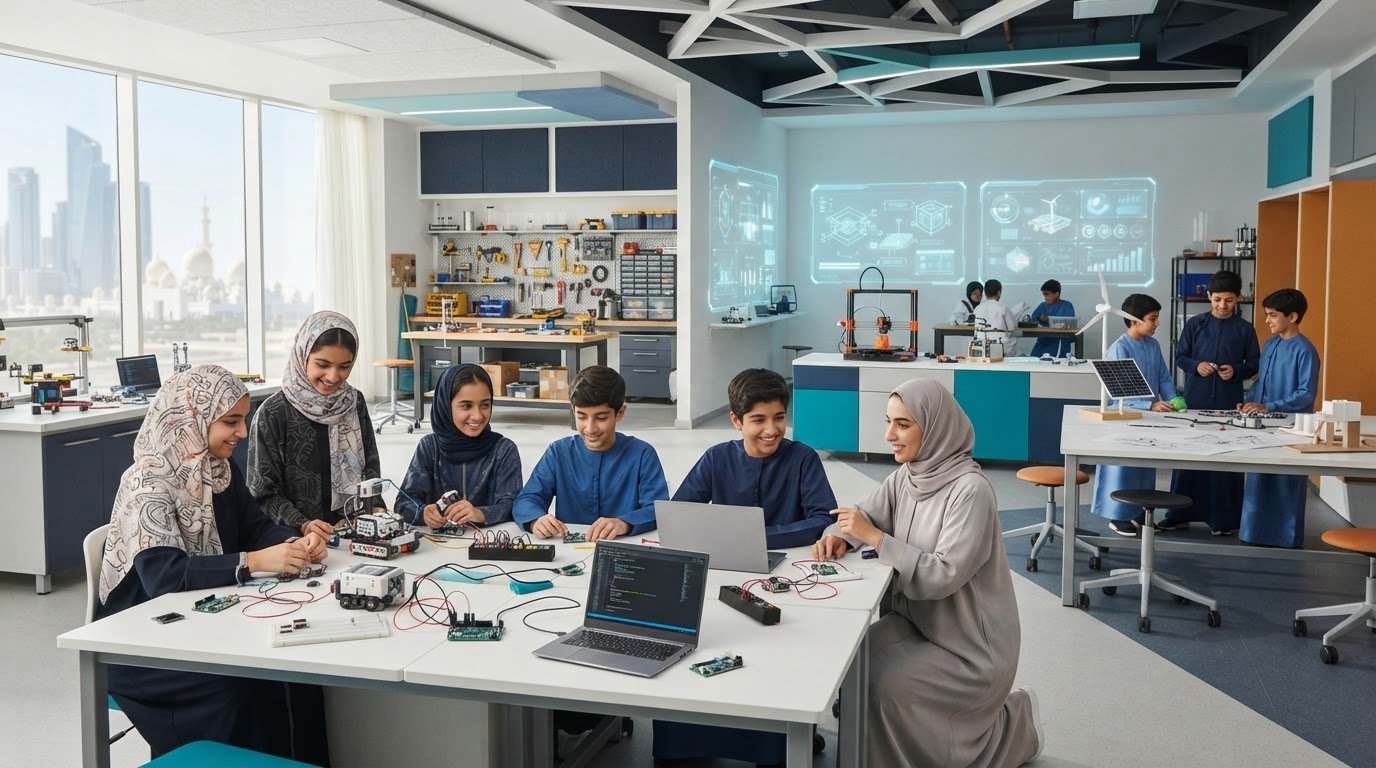
A modern laboratory is an adaptable learning environment, not simply a room with advanced technology. It should support investigation, prototyping, testing, and collaboration, with equipment and software selected for relevant curriculum activities. Safety arrangements and teacher readiness matter too: students need appropriate oversight, and educators need to understand how the tools fit into lessons. A science space, Makerspace, or Design and Technology Lab may serve different purposes, but each works best when its layout, resources, and teaching use are planned together.
Why are schools revisiting lab priorities now?
Changing technical skills and emerging tools are prompting schools to consider more applied, interdisciplinary learning. Robotics, coding, digital design, and AI can create new possibilities for student projects, but only when they serve clear learning objectives. Without that connection, technology can become an isolated feature rather than a meaningful part of curriculum delivery.
There are also specific UAE education signals to consider. The Ministry of Education’s 2023-2026 strategic plan included a goal to activate scientific laboratories across its schools and have 30% of science subjects taught in labs. For the 2026-2027 academic year, the Ministry has introduced a unified Artificial Intelligence and Technology subject, linking technology learning more directly with curriculum planning. These developments do not mean every school needs the same lab configuration. The education system in the UAE includes varied institutional and curriculum contexts, so planning should begin with each school’s learning goals.
The practical question is not which technology looks most advanced. It is which combination of space, equipment, and teaching support will make intended learning possible now and as priorities evolve.
Five Trends Shaping School Lab Modernization Across the UAE
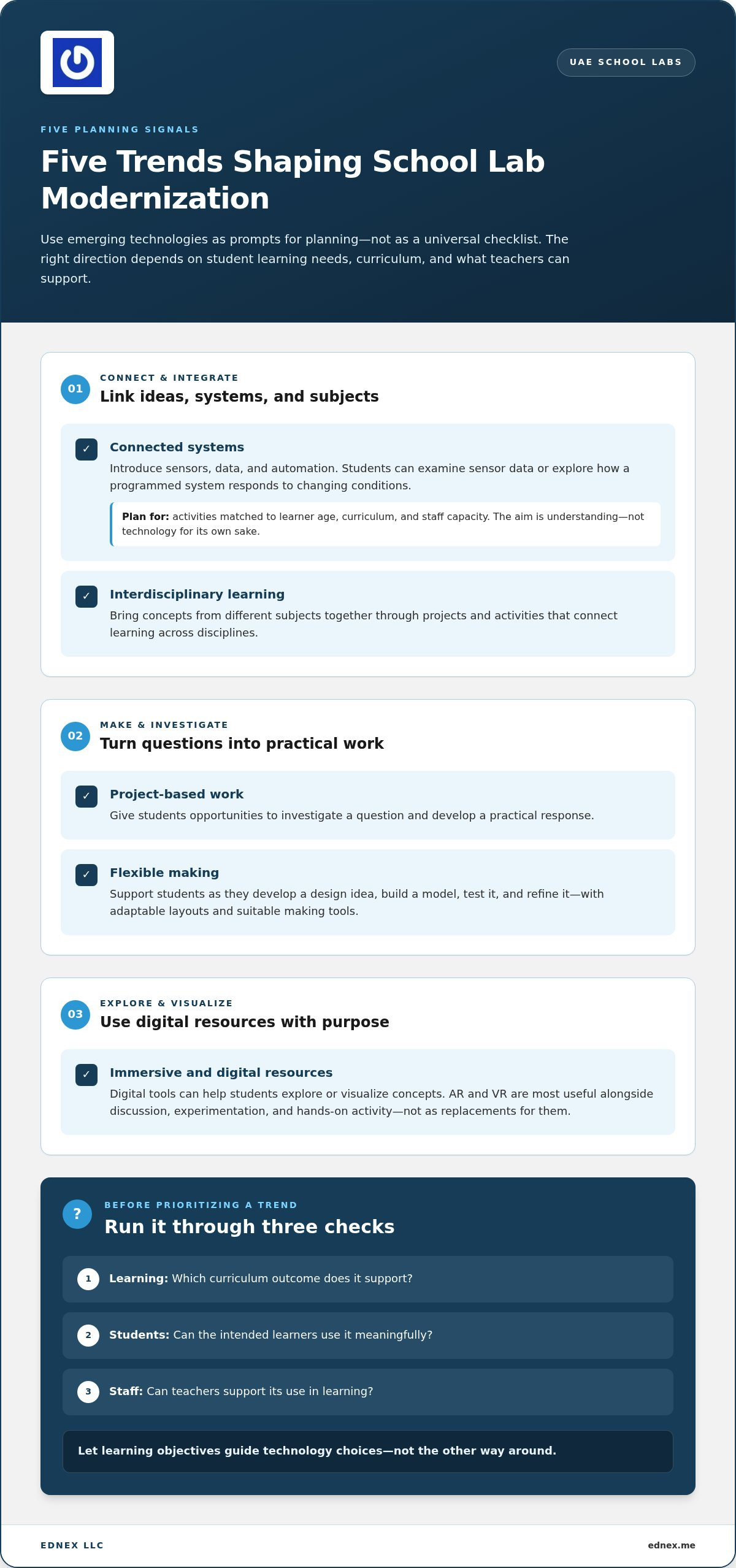
For school lab modernization UAE, emerging technologies are planning signals, not a universal checklist. The right direction depends on what students need to learn, how teachers deliver the curriculum, and what the institution can support. Technology trends should serve learning objectives, not determine them.
Five themes are influencing how schools think about lab environments:
- Connected systems: Activities that introduce sensors, data, and automation.
- Interdisciplinary learning: Projects that bring concepts from different subjects together.
- Project-based work: Opportunities to investigate a question and develop a practical response.
- Flexible making: Space and tools for designing, prototyping, and refining ideas.
- Immersive and digital resources: Technologies that help students explore or visualize concepts.
Use these themes as prompts for discussion, not a mandate to adopt every approach. Before prioritizing a trend, identify the curriculum outcome it supports and whether the intended students and staff can use it meaningfully.
How are AI, IoT, and Industry 4.0 influencing learning spaces?
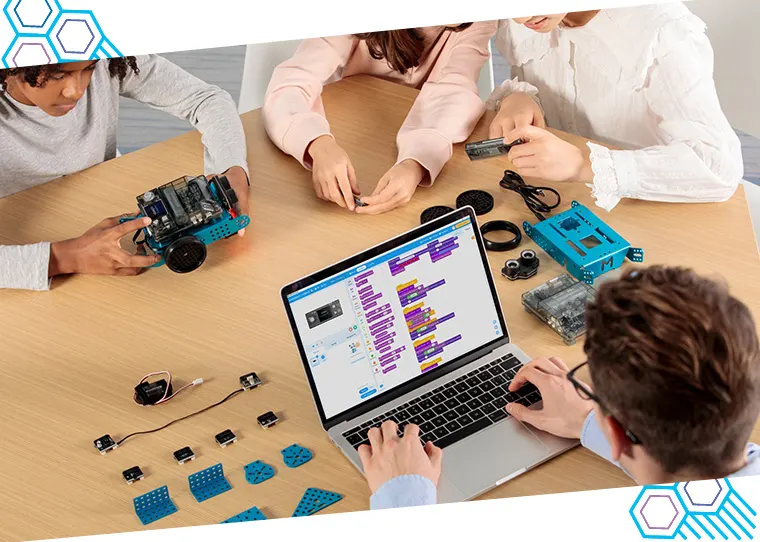
AI, the Internet of Things, and Industry 4.0 can help students explore how connected systems collect information, respond to inputs, and automate processes. A class might examine sensor data or trace how a programmed system reacts to changing conditions. Match the complexity of activities to learner age, curriculum, and staff capacity. The goal is understanding, not technology for its own sake. For further implementation detail, see the Industry 4.0 lab solutions guide.
Why are flexible making and immersive learning gaining attention?
Prototyping and fabrication make project work tangible: students can develop a design idea, build a model, test it, and refine it. Adaptable layouts and suitable making tools are therefore useful planning considerations. AR and VR offer another way to visualize or explore a topic, but work best alongside discussion, experimentation, and hands-on activity, not as replacements for them. For more on space planning, explore the Makerspace design planning guide.
Schools shaping these priorities into a coherent environment can explore Ednex’s educational laboratory design and equipment capabilities as part of planning spaces around institutional learning goals.
How to Assess Modernization Priorities Before Choosing Lab Technology
Assess needs before choosing equipment so you can identify which learning barriers a technology must address. For school lab modernization UAE, this keeps decisions tied to curriculum and institutional priorities rather than the appeal of a new device.
Start by reviewing the practical activities students are expected to complete. Which curriculum outcomes require investigation, design, or testing? Where do lessons currently fall short: limited equipment access, crowded work areas, insufficient storage, or tools that do not suit the activities? Check the condition and availability of resources, the room layout, and whether students can participate meaningfully in different tasks.
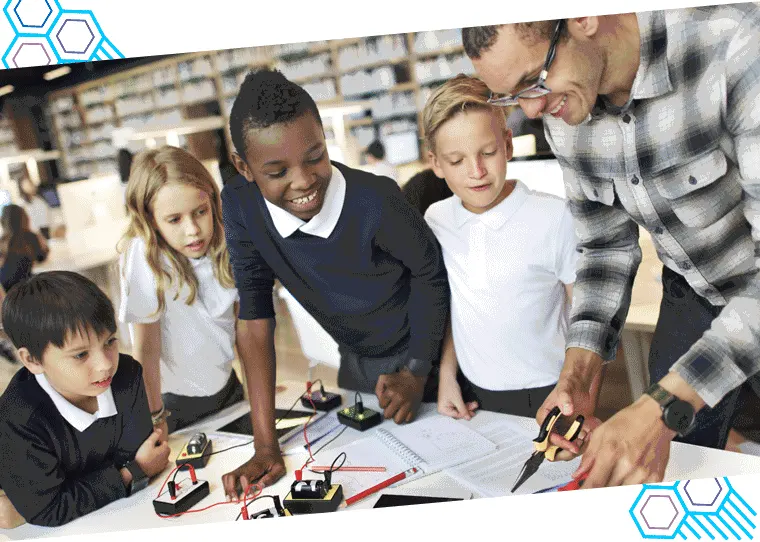
Bring together school leaders, teachers, technicians, and learners where appropriate. Teachers can identify curriculum and lesson-planning needs; technicians can highlight storage, upkeep, and operational considerations; learners can describe barriers they encounter during practical work. These perspectives help distinguish an urgent gap from a desirable upgrade.
How can schools compare trends with real institutional needs?
Compare each option consistently before committing to a technology. A trend becomes a priority only when it supports a defined learning outcome and fits the school’s implementation capacity. Consider learning value, staff readiness, flexibility for future activities, and maintenance needs alongside initial appeal.
Planning matrix: connect the need to the response
- Need: Students need space to develop and refine design ideas. Space: Flexible work areas. Equipment: Tools suited to planned prototyping tasks. Professional learning: Support for integrating the process into lessons.
- Need: Students need to investigate connected systems. Space: An area suitable for collaborative practical work. Equipment: Sensors or other resources selected for the curriculum. Professional learning: Preparation for guiding activities and interpreting results.
- Need: Existing practical activities are constrained by access or storage. Space: A layout that improves movement and resource access. Equipment: Prioritize gaps in existing provision. Professional learning: Align lesson use with available resources.
For a quick comparison, record each option against four criteria:
- Learning value: Which intended outcomes does it support?
- Readiness: Can staff use it within current curriculum and capacity?
- Flexibility: Could it serve more than one relevant activity or learner group?
- Maintenance: What ongoing care and support will its use require?
Then separate defined requirements in the school improvement plan from emerging ideas worth exploring later. For guidance on connecting subjects through practical learning, see the STEAM programs for schools guide.
A Practical Roadmap for School Lab Modernization in the UAE
Modernization is easier to manage as a sequence of connected decisions than as a single installation. This adaptable five-stage roadmap can help UAE school teams align improvements with learning needs, institutional capacity, and daily operations. It is planning guidance, not a mandatory UAE procedure.
How should schools move from audit to phased implementation?
Begin with the learning outcomes and practical activities the school wants to support. Map existing spaces, equipment, access, and staff capabilities against those objectives. This reveals which gaps are urgent and which can wait. For each phase, identify a responsible lead, dependencies, and a review point before moving forward. A staged approach can limit avoidable disruption while keeping the wider direction in view.
- Define outcomes: Set clear objectives based on curriculum and learner needs.
- Audit: Document current spaces, resources, operating processes, and staff readiness.
- Prioritize: Select gaps with the clearest connection to learning goals and practical use.
- Implement: Sequence upgrades in manageable stages, with responsibilities and dependencies made clear.
- Evaluate: Review use and feedback, then refine priorities for the next stage.
How can schools support adoption after installation?
A physical upgrade is only part of the work. Teachers need orientation and practical opportunities to build confidence using the environment in lessons. Schools can also establish operating processes: who can access the space, how equipment is stored and maintained, and how its use is coordinated across classes. Clear routines connect investment to everyday teaching.
Evaluation should guide the next decision, not simply close the project. Review which learning activities took place, how students and staff used the space, and what operational feedback emerged. Participation patterns, access issues, or recurring equipment needs can help leaders decide whether to adjust routines, provide further staff development, or plan another phase. Avoid relying on a single measure of success; interpret feedback in relation to the original objectives.
For school lab modernization UAE, this cycle of planning, implementation, and review keeps improvements responsive to institutional priorities rather than fixed to a one-time specification. Ednex brings educational laboratory design and equipment together with school-focused STEAM, robotics, and coding programs. Explore Ednex’s school lab solutions to see how an integrated environment can support your institution’s learning objectives.
How Ednex Supports Future-Ready School Lab Modernization
Turning modernization priorities into a practical learning environment takes more than selecting equipment. Schools need spaces and resources connected to institutional objectives, curriculum, learner groups, and teaching plans. Ednex brings educational laboratory design and equipment together with school-focused programs, helping institutions plan around their needs rather than starting from a fixed package.
What can an integrated school lab ecosystem bring together?
An integrated approach considers how a room will be used, what equipment supports those activities, and how educators can connect resources to learning goals. One school may need a Makerspace or FAB Lab for design, prototyping, and creative project work. Another may prioritize a Future Science Lab, robotics and coding, or STEAM programs that connect practical activities across subjects.
These capabilities can be combined, but no single configuration suits every institution. Curriculum, available space, student age groups, and intended activities all shape the right balance. Ednex designs and equips educational laboratories, with capabilities across Makerspaces, Future Science Labs, AI and IoT labs, and Design and Technology labs. Its school-focused STEAM, robotics, and coding programs can also be considered alongside physical spaces and equipment when planning practical learning.
For school lab modernization UAE, this coordination helps leaders plan for the whole learning environment, not just an equipment list. It also allows schools to develop their plans in stages, keeping future possibilities in view while addressing current institutional priorities.
What is a useful next step for school leaders?
Translate the assessment into a concise institutional brief before deciding on specific upgrades. Set out the learning goals, learner groups, existing spaces, current barriers, and activities the school wants to enable. Include staff readiness, access, and how the environment will operate day to day. A clear brief makes it easier to consider solutions in relation to the school’s actual needs.
School leaders can then explore how laboratory design, equipment, and relevant programs might support that direction. Ednex’s educational lab solutions cover school learning environments and specialized capabilities, with the approach shaped around institutional objectives. Explore Ednex educational lab solutions.
Build a Lab Strategy Ready for What Comes Next
Successful school lab modernization UAE planning begins with learning goals, not a catalogue of equipment. Strong decisions connect curriculum, practical activities, adaptable spaces, and staff readiness, then address priority gaps in manageable phases. Emerging technologies can broaden what students explore, but each choice should have a clear role in the institution’s learning plans.
Ednex designs and equips educational laboratories for schools and other learning institutions, bringing together spaces and resources with relevant learning programs. Its offerings include STEAM, robotics, coding, Makerspaces, and Future Science Labs, which schools can consider in line with their goals and learner needs.
Ready to plan your next steps? Explore Ednex educational lab solutions and consider how a tailored modernization direction could support your school’s priorities.
Frequently Asked Questions
What does school lab modernization involve?
School lab modernization aligns learning spaces, equipment, teaching practices, and curriculum needs. It may involve adapting a room layout, improving access to practical activities, selecting suitable technology, or preparing staff to use resources effectively. It does not automatically mean replacing every device. Identify what learners and teachers need, then prioritize changes that support those goals. A phased plan can address the most relevant gaps first while keeping longer-term objectives in view.
Why should UAE schools modernize their laboratories?
Modernization can help UAE schools create more adaptable settings for practical, collaborative, and interdisciplinary learning. Priorities depend on each institution’s curriculum, learner population, facilities, and strategic objectives, so one configuration will not suit every school. Leaders can distinguish official education guidance from broader technology trends by checking whether a proposed change supports a defined school priority. They should also consider how spaces and resources will be used in daily teaching, not just what they add to the room.
Which technologies are influencing school lab modernization?
Technologies schools may consider include robotics, coding, AI, IoT, AR and VR, digital fabrication, and connected manufacturing concepts. Their relevance depends on learning objectives, student age groups, curriculum, and staff readiness. A school does not need to adopt every emerging tool. A technology is more purposeful when it enables an activity linked to a learning goal than when it is installed without a clear classroom use. Needs-led planning helps schools decide what to introduce now and what may suit a later phase.
How can a school plan laboratory modernization without replacing everything at once?
Audit existing spaces, equipment, practical activities, and staff needs. Identify the gaps that most affect intended learning, then group improvements into manageable phases, each with a clear objective and review point. This helps schools align plans with institutional capacity while keeping curriculum and daily operations in view. After each phase, review what has been used and what remains challenging. Use that evidence to refine priorities before deciding on the next set of changes.
Can modernized school labs support interdisciplinary learning?
Yes. A well-planned lab can support activities that bring ideas and methods from different subjects together through investigation, design, building, and testing. For example, a student project may apply scientific concepts while students plan and refine a practical design. Activities should fit the curriculum, available space and equipment, and teacher preparation. Technology alone does not create interdisciplinary learning. Schools also need to connect lab use with specific learning objectives and provide educators with practical support to guide activities.
How can schools tell whether a lab modernization plan is working?
Set review criteria before implementation, based on the school’s objectives. Consider whether planned learning activities are taking place, how teachers and learners use the space, whether equipment is accessible, and what operational feedback staff provide. A technology purchase alone is not evidence that a plan is working. Reviewing these areas together can reveal what needs adjustment, such as access routines or staff support, and help leaders make informed decisions about later modernization phases.
Does school lab modernization mean adopting the newest technology?
No. The purpose of school lab modernization UAE is to improve how the learning environment supports teaching and practical learning, not to acquire technology for its own sake. New tools can be valuable when they address a defined need and the school is prepared to support their use. In other cases, improving room layout, access to existing resources, staff readiness, or the condition of current equipment may be more relevant. Begin with the learning requirement, then choose an appropriate response.
Related Posts ...
Comments are disabled