







AI Lab Setup for UAE Universities: 2026 Buying Guide
For anyone researching “AI lab setup for universities UAE,” the key question is not which hardware looks most advanced, but what students and researchers need to learn and do. What should a university AI lab include, and how can you choose a setup that fits your institution’s priorities and resources?
It’s understandable to focus first on computing capacity, software, and emerging tools. But a sustainable university AI lab starts with academic outcomes, then matches technology and facilities to those goals. This approach helps prevent a technology-led purchase from becoming underused because learning resources or faculty preparation were overlooked.
This guide compares academic, technical, and implementation requirements to help you define a realistic scope, assess configurable solutions, and plan for lasting use by faculty and students. It covers how to align equipment, software, and collaborative workspaces with teaching and research priorities, while considering connections to wider IoT and Industry 4.0 environments. Use it to compare options and move from ambition to informed planning.
Key Takeaways
- Decide whether the lab will support AI literacy, machine learning instruction, applied projects, research, or a combination before selecting technology.
- Scope computing, software, datasets, connectivity, workspaces, and learning resources around cohort size, workloads, teaching goals, and existing campus infrastructure.
- Compare cloud-first, local-workstation, and hybrid options based on access, governance, workloads, and support needs. Request itemized proposals against the same scope.
- Use a structured implementation plan that involves faculty, IT, facilities, procurement, and leadership from the readiness review through post-launch evaluation.
- Consider how an AI lab can align with higher-education priorities and connect with wider AI, IoT, and Industry 4.0 learning environments.
AI lab setup for universities in the UAE: define outcomes before choosing technology
A university AI lab is a planned learning and research environment where people, academic activities, and enabling resources come together to explore artificial intelligence. It may support introductory AI literacy, structured machine learning instruction, applied student projects, faculty research, or a deliberate combination. These goals are related, but they do not require identical spaces, access models, or technical capabilities.
Start with outcomes the university can observe: students explain AI concepts, train and assess models in a course, build supervised project prototypes, or carry out defined research activities. These are academic outcomes. Employability, innovation, and broader economic impact may be strategic ambitions, but they should not be treated as guaranteed results of purchasing a lab.
A university AI lab is defined by the outcomes it enables, the people it serves, and the resources that let them learn, build, and conduct research. That keeps decisions grounded. For an AI lab setup for universities UAE institutions, bring faculty, IT, facilities, procurement, and academic leadership into scope-setting early. Their input helps connect curriculum and research plans with infrastructure, room readiness, purchasing requirements, and institutional priorities. A lab may also draw on a collaborative makerspace model, where shared resources support hands-on and creative work.
Which university programmes and users will the AI lab serve?
Map users by programme and purpose rather than assuming one shared syllabus. Undergraduate classes may need scheduled teaching access; postgraduate cohorts may require space for longer projects; vocational programmes may focus on applied tasks; and interdisciplinary teams may have distinct data, methods, and supervision needs. Decide whether the primary use is teaching, student projects, faculty research, or a defined mix. Record class sizes, teaching formats, access patterns, and who will supervise project work.
How should universities turn ambitions into measurable requirements?
Translate broad priorities into activities and evidence. If the goal is machine learning instruction, specify what students should practise and demonstrate. If the goal is research, clarify the intended work and who needs access. Separate what the first phase must support from capabilities that could be added later. The result is a traceable project brief, not a technology wish list.
- Capability: State the resource or facility under consideration.
- User: Identify the programme, cohort, or research group it serves.
- Use case: Describe the learning or research activity it enables.
- Evidence: Define how the institution will assess whether that activity is supported.
For example, a proposed project workspace should connect to a named course or supervised project format, not simply a broad ambition to “encourage innovation.” When every requirement has a user and use case, the university can prioritise essentials, identify gaps, and plan for considered expansion.
What should an AI lab setup for universities include?
A university AI lab specification should cover more than computing hardware. It needs to connect computing access with suitable software environments, datasets, network connectivity, workspaces, and learning resources. The right balance depends on cohort size, expected workloads, teaching goals, and existing campus infrastructure. A lab for introductory coursework may need something different from a lab supporting intensive research, so avoid treating one equipment list as a universal standard.
Lab equipment should follow course workloads and user needs, not the other way around. Compare cloud access, local workstations, and hybrid arrangements by asking the same questions: What tasks must users run? How will students access resources? What governance, connectivity, and institutional support are needed? Scope teaching systems for planned class activities. Consider research-grade infrastructure only when defined research workloads and institutional capacity call for it. The AI lab setup for universities UAE institutions specify should reflect these distinctions.
- Computing access: Identify expected tasks and whether cloud, local, or hybrid access suits them.
- Software and datasets: Review development tools, framework options, data access, licensing, and curriculum fit.
- Connectivity and workspaces: Check campus network readiness, room layout, collaboration needs, and access patterns.
- Learning resources: Align practical activities and teaching materials with course levels and faculty readiness.
Which AI software and practical learning tools belong in the specification?
Python, machine-learning frameworks, and development environments may be relevant options, but each needs institutional review for licensing, compatibility, maintenance, and curriculum fit. TensorFlow and Raspberry Pi are examples to assess for particular learning activities, not automatic requirements or confirmed project inclusions. Ask faculty and IT to test proposed tools against actual course exercises and the university’s existing systems before specifying them.
How do AI, machine learning, and IoT fit together in a university lab?
AI describes systems that perform tasks associated with human reasoning; machine learning is an approach in which systems learn patterns from data. Students might examine a dataset, train a model, and assess its results. IoT can add data from connected devices, enabling practical experiments that combine sensing and analysis when the project scope supports them. For a wider view of connected learning environments, explore Industry 4.0 lab solutions. The UAE’s national strategy for AI in education also provides institutional context for considering AI in higher education.
Once requirements are documented, universities can compare them with potential AI and IoT lab solutions from Ednex LLC, which designs and equips educational laboratories across the UAE. Confirm proposed equipment, software, and project inclusions against the institution’s needs.
How can universities compare AI lab configurations and infrastructure?
There is no single infrastructure model for every university AI lab. Cloud-first access, local workstations, and hybrid configurations involve different trade-offs in workload capacity, user access, governance, and support. For an AI lab setup for universities UAE institutions should compare these options against defined teaching and research activities, rather than assuming that the most substantial infrastructure is automatically the right fit.
Review existing campus networks, device management, data access arrangements, and technical support before planning upgrades. Then ask suppliers to respond to the same project scope with comparable, itemized proposals. This makes it easier to assess configuration differences and included components without relying on broad claims or unverified cost estimates.
| Use case | Infrastructure option | Advantages | Trade-offs and questions to verify |
|---|---|---|---|
| Course activities with variable computing demand | Cloud-first | Can provide access to computing resources without making every user dependent on a dedicated lab workstation. | Check network readiness, account and access controls, data governance, service continuity, and who manages the environment. |
| Practical work using campus-based devices or local resources | Local workstations | Provides an on-campus environment configured for the activities and teaching formats the university specifies. | Assess device management, maintenance responsibilities, room capacity, and whether local resources fit the actual workload. |
| A mix of routine teaching and more demanding or specialised activities | Hybrid | May combine campus access with cloud resources where different activities call for different capabilities. | Clarify how users move between environments, how data is handled, and what support each part requires. |
Does a university AI lab need dedicated high-performance computing?
Not necessarily. Requirements depend on course activities, dataset size, research workloads, and how many users need access at the same time. Some teaching may be supported by existing campus devices or cloud resources; particular research tasks may justify evaluating local capacity or a hybrid approach. Before specifying a dedicated cluster, document the workload and review data governance, access controls, service continuity, and institutional policy with the relevant teams.
How should AI labs connect with robotics and advanced manufacturing?
Software-focused AI teaching can centre on data and model development. Projects involving sensors, robotics, or physical systems add requirements for equipment, workspace, and safe coordination of practical activities. If robotics is a substantial programme need, consult this guide to robotics lab setup in the UAE. For integrated applications linking AI with production technologies, explore the advanced manufacturing technology lab guide.
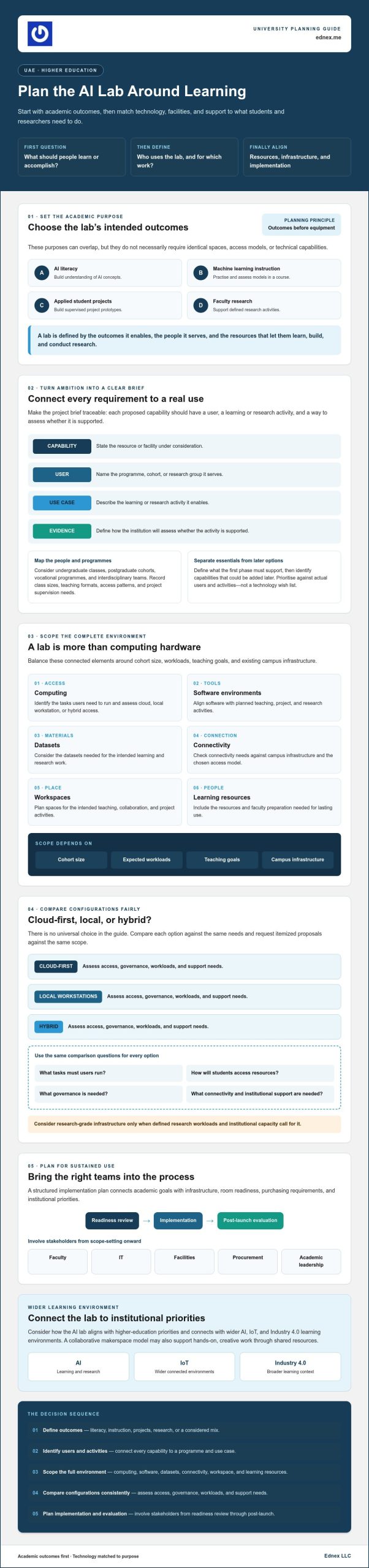
How to plan an AI lab setup for a UAE university step by step
A well-planned AI lab moves from academic need to operational readiness through clear decisions and shared ownership. For an AI lab setup for universities UAE institutions should involve faculty, IT, facilities, procurement, and academic leadership when their expertise and approval are needed. A phased approach can address immediate teaching priorities while leaving room for future research or programme expansion.
What should the university assess before requesting proposals?
Build a project brief before approaching suppliers. Record the courses and research activities to be served, anticipated user numbers, teaching formats, access patterns, and infrastructure already available. Involve faculty in defining academic use, IT in reviewing networks and systems, and facilities teams in checking room readiness. Include power, connectivity, storage, accessibility, and operational ownership. Consider how the project fits the university’s broader academic direction in the UAE without assuming that a particular lab specification is required by regulation.
How can a university assess implementation and faculty readiness?
Use this sequence to turn the brief into a deliverable project:
- Step 1: Confirm priorities. Faculty and academic leadership agree on the courses, users, research activities, and first-phase outcomes.
- Step 2: Review readiness. IT and facilities assess existing infrastructure, room conditions, access, and operational responsibilities.
- Step 3: Define the scope. Translate priorities into required capabilities, separate essential items from possible future expansion, and set evaluation criteria.
- Step 4: Compare proposals. Procurement coordinates a consistent review of scope, compatibility, responsibilities, and stated assumptions.
- Step 5: Plan delivery and handover. Confirm responsibilities, commissioning checks, documentation, and what the university must prepare before use.
- Step 6: Evaluate use. Review whether the lab supports intended teaching and research activities, then decide whether to adjust or expand.
Ask suppliers how faculty onboarding or training could align with the university’s teaching plan, and confirm what each proposal includes. A pilot or phased rollout may suit the institution when its goals, staffing, and capacity support that approach; it is not automatically the right choice for every project.
How can universities compare supplier proposals fairly?
Send each supplier the same outcome-led brief and evaluation criteria. Compare proposed scope, compatibility with existing infrastructure, delivery and support responsibilities, faculty preparation, documentation, and assumptions about future expansion. Ask suppliers to identify exclusions and dependencies clearly. Leadership can review strategic fit while procurement evaluates proposals against consistent requirements.
Once your project brief is defined, you can discuss your university’s AI lab requirements with Ednex, a provider of educational laboratory design and equipment across the UAE. Confirm project-specific inclusions, delivery responsibilities, and any faculty preparation requirements during proposal discussions.
How Ednex can support a university AI lab project in the UAE
Once a university has defined its academic outcomes, user groups, infrastructure needs, and implementation priorities, it can assess design partners against that brief. Ednex designs and equips educational laboratories across the UAE, including AI and IoT lab solutions for higher education. Its work in advanced engineering, robotics, and Industry 4.0 may also be relevant when a university wants to connect AI learning with wider applied technology environments.
The right project begins with institutional requirements, not a preset equipment list. For an AI lab setup for universities UAE institutions should confirm how each proposed component supports specific teaching, student project, or research activities. Equipment, software, training, delivery, and support arrangements depend on the agreed project scope, so universities should request clear confirmation rather than assume particular inclusions.
What should a university clarify with Ednex during an initial discussion?
Prepare a concise brief covering programme objectives, intended users, teaching activities, research needs, existing infrastructure, and desired rollout stages. Then ask which AI and IoT lab components may fit those requirements and how the proposal maps each component to its intended use. Request written clarification of proposed inclusions, delivery responsibilities, handover requirements, and any support arrangements under consideration.
This discussion should also identify assumptions and dependencies. For example, clarify which campus preparations the university would need to complete and whether proposed software or equipment requires compatibility checks. Confirm any training or faculty onboarding options for the specific project, including who would provide them and how they could align with the institution’s teaching plan.
What makes an AI lab partnership fit for long-term institutional goals?
A suitable design should align with the curriculum, faculty readiness, campus infrastructure, and the university’s approach to research and applied learning. It should also give the institution a way to review how the lab is used, which learning activities it supports, and whether future requirements call for phased expansion. Agree on those review questions early so the university can assess ongoing academic fit without presuming a particular outcome.
Ednex’s higher-education AI and IoT lab solutions, alongside its wider engineering and Industry 4.0 learning environments, may be relevant for institutions exploring connected, interdisciplinary projects. The scope still needs to be confirmed against each university’s academic and operational needs.
Have your goals, users, current infrastructure, and preferred rollout stages ready for a focused conversation. Explore Ednex AI lab solutions for higher education and share the priorities your institution wants the project to address.
Build a university AI lab around lasting academic value
A successful lab starts with a clear purpose: define the learning and research activities it must support, then select infrastructure that fits. Compare cloud, local, and hybrid configurations against campus readiness, access, governance, and support requirements. Plan implementation with faculty and operational teams so the environment is usable, not simply installed.
That outcome-led approach gives institutions a practical foundation for an AI lab setup for universities UAE students and faculty can put to meaningful use. It also leaves room to connect AI and IoT learning with broader engineering and Industry 4.0 priorities as academic needs evolve.
Ednex provides educational laboratory design and equipment supply across the UAE, and lists AI and IoT lab solutions for higher education. Confirm equipment, software, training, and delivery details against the institution’s brief. Discuss your university’s AI lab requirements with Ednex and share your goals, users, infrastructure, and implementation priorities. A well-scoped first step can help turn academic ambition into a purposeful learning environment.
Frequently Asked Questions
What should an AI lab at a university include?
An AI lab should include resources matched to its teaching and research goals, not a standard equipment list. Its scope may cover computing access, software environments, datasets, connectivity, workspaces, and learning resources. For an AI lab setup for universities UAE institutions should also consider the programmes served, user access patterns, cohort sizes, and existing campus infrastructure. These factors help distinguish essential first-phase capabilities from options for future expansion.
How much computing power does a university AI lab need?
There is no single computing requirement for every university AI lab. The right capacity depends on the work students and researchers will perform, dataset size, software needs, and how many people may use resources at once. Introductory course activities may have different demands from research workloads. Document representative tasks and assess cloud, local workstation, or hybrid options against them before specifying capacity or considering dedicated infrastructure.
Can one AI lab support both teaching and university research?
Yes, one lab can support both if its design accounts for each group’s needs. Teaching may require scheduled access, consistent course environments, and practical learning resources, while research teams may need different datasets, software, or access arrangements. Map these requirements before finalising the scope. Clear scheduling, access controls, and defined responsibilities can help the university determine whether a shared environment is suitable or whether distinct resources are needed.
Is cloud computing enough for a university AI lab?
Cloud computing may support many lab activities, but it is not automatically sufficient for every institution or workload. Assess network readiness, user access, data governance, service continuity, and institutional policy. Some universities may find cloud access suits variable or occasional workloads, while others may need to evaluate local resources or a hybrid approach. Compare options using actual teaching and research activities, and confirm how each environment will be managed and supported.
How do universities choose between an AI lab and an AI and robotics lab?
Choose based on the activities the programmes need to deliver. A software-focused AI lab may centre on data, programming, and model development. An AI and robotics lab adds practical work with physical systems, which can involve sensors, robotics equipment, and suitable workspace. If courses include both software development and hands-on robotic projects, assess whether an integrated scope is appropriate. Match each proposed capability to a course, project, or research use case.
What should universities ask an AI lab supplier before requesting a proposal?
Share the intended programmes, users, teaching activities, research needs, and existing infrastructure, then ask how the proposed scope addresses them. Clarify what equipment and software are included, their compatibility requirements, delivery responsibilities, commissioning and handover arrangements, and any specified training or support. Ask suppliers to state assumptions and exclusions clearly. A consistent project brief helps the university compare itemized proposals fairly without mistaking unconfirmed options for guaranteed inclusions.
How can a university prepare faculty to use a new AI lab?
Prepare faculty by connecting lab access and tools to planned courses, teaching activities, and student projects before the lab opens. Identify which instructors will use the environment, what practical tasks they intend to teach, and what preparation they need. Discuss whether faculty onboarding or training is available within the project scope, and confirm its format and responsibilities. A pilot may help gather feedback when it fits the university’s goals and capacity.
Related Posts ...



Comments are disabled