






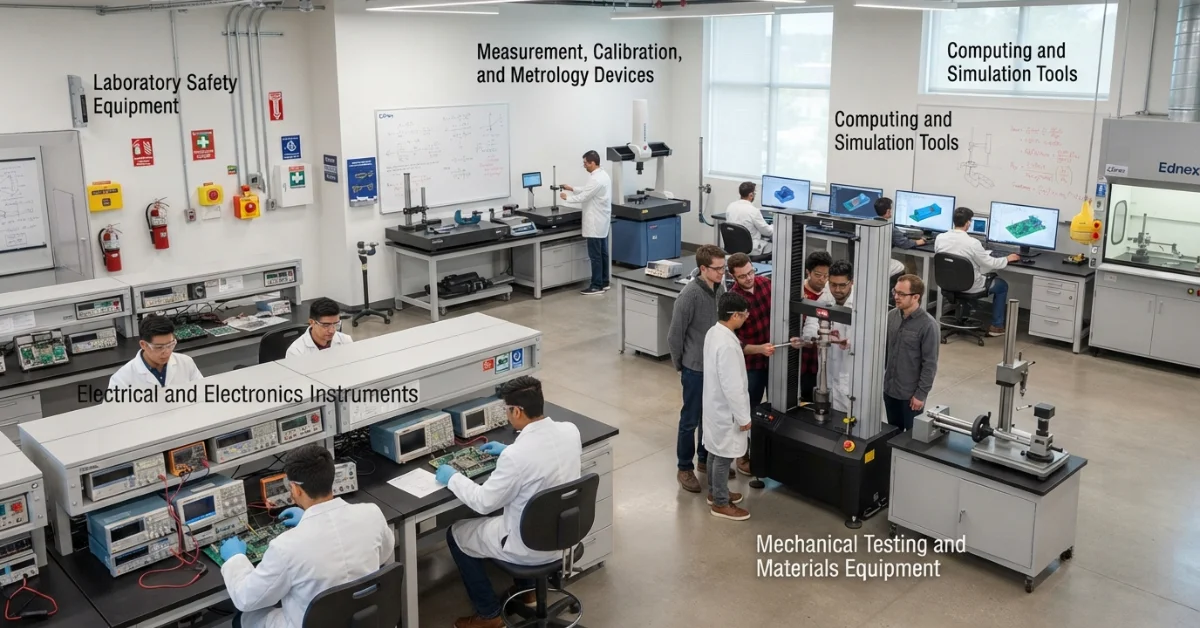
Core Engineering Lab Equipment List: What Every University Department Needs
A well-equipped engineering laboratory is the operational foundation of any credible university engineering program. The instruments installed within these spaces determine the depth of practical instruction, the accreditation standing of the department, and the employability of its graduates. This article provides a structured Engineering Lab Equipment List organized by functional category, defines the purpose of each equipment class, and outlines the procurement considerations that govern institutional investment. Readers will gain a reference framework covering five core equipment categories, their instructional value, and the criteria that inform purchasing decisions.
Why Equipment Selection Determines Program Quality
Core Engineering Lab Equipment refers to the instruments, testing apparatus, and measurement systems that enable students to translate theoretical principles into measurable practice. The composition of this equipment inventory directly affects the quality and scope of instruction a department delivers.
Equipment selection influences the following program outcomes:
- Determines the range of experiments a curriculum can support.
- Establishes compliance with engineering accreditation requirements.
- Defines the practical competencies graduates acquire before employment.
- Affects laboratory throughput and the instrument-to-student ratio.
- Governs long-term maintenance cost and replacement scheduling.
University Engineering Laboratories serve multiple disciplines simultaneously, including electrical, mechanical, civil, and computer engineering. Consequently, equipment procurement must balance discipline-specific specialization against shared, multipurpose instrumentation. The categories that follow represent the foundational inventory common to most undergraduate engineering departments.
Electrical and Electronics Instruments
Electrical and electronics instruments are measurement and signal-generation devices designed to analyze, generate, and verify electrical behavior across circuits and systems. These instruments form the analytical core of electrical engineering instruction and support cross-disciplinary coursework in instrumentation and control.
The essential electrical category includes the following:
- Digital multimeters: Measure voltage, current, resistance, and continuity across circuits.
- Oscilloscopes: Display and analyze time-varying signals in the time and frequency domains.
- Function generators: Produce defined waveforms for circuit excitation and testing.
- DC power supplies: Deliver regulated, adjustable voltage and current to experimental circuits.
- Logic analyzers: Capture and decode digital signals across multiple channels.
- LCR meters: Measure inductance, capacitance, and resistance of passive components.
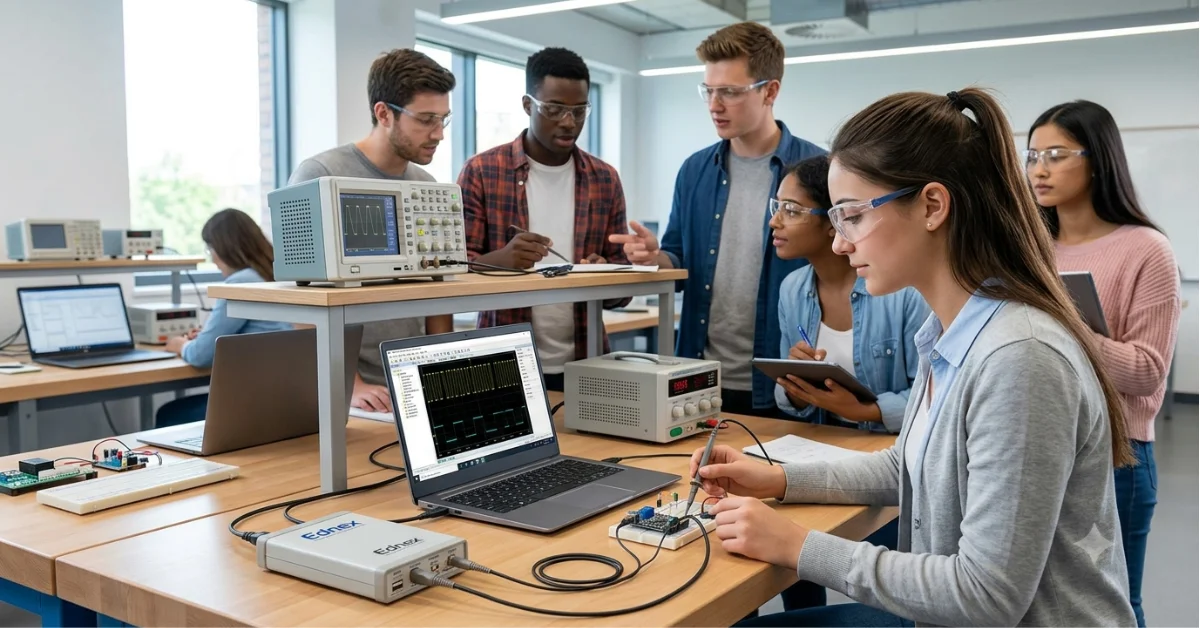
The instructional value of electrical instrumentation derives from its capacity to render abstract circuit theory observable. A student who measures the response of an RC circuit on an oscilloscope connects mathematical derivation to physical behavior. Furthermore, this category supports laboratory exercises across digital electronics, signals and systems, power engineering, and embedded design, which makes it the most heavily utilized inventory within most departments.
Additionally, modern electrical laboratories increasingly adopt PC-based and modular instrumentation. These systems consolidate multiple measurement functions within a single platform, reduce bench footprint, and standardize the student interface across workstations.
Mechanical Testing and Materials Equipment
Mechanical testing equipment comprises the apparatus used to evaluate the structural, thermal, and dynamic properties of materials and mechanical systems. This category underpins instruction in mechanical, civil, and materials engineering disciplines.
Core mechanical testing equipment includes the following:
- Universal testing machines: Apply tensile, compressive, and flexural loads to characterize material strength.
- Hardness testers: Measure resistance to indentation across metals, polymers, and composites.
- Impact testing machines: Quantify material toughness under sudden loading conditions.
- Fatigue testing rigs: Assess material endurance under cyclic stress.
- Vibration and dynamics apparatus: Demonstrate resonance, damping, and oscillatory behavior.
- Fluid mechanics benches: Measure flow, pressure, and hydraulic principles.
The pedagogical strength of mechanical testing equipment lies in its direct demonstration of failure mechanisms. Students observe yield points, fracture behavior, and deformation in real materials rather than inferring them from textbook curves. Moreover, this equipment generates quantitative datasets that support coursework in statistical analysis, material selection, and design verification.
Mechanical apparatus typically represents the highest capital cost within Engineering Department Equipment inventories. Universal testing machines and fatigue rigs require substantial expenditure, dedicated floor space, and structured maintenance protocols, which positions them as long-term institutional investments rather than routine consumable purchases.
Measurement, Calibration, and Metrology Devices
Measurement and calibration devices are precision instruments designed to quantify physical dimensions and verify the accuracy of other laboratory equipment. Metrology forms the discipline that ensures all measurements within a laboratory remain traceable and reliable.
This category includes the following:
- Micrometers and vernier calipers: Measure linear dimensions to defined tolerances.
- Dial gauges and indicators: Detect displacement, runout, and surface variation.
- Coordinate measuring instruments: Capture geometric dimensions of complex components.
- Calibration standards: Provide reference values for instrument verification.
- Thermocouples and pressure transducers: Convert physical quantities into measurable signals.
- Data acquisition systems: Record sensor outputs for analysis and documentation.
The instructional significance of metrology equipment rests on the principle that engineering depends on quantified, repeatable measurement. Students develop dimensional measurement discipline, an understanding of tolerance, and an appreciation for measurement uncertainty. Furthermore, calibration apparatus introduces the concept of traceability, which connects laboratory practice to international measurement standards and industrial quality systems.
Additionally, accurate metrology underpins the integrity of every other equipment category. An uncalibrated instrument produces unreliable results, which compromises both instruction and assessment. Consequently, departments treat calibration capacity as a foundational rather than supplementary requirement.
Computing and Simulation Tools
Computing and simulation tools are the hardware and software systems used to model, analyze, and visualize engineering systems before or alongside physical experimentation. These resources extend laboratory capability beyond the constraints of physical apparatus.
Core computing and simulation resources include the following:
- Workstation computers: Provide the processing capacity for computational engineering tasks.
- Computer-aided design software: Enable geometric modeling and technical drawing.
- Finite element analysis platforms: Simulate stress, thermal, and structural behavior.
- Circuit simulation software: Model electronic behavior prior to physical construction.
- Programming and control environments: Support embedded systems, automation, and data analysis.
- Computational fluid dynamics tools: Model fluid flow and thermal transfer.
The instructional value of simulation tools derives from their capacity to model conditions that physical laboratories cannot reproduce safely or economically. Students analyze high-stress scenarios, optimize designs iteratively, and visualize behavior that physical instruments measure only indirectly. Moreover, proficiency with industry-standard software constitutes a direct employment competency that hiring organizations expect.
Furthermore, computing resources integrate the other equipment categories. Data acquired from electrical and mechanical instruments transfers directly into simulation and analysis environments, which establishes a continuous workflow from measurement to modeling to documentation.
Laboratory Safety Equipment
Laboratory safety equipment comprises the protective systems, devices, and infrastructure that safeguard personnel and ensure regulatory compliance within engineering laboratories. This category is non-negotiable across all University Engineering Laboratories regardless of discipline.
Essential safety equipment includes the following:
- Personal protective equipment: Provide eye, hand, and body protection during experiments.
- Fire suppression systems: Contain and extinguish electrical and chemical fires.
- Emergency shutoff controls: Disconnect power and gas supplies during incidents.
- Ventilation and fume extraction: Remove hazardous airborne contaminants.
- First aid and eyewash stations: Address immediate injury and chemical exposure.
- Signage and lockout systems: Communicate hazards and prevent unauthorized operation.
The instructional importance of safety infrastructure extends beyond compliance. Laboratory safety protocols cultivate the professional discipline that industrial engineering practice demands, and they establish a culture of risk assessment that students carry into their careers. Moreover, regulatory bodies and accreditation agencies require documented safety provisions as a precondition for laboratory operation.
Additionally, safety equipment requirements vary by discipline. High-voltage electrical laboratories, materials testing facilities, and chemical processing labs each impose specific protective standards that departments must address during facility design.
Procurement Considerations for Engineering Departments
Procurement planning is the structured evaluation of equipment specifications, budget, and operational requirements that precedes any institutional purchase. Effective procurement aligns the Engineering Lab Equipment List with curriculum objectives and long-term sustainability.
Departments should evaluate the following criteria:
- Curriculum alignment: Equipment must correspond to defined learning outcomes and accreditation standards.
- Instrument-to-student ratio: Quantity must support cohort size and minimize shared-equipment delays.
- Scalability: Modular systems permit incremental expansion as enrollment increases.
- Maintenance and support: Service contracts, replacement parts, and technical training sustain long-term operation.
- Total cost of ownership: Evaluation must extend beyond purchase price to include calibration, consumables, and lifecycle cost.
- Vendor reliability: Supplier capacity for support, warranty, and timely delivery affects operational continuity.
These criteria ensure that capital investment produces measurable instructional return rather than underutilized or rapidly obsolete equipment. Furthermore, structured procurement coordinates purchasing across disciplines, which reduces duplication and maximizes the value of shared, multipurpose instrumentation.
Conclusion
A complete Engineering Lab Equipment List spans five interdependent categories that together define the practical capacity of a university engineering department. Electrical and electronics instruments render circuit theory observable. Mechanical testing equipment demonstrates material behavior and failure. Measurement and calibration devices ensure quantified, traceable results across all experiments. Computing and simulation tools extend analysis beyond physical limits. Laboratory safety equipment protects personnel and satisfies regulatory requirements. Structured procurement aligns each category with curriculum objectives, cohort size, and lifecycle cost. Together, these categories prepare graduates with the operational competence that the engineering workforce requires.
Ednex supplies comprehensive laboratory equipment and complete laboratory solutions configured for university engineering departments. Ednex aligns instrument specifications, equipment quantities, and support services with curriculum objectives, accreditation standards, and budget parameters to deliver scalable, sustainable laboratory provisioning. Contact Ednex today to design an engineering laboratory equipped to your department’s requirements.
Frequently Asked Questions
What is included in a core engineering lab equipment list?
A core engineering lab equipment list includes electrical and electronics instruments, mechanical testing and materials equipment, measurement and calibration devices, computing and simulation tools, and laboratory safety equipment. These five categories support the practical instruction common to most undergraduate engineering programs.
Which equipment is most essential for a new university engineering laboratory?
Measurement and safety equipment form the non-negotiable foundation, because accurate measurement underpins every experiment and safety provisions are required for laboratory operation. Electrical instruments and mechanical testing apparatus follow as discipline-specific priorities.
How do electrical and electronics instruments support engineering instruction?
Electrical instruments render abstract circuit theory observable. Digital multimeters, oscilloscopes, function generators, and power supplies allow students to measure and analyze real electrical behavior across digital electronics, signals, power, and embedded systems coursework.
Why is calibration equipment important in university engineering laboratories?
Calibration equipment ensures that all measurements remain accurate and traceable to recognized standards. An uncalibrated instrument produces unreliable results, which compromises both instruction and student assessment, so departments treat calibration capacity as a foundational requirement.
What role do computing and simulation tools play in engineering departments?
Computing and simulation tools model conditions that physical laboratories cannot reproduce safely or economically. They enable iterative design optimization, visualization of complex behavior, and proficiency with industry-standard software that employers expect.
How much budget should a department allocate for engineering laboratory equipment?
Budget allocation depends on discipline, cohort size, and curriculum scope. Departments should evaluate total cost of ownership, which includes purchase price, calibration, consumables, maintenance, and lifecycle replacement, rather than purchase price alone.
What procurement criteria should engineering departments consider before purchasing?
Departments should assess curriculum alignment, instrument-to-student ratio, scalability, maintenance and support, total cost of ownership, and vendor reliability before committing to equipment purchases.
How does equipment selection affect engineering program accreditation?
Accreditation bodies require laboratory provisions that support defined practical competencies and documented safety standards. Equipment that aligns with curriculum learning outcomes directly supports accreditation evaluation and program credibility.
Author Bio
Ednex is a provider of educational laboratory solutions specializing in engineering and technical instruction. Ednex supplies electrical instrumentation, mechanical testing apparatus, measurement and calibration systems, computing resources, and laboratory safety equipment for university engineering departments. Through structured equipment provisioning, procurement guidance, and technical support, Ednex enables institutions to deliver scalable, accreditation-aligned engineering instruction.
Related Posts ...

Comments are disabled