

What Is a Virtual Lab and How Does It Work
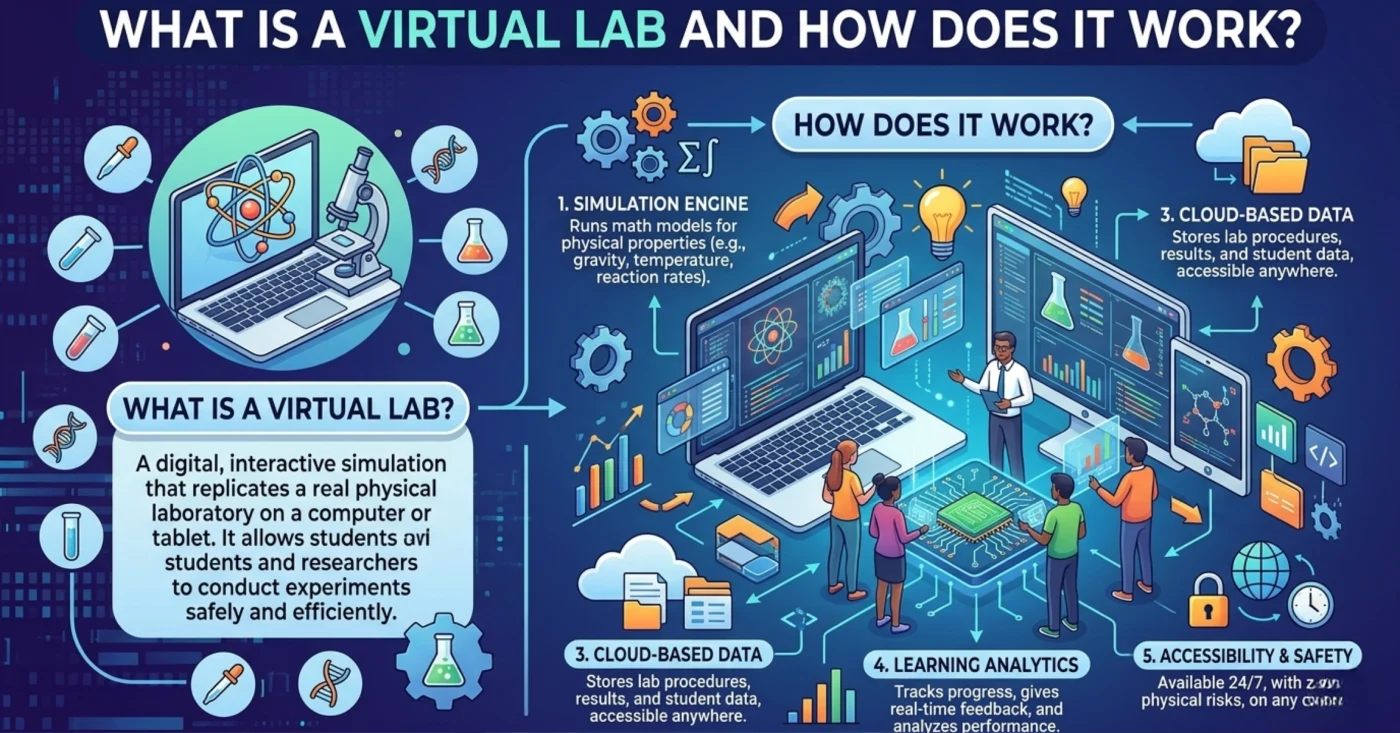
A virtual lab is an interactive digital environment that simulates real-world scientific experiments. It allows students to conduct complex tests, mix chemicals, and observe physical reactions purely through a computer or tablet. This technology transforms how educational institutions deliver STEM education by removing physical boundaries.
Schools and universities continuously seek better ways to deliver digital science education. Using an online virtual laboratory provides a safe, cost-effective, and highly accessible alternative to traditional physical labs. Students can explore complex scientific concepts without the risk of handling dangerous materials.
Read on to discover exactly what a virtual lab is, how the underlying technology functions, and why interactive learning platforms are reshaping the future of education.
What Is a Virtual Lab?
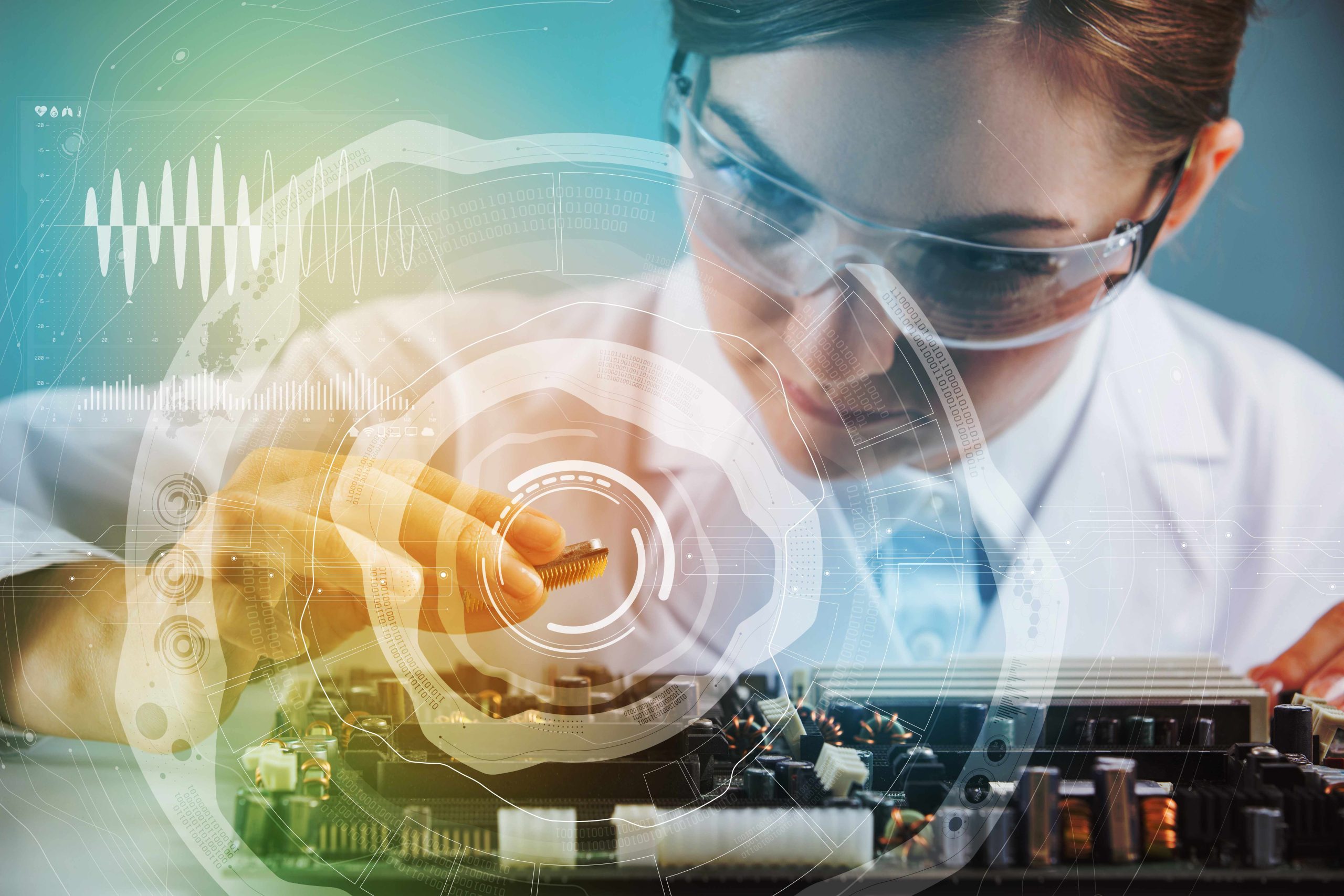
A virtual lab is a computer-based simulation that replicates the equipment, processes, and outcomes of a physical scientific laboratory. Instead of using real beakers and microscopes, students manipulate digital 3D models using their mouse or touchscreen. The software relies on mathematical algorithms to generate accurate, real-world scientific results.
The primary goal of a virtual lab for students is to provide an immersive, hands-on learning experience entirely online. These platforms allow learners to conduct online science experiments safely from any location.
Key characteristics of a virtual lab include:
- Realistic simulations: High-fidelity graphics that mimic real laboratory equipment.
- Algorithm-driven outcomes: Software that accurately calculates chemical reactions and physical physics based on real-world data.
- Infinite repetition: The ability to restart an experiment instantly without wasting physical materials.
- Gamified learning: Interactive modules that guide students through procedures step-by-step.
Importance of Virtual Labs in Modern Education
Virtual labs in education are vital because they democratize access to high-quality scientific tools. Many schools lack the budget to build fully equipped physical laboratories. Digital labs bridge this gap, ensuring every student has the opportunity to explore advanced STEM concepts.
Providing a robust virtual lab for students builds critical thinking and analytical skills. Students learn to hypothesize, test variables, and analyze data in a completely controlled environment. This digital fluency prepares them for modern careers in science and engineering.
Reasons to prioritize virtual lab platforms for schools:
- Equal access: Levels the playing field for underfunded educational institutions.
- Remote learning: Enables continuous education even when students cannot attend school physically.
- Engagement: Interactive learning platforms capture student attention better than static textbooks.
- Safety: Completely eliminates the risks associated with toxic chemicals and high-voltage equipment.
How Virtual Labs Work
Virtual labs work by using complex mathematical models to simulate physical and chemical behaviors in a digital space. When a student interacts with the software—such as increasing the heat on a digital Bunsen burner—the underlying algorithm calculates exactly how the simulated substances should react. The software then displays this reaction visually on the screen.
Understanding what is a virtual lab and how does it work requires looking at the software architecture. These platforms combine game-engine graphics with strict scientific databases to create a believable, accurate testing environment.
The operational process of a virtual lab:
- User input: The student selects tools, measures digital liquids, or adjusts environmental variables.
- Algorithmic processing: The software computes the physical or chemical equations in real-time.
- Visual rendering: The screen updates to show the result, such as a liquid changing color or a digital bridge collapsing under weight.
- Data output: The system generates a data log or graph for the student to analyze for their lab report.
Key Features of Virtual Lab Platforms
The best virtual lab platforms feature highly interactive 3D graphics, real-time data tracking, and comprehensive teacher dashboards. You cannot simply watch a video of an experiment; a true virtual lab requires active student participation. The interface must allow learners to make mistakes and see the consequences of those errors.
Effective virtual laboratory simulation tools must align with standard academic curriculums. Teachers need the ability to track student progress, grade lab reports, and customize the difficulty of the simulations.
Essential features of a top-tier platform include:
- Interactive equipment: Digital microscopes, scales, and oscilloscopes that function just like their physical counterparts.
- Formative assessments: Built-in quizzes that test student knowledge before, during, and after the experiment.
- Variable control: Sliders and dials that let students change gravity, temperature, or friction to see varying results.
- Detailed analytics: Dashboards that show teachers exactly where a student struggled during a procedure.
Benefits of Virtual Labs for Students and Teachers
The primary benefits of virtual labs in education include immense cost savings, enhanced physical safety, and the ability to learn at an individualized pace. Traditional labs require constant restocking of expensive consumables like chemicals and biological specimens. Digital labs require only a single software license to serve hundreds of students.
When schools adopt e-learning tools for schools, they empower students to take control of their education. Students can pause, rewind, and repeat complex experiments until they fully understand the underlying concepts.
Top advantages for educational institutions:
- Zero material costs: No need to buy replacement test tubes, gases, or raw materials.
- Absolute safety: Students can experiment with radioactive decay or explosive chemical reactions without any physical danger.
- Time efficiency: Digital experiments do not require 30 minutes of setup and clean-up time.
- Immediate feedback: Software instantly corrects procedural errors, helping students learn faster.
Applications of Virtual Labs in STEM Education
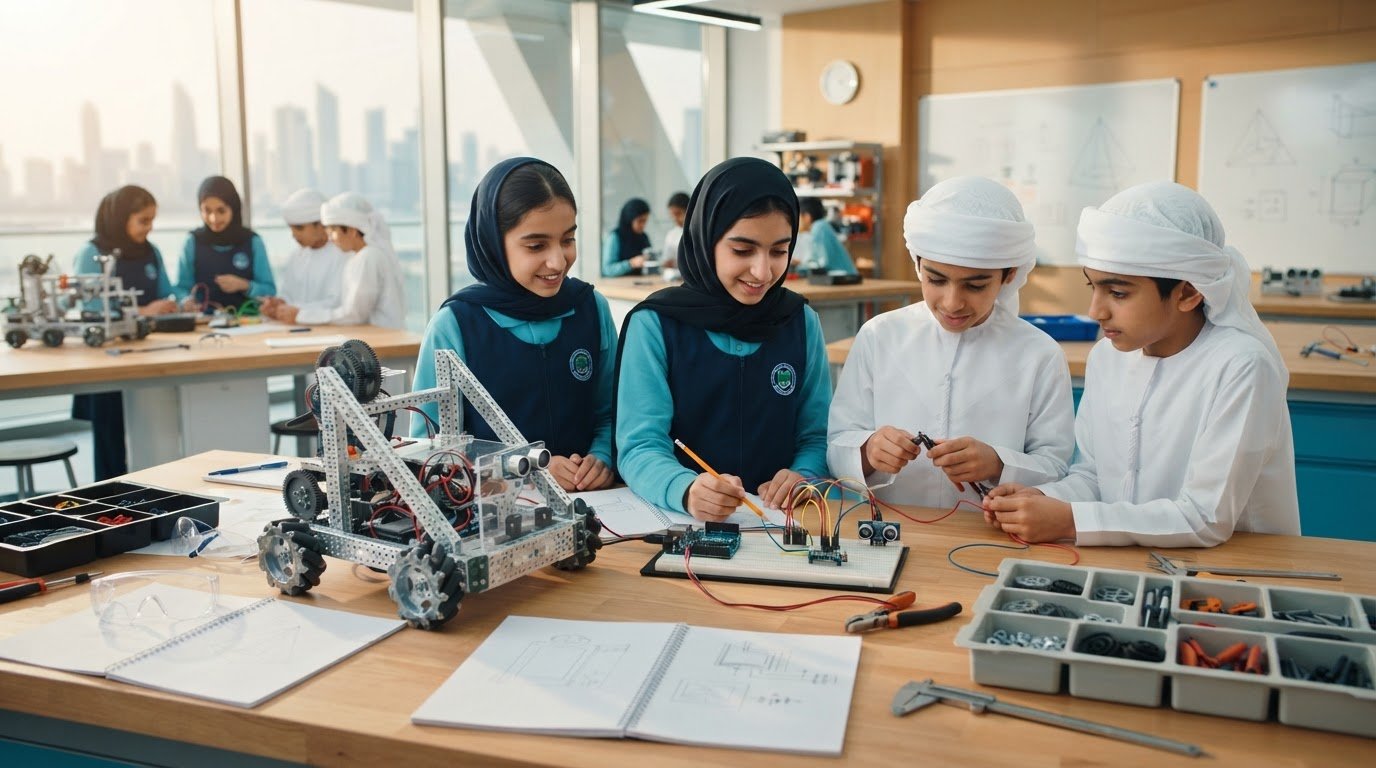
Virtual labs are used across all STEM disciplines to teach biology, chemistry, physics, and engineering through interactive simulations. Because the software is highly versatile, a single computer can serve as a chemistry workbench in the morning and a physics testing arena in the afternoon. This cross-curricular utility makes them an incredible investment.
Integrating virtual labs for STEM education allows students to conduct professional-grade experiments that are impossible in a normal classroom. They can speed up time to watch evolutionary biology unfold or zoom in to a subatomic level to observe electron orbits.
Popular classroom applications include:
- Chemistry: Titration experiments, molecular building, and testing acid-base reactions.
- Biology: Virtual dissections, DNA sequencing, and cellular respiration modeling.
- Physics: Simulating projectile motion, electrical circuit building, and studying thermodynamics.
- Engineering: Designing digital bridges and testing their structural integrity against simulated wind and weight.
Virtual Labs vs Traditional Physical Labs
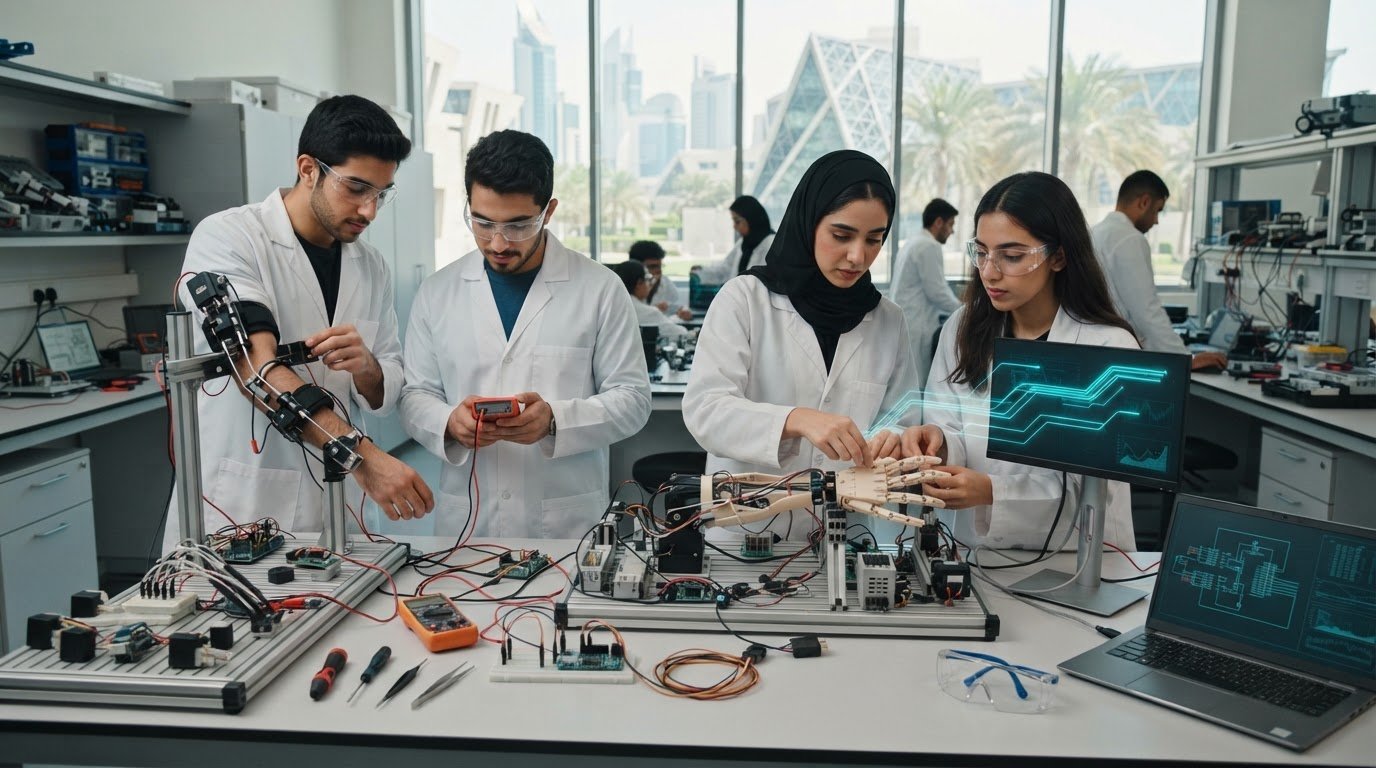
The main difference between virtual and traditional physical labs lies in sensory feedback and practical cost. Physical labs teach students the tactile skills of handling delicate glassware and precisely measuring liquids. Virtual labs excel at demonstrating abstract concepts and allowing for limitless repetition without material constraints.
While physical labs are excellent for building manual dexterity, simulation-based learning is vastly superior for data analysis and conceptual understanding. Schools achieve the best results by using a blended approach, using virtual labs to prepare students before they enter a physical workspace.
Key comparisons between the two formats:
- Cost of operation: Virtual labs are significantly cheaper because they lack ongoing consumable costs.
- Tactile feedback: Physical labs teach the “feel” of real equipment; virtual labs only use a mouse and keyboard.
- Scalability: A digital lab can accommodate a thousand students simultaneously; a physical lab fits maybe thirty.
- Error consequences: Making a mistake in a virtual lab is a learning moment; making a mistake in a physical lab can be dangerous and expensive.
Challenges and Limitations of Virtual Labs
The primary challenges of using virtual labs include a lack of tactile skill development, heavy reliance on reliable internet access, and the potential for screen fatigue. Because the student only clicks a mouse, they do not learn how to physically calibrate a real microscope or safely pour a caustic acid. Schools must be aware of these limitations to provide a well-rounded education.
While online science experiments save money, they do introduce a layer of technical troubleshooting. If a school’s Wi-Fi fails or a tablet breaks, the student completely loses their ability to conduct the experiment.
Common challenges and practical solutions:
- Digital divide: Ensure the school provides devices and internet access for all students to maintain equity.
- Lack of physical skills: Pair virtual simulations with simple, safe, hands-on physical projects to build fine motor skills.
- Software glitches: Choose established, reputable platforms that offer robust technical support and offline capabilities.
- Student isolation: Encourage students to complete virtual labs in pairs to maintain collaborative teamwork.
Future of Virtual Labs in Education
The future of remote learning labs involves integrating virtual reality (VR), augmented reality (AR), and artificial intelligence (AI) to create hyper-immersive experiences. As educational technology evolves, students will put on VR headsets to physically walk around a digital laboratory. This will completely solve the current lack of spatial awareness and tactile feedback.
Looking ahead, how virtual labs help students learn science will become highly personalized. AI algorithms will track how a student learns and dynamically adjust the difficulty of the digital experiment in real-time.
Emerging trends to watch:
- VR integration: Using headsets to allow students to physically grasp and move digital beakers with hand-tracking technology.
- AR overlays: Projecting digital chemical reactions onto real physical desks using smart glasses.
- AI tutoring: Virtual lab assistants that speak to students and guide them when they get stuck during a procedure.
- Global collaboration: Students from different countries logging into the same virtual lab to conduct experiments together in real-time.
Conclusion
Adopting a virtual lab platform fundamentally modernizes how students learn complex scientific concepts. These digital tools offer unmatched affordability, absolute safety, and a highly interactive experience that resonates with modern learners. They remove the geographic and financial barriers that have historically made high-level science education exclusive.
By investing in high-quality virtual lab platforms for schools, educational institutions prioritize active, inquiry-based discovery. Students transition from passively reading about chemical reactions in textbooks to actively triggering them on their screens. Equip your classrooms with these versatile digital tools today to build the confident, capable scientists and engineers of tomorrow.
Transform Your Science Curriculum Today
Are you ready to equip your students with industry-leading digital science education tools? Ednex specializes in supplying top-tier virtual lab platforms and complete e-learning setups for educational institutions across the GCC region, including the UAE, Saudi Arabia, and Qatar.
We provide end-to-end technology solutions from software integration and hardware procurement to comprehensive teacher training. Partner with Ednex today to build a state-of-the-art interactive learning platform that inspires future scientists to contact our GCC team for a free consultation!
Frequently Asked Questions (FAQ)
What is a virtual lab and how does it work?
A virtual lab is a computer-based simulation that mimics a real scientific laboratory. It works by using complex mathematical algorithms to calculate how simulated objects and chemicals should react when a student manipulates them on a screen.
Do virtual labs replace physical science labs?
No, virtual labs are best used to complement physical labs, not replace them entirely. While virtual labs are perfect for learning concepts and repeating dangerous experiments safely, physical labs are still necessary to teach tactile motor skills and equipment handling.
What are the main benefits of virtual labs in education?
The main benefits include extreme cost savings, absolute safety, and accessibility. Schools do not need to buy expensive, consumable materials, and students can conduct complex online science experiments from anywhere with an internet connection.
Can virtual labs be used for subjects other than chemistry?
Yes, virtual labs cover a wide variety of STEM subjects. There are dedicated simulation platforms for physics, biology, earth science, and even structural and electrical engineering.
Author Bio:
Ednex is a premier educational technology and curriculum solutions provider dedicated to transforming STEM learning environments. By equipping institutions with world-class digital laboratory instruments, interactive virtual labs, and expert faculty training, Ednex prepares students across the globe to lead the future of science and applied technologies.
Related Posts ...
Comments are disabled